How Long to Smoke a Brisket: Time & Temperature Guide
Use this brisket smoking time chart to plan your cook at 225, 250, or 275, then let tenderness decide when it is done
The hardest part of smoking a brisket is timing it so dinner is not waiting on the meat. A change in pit temperature can move the finish by several hours, and thickness, wrapping, and the stall can stretch the cook even more.
Use the chart below to estimate smoker time from trimmed weight and pit temperature. Let tenderness in the flat decide when the brisket comes off, and add rest or hot-hold time separately. If you need to work backward from dinner time, use the Brisket Calculator instead.
How long does brisket take?
Quick example: 12 lb brisket
A 12 lb trimmed whole packer brisket usually takes about 12 to 18 hours at 225°F, 10 to 14 hours at 250°F, or 8 to 11 hours at 275°F.
These are estimated smoker times only. Add rest or hold time separately, and pull the brisket when the flat probes tender.
Simply put, a brisket takes as long as it takes. Those times are a starting point, not a promise. Thickness, wrapping, weather, the stall, and even how steadily your smoker holds temperature can move the finish by hours.
Brisket smoking time chart
Use this chart to estimate smoker time before the cook. The weights below are trimmed cooking weights, not the full packaged weight from the store.
If you bought a 14 lb brisket and trimmed off 2 lb of hard fat, use the 12 lb row in the chart.
| Trimmed brisket weight | At 225°F | At 250°F | At 275°F |
|---|---|---|---|
| 5 lb flat | 6 to 8 hours | 5 to 6 hours | 4 to 5 hours |
| 8 lb flat or small packer | 9 to 12 hours | 7 to 9 hours | 6 to 8 hours |
| 10 lb packer | 10 to 15 hours | 8 to 12 hours | 7 to 10 hours |
| 12 lb packer | 12 to 18 hours | 10 to 14 hours | 8 to 11 hours |
| 15 lb packer | 15 to 22 hours | 12 to 17 hours | 10 to 14 hours |
Note: These are Destination BBQ planning estimates informed by practical experience and published brisket guidance. They are not the results of controlled side-by-side testing. They cover smoker time only. Add at least 1 hour for resting, or more if you plan to hot hold the brisket, and let tenderness decide when it is done.
A wrapped brisket will usually finish sooner than an unwrapped one. A thick brisket may run long for its weight. A pre-trimmed flat is leaner and shaped differently, so it may not follow the same timing as a whole packer.
Example: how long does a 12 lb brisket take?
At 225°F, plan on about 12 to 18 hours on the smoker. For a brisket this size, that often means an overnight cook.
At 250°F, plan on about 10 to 14 hours on the smoker. Cooking at 250 usually shortens the cook compared with 225 without raising the pit all the way to 275.
At 275°F, plan on about 8 to 11 hours on the smoker. The cook is shorter, but the flat needs closer attention so it does not dry out.
In all three cases, add rest or hold time after the brisket comes off the smoker. If you are trying to serve dinner at a specific time, build a custom brisket timeline instead of relying on the chart alone.
When is brisket done? Use temperature and tenderness
Brisket is not done just because the chart says it should be. It is also not done just because the thermometer hits one magic number.
Most briskets become tender somewhere around an internal temperature of 195 to 205°F. Start checking the flat as it gets close, but do not pull the brisket based on the number alone. Pull it when a probe or skewer slides into the thick part of the flat with very little resistance.
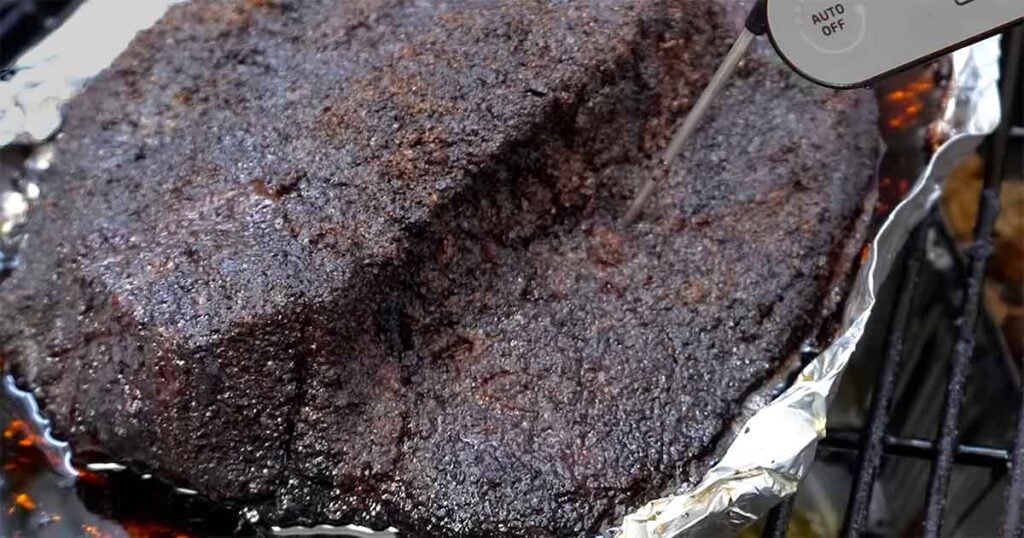
That matters because the flat is the leaner muscle and usually the part most likely to dry out. The point often becomes tender before the flat, so use the flat as your main doneness check.
Food safety and barbecue tenderness are not the same thing. USDA considers whole cuts of beef safe at 145°F after a 3-minute rest, but brisket is usually cooked far beyond that point because the connective tissue needs more time and heat to soften.
How long to smoke brisket per pound
The old rule of thumb says brisket takes about 1 to 1.5 hours per pound at lower smoking temperatures. That can still help you budget time, especially around 225 to 250, but it should not be treated like a promise.
A better way to use time per pound is this:
- At 225: plan on roughly 1 to 1.5 hours per pound, sometimes longer for thick or unwrapped briskets
- At 250: plan on roughly 45 to 75 minutes per pound
- At 275: plan on roughly 35 to 60 minutes per pound
The reason this is only a starting point is that a brisket is not a stack of identical 1-pound pieces. A long, thinner 12 lb brisket and a short, thick 12 lb brisket can cook very differently.
Quick reference
What can make brisket cook faster or slower?
Usually speeds the cook
- Higher pit temperature
- Wrapping in foil
- Wrapping in butcher paper, though usually less than foil
Usually slows the cook
- A thicker flat
- Cooking without wrapping
- Frequent spritzing, mopping, or opening the smoker
- Cold or windy conditions
Makes timing less predictable
- Uneven airflow around the brisket
- Unsteady pit temperature
- Differences in brisket shape and trim
These are general tendencies. Any one brisket may cook differently depending on the meat and the smoker.
Why brisket cooking time varies
Here’s the thing: weight is only part of the picture. Thickness, shape, whether you are cooking a whole packer or a flat, how much fat was trimmed, and the way your smoker runs can all change the timing.
Thickness and shape
Thickness matters more than most people expect. Heat has to work its way into the meat, and a thick flat takes longer than a thinner one.
A brisket with a thick, blocky flat may run long even if the weight looks normal. A flatter brisket may finish sooner than the chart suggests.
Whole packer vs flat
A whole packer includes both the flat and the point. The flat is leaner, while the point is fattier and more forgiving.
A pre-trimmed flat does not cook like a whole packer. It may be easier to fit in the smoker, but it can dry out faster and may not follow the same timing as a full brisket.
For a closer look at how the muscles differ, see our full brisket guide.
Trim level and fat
A heavily trimmed brisket may cook differently from one with more fat left on the surface. A thick fat cap can slow heat transfer in places, while heavy trimming can expose more lean meat.
Your smoker
A smoker set to 250 does not always cook like another smoker set to 250.
Pellet grills, offsets, charcoal cookers, and cabinet smokers all move heat and air differently. A windy day, a cold day, a water pan, a leaky lid, or frequent lid opening can also change the timing.
Fuel and smoke choice are separate from timing, but our guide to choosing smoking wood can help you pair oak, hickory, pecan, or another wood with your brisket.
What the stall does to brisket timing
The stall is the part of the cook where the brisket’s internal temperature seems to stop climbing. It often shows up during the middle of the cook and can last for hours.
The basic idea is simple. Moisture moves to the surface of the meat and evaporates. That evaporation cools the brisket, much like sweat cools your skin. While that cooling is happening, the internal temperature may slow down or seem stuck.
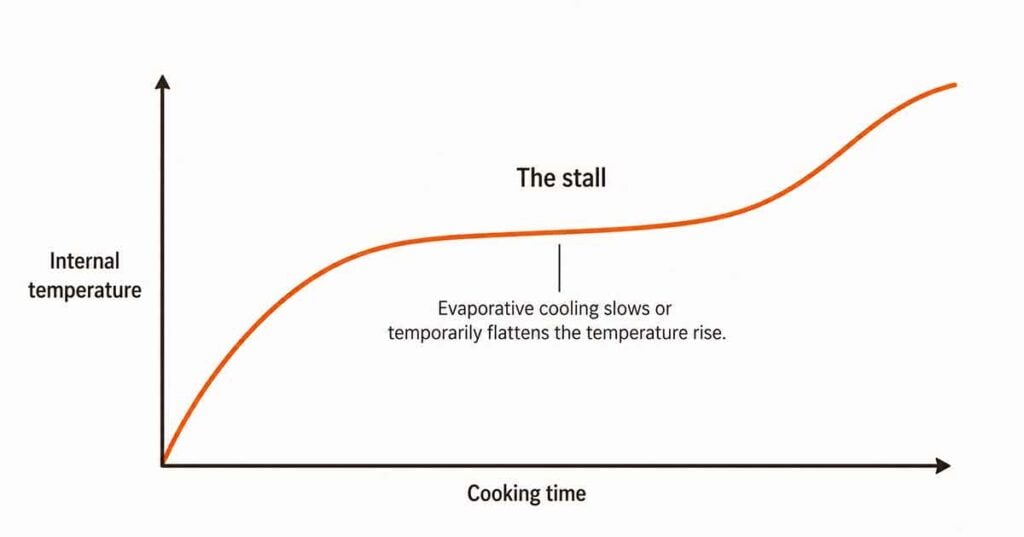
The stall is one reason a brisket that looked on schedule at breakfast can feel behind by lunch.
A few things can affect the stall:
- Lower pit temperatures often mean a longer stall
- Airflow affects evaporation, so different smokers can stall at different temperatures and for different lengths of time
- Spritzing or mopping can cool the surface and slow the cook
- Wrapping reduces evaporation and usually helps the brisket move through the stall faster
The stall is normal. Do not panic just because the thermometer slows down. Decide whether to keep cooking unwrapped for bark or wrap to shorten the stall and protect the brisket.
How wrapping changes brisket time and bark
Wrapping is not required, but it is one of the biggest choices that affects timing.
Foil
Foil usually gives you the fastest finish. It traps moisture and reduces evaporative cooling, which helps the brisket push through the stall.
The tradeoff is bark. Foil can soften the bark because the brisket steams inside the wrap. That may be fine if your main goal is tenderness and timing, but it is not the best choice if you want the firmest bark possible.
Butcher paper
Butcher paper protects the brisket and usually shortens the cook compared with no wrap, but it does not trap moisture as tightly as foil. That helps the bark stay firmer than it would in foil.
No wrap
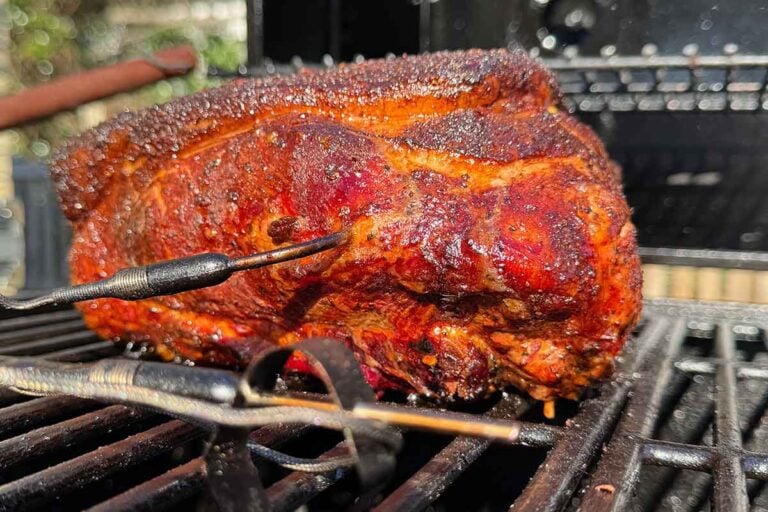
No-wrap brisket usually takes the longest and is the least predictable. The upside is bark. Leaving the brisket unwrapped gives the surface more time to dry, darken, and firm up.
The tradeoff is time and risk. The flat can dry out if the cook runs long, especially at higher pit temperatures.
How long does brisket take at 300?
At 300, plan on roughly 30 to 50 minutes per pound. A 12 lb trimmed whole packer may take about 6 to 10 hours on the smoker, but a thick or unwrapped brisket can take longer.
Cooking at 300 is a hot-and-fast approach. The higher pit temperature shortens the cook and may make the stall brief or barely noticeable. If the brisket does stall, wrapping after the bark has set can help move the cook along and protect the flat from the higher heat.
Start checking earlier than you would at 225 or 250. Watch the bark, pay close attention to the flat, and begin probing as the internal temperature approaches the expected finishing range. Do not pull the brisket just because it reached a certain temperature. It still needs to probe tender.
The main chart stops at 275 because it covers the more common low-and-slow temperatures. At 300, timing depends even more on brisket thickness, wrapping, and how steadily your smoker holds its temperature.
Plan rest and hot-hold time separately
Do not skip the rest if you want clean slices and a better bite.
At minimum, give your brisket about 1 hour to rest. For many cooks, a longer hot hold is even more useful because it gives you more room in the schedule.
Use a proper warmer, holding oven, or another setup whose temperature you have verified with a thermometer. Do not guess during a long hold.
A cooler hold can work for a shorter rest if the brisket is well wrapped and the cooler is packed with towels, but it is not the same as a controlled hot hold.
Holding safety
If you are holding brisket hot before serving, keep the meat itself at or above 140°F and verify it with a thermometer. If it falls below 140°F, serve or refrigerate it within 2 hours, or within 1 hour if the air temperature is above 90°F.
How to handle a brisket that finishes early or runs late
Brisket rarely finishes exactly when the chart predicts. If it is done early, a safe rest or hot hold can protect the brisket and give you more flexibility. If it is running late, wrapping or raising the pit temperature can help move the cook along. Here is how to handle either situation without sacrificing tenderness.
What to do if your brisket finishes early
Early is usually better than late. A finished brisket can rest or be held, while an unfinished brisket cannot be rushed without tradeoffs.
Keep the brisket wrapped and let it rest. If dinner is still several hours away, move it to a hot hold that you have checked with a thermometer and can keep at or above 140°F. It is easier to hold a tender brisket than to make a late brisket tender on command.
What to do if your brisket is running late
If your brisket is running late, first make sure it is truly behind. A brisket sitting in the stall may feel stuck, but that does not mean something is wrong.
If you need to move the cook along, you have a few options:
- Wrap it. Foil is the fastest choice. Butcher paper is a more bark-friendly middle ground.
- Raise the pit temperature modestly. Moving from 225 to 250 or 275 can help without turning the cook into a sprint.
- Stop opening the cooker. Every peek costs heat and time.
- Check the flat, not just the point. The point may feel ready while the flat still needs time.
- Shorten the rest only if you must. Do not skip it completely if you can avoid that.
What you should not do is pull the brisket just because guests are hungry. If the flat is still tight, slicing it early will not make it tender.
If dinner time is firm, plan the next cook with more cushion. Brisket is much easier to hold safely than it is to rush at the end.
When to use the Brisket Calculator
Use this guide when you need a rough smoker-time range. Use the Brisket Calculator when you need to work backward from dinner time and build a custom plan.
The calculator builds a custom timeline using your brisket cut, smoker temperature, wrap choice, rest or hot hold, altitude, yield, and serving plans.
If you are still deciding how much meat to buy, see our guide to how much brisket per person.
Brisket timing FAQs
Allow time for the planned rest plus some extra room in case the cook runs long. If you need to serve at a set time, a 2-hour cushion is useful when you have a tested way to hold the finished brisket at or above 140°F. It is easier to hold a tender brisket than rush one that is not ready.
Wrap the brisket when the bark is as dark and firm as you want it. For many cooks, that happens during the stall, but do not wrap based on internal temperature alone. If the seasoning rubs off easily or the surface still looks wet, give the bark more time before wrapping.
Wrapping does not start a predictable countdown. A brisket may still need several hours, depending on its thickness, pit temperature, wrap material, and how far along it was when wrapped. Foil usually cooks faster than butcher paper. Watch the internal temperature, then begin probing the flat as it approaches the expected finishing range.
Yes. Once the bark is set and the brisket is wrapped, you can move it to an oven and continue cooking at the same temperature. Place it on a rimmed pan in case the wrap leaks. Keep checking the flat and remove the brisket when it probes tender, not simply when it reaches one prescribed internal temperature.
Yes. Leave a brisket cooking too long and the flat can become crumbly, dry, and difficult to slice cleanly. Begin probing before the projected finish and remove it when the thick part of the flat offers very little resistance. A hot, tightly wrapped brisket can also continue cooking early in the rest.
Corrections and editorial standards
- Spotted something wrong or outdated? Send a correction here: Corrections & Updates
- How we handle sources, testing, and updates: Editorial Standards
- Media or general notes: Email the publisher
Sources and accuracy note
- USDA FSIS: Safe Minimum Internal Temperature Chart : supports the 145°F minimum temperature and 3-minute rest guidance for whole cuts of beef.
- USDA FSIS: Danger Zone : supports keeping hot food at or above 140°F and the time limits for food outside temperature control.
- Texas A&M Meat Science: Barbecue Science : explains collagen-rich barbecue cuts and why brisket requires extended cooking for tenderness.
- AmazingRibs: What Causes the Barbecue Stall : supports the evaporative-cooling explanation and the effects of pit temperature, humidity, airflow, and wrapping.
- AmazingRibs: Texas-Style Smoked Brisket : provides practical context for broad cooking-time ranges, wrap choices, holding, and the limits of exact timing formulas.
About the author
James Roller documents South Carolina barbecue for Destination BBQ and authored the SC BBQ cookbook Going Whole Hog. This guide combines practical experience planning brisket cooks with published meat-science and food-safety guidance to help readers estimate cook time without pretending the clock is exact.