Rib Calculator
Use this rib calculator to match your crowd, cut, and serving style to how many racks or beef plate ribs to buy instead of relying on the half-rack rule
Rib planning looks simple until you are standing at the meat case trying to turn a headcount into real racks. Cut choice changes the answer fast. So do kids, sides, and whether ribs are the main event or just part of the spread.
Use the calculator first. Pick your crowd, your cut, and how ribs fit the meal, and it will tell you how much to buy.
Rib Planner
Estimate how many ribs to buy, compare cuts, and shop smarter with a built-in cushion.
Your Crowd
Count teens as adults.
Advanced options
Buys a little extra so you'll have leftovers.
Add your crowd to see your plan
Enter adults or kids to see how many ribs to buy.
Plan on —
About — bones total
Estimated raw weight: —
Why this number
- Counted as
- —
- Planning basis
- —
- Crowd demand (before rounding)
- —
- Rounded to
- —
- Estimated raw weight
- —
- Cushion
- —
Compare cuts
Here's how the other cuts would feed the same crowd.
More BBQ planning tools
Need help with another part of the cook? Our BBQ Tools & Calculators page has tools for planning portions, timing cooks, choosing wood, seasoning by weight, and serving barbecue without running short.
These are planning estimates, not official serving rules. The calculator uses the cut, the crowd, and how ribs fit the meal to work out how many racks or bones you’ll need.
Quick answer
Baby backs usually take more bones per person than St. Louis ribs or spare ribs. Beef back ribs and especially beef plate ribs are different enough that they need their own plan.
At a glance
- Baby back ribs: about 6 bones per adult as a main dish, about 3 if ribs are one of several meats, about 2 as an appetizer
- St. Louis ribs or spare ribs: about 4 bones per adult as a main dish, about 2 to 3 if ribs share the plate, about 2 as an appetizer
- Beef back ribs: about 3 bones per adult as a main dish
- Beef plate ribs (dino ribs): often about 1 bone per adult as a main dish because each bone carries far more meat
- Real racks vary. The calculator turns those estimates into how much to buy.
Why a quick rule falls short
The common shorthand is about half a rack per person. That is not exactly wrong, but it assumes everyone is eating the same cut, in the same kind of meal, in roughly the same amount.
A few things the generic rule ignores: different cuts carry different amounts of meat, so a half rack of baby backs is not the same as a half rack of St. Louis ribs. Kids do not eat the same as adults. If ribs are one of three meats on the table, you do not need as much as when they are the only thing. And once you have a number in bones, you still have to turn that into whole racks you can actually buy at the store.
The calculator adjusts for the crowd, the cut, and how you’re serving the meal, then tells you how many racks to buy, or for plate ribs, how many bones you’ll need.
How many ribs per person?
Use the table for quick back-of-the-napkin math. It gets you in the neighborhood, then the calculator tightens the number based on your crowd, your cut, and the way you plan to serve the meal.
| Cut | Main dish | One of multiple meats | Appetizer/starter |
|---|---|---|---|
| Baby back ribs | About 6 bones | About 3 bones | About 2 bones |
| St. Louis ribs | About 4 bones | About 2 to 3 bones | About 2 bones |
| Spare ribs | About 4 bones | About 2 to 3 bones | About 2 bones |
| Beef back ribs | About 3 bones | About 2 bones | About 1 to 2 bones |
| Beef plate ribs (dino ribs) | About 1 bone | About 1 bone for 2 adults | About 1 bone for 3 adults |
Kids under 12 usually count lighter than adults. Racks also vary by trim, brand, and store, which is why the calculator gives you a weight range instead of pretending every rack is the same. If you want the fuller serving-side explanation by rib type, kids, sides, and beef ribs, the ribs per person guide walks through the decision before you turn it into racks.
What the result means
The tricky part is that people eat servings, but stores sell ribs by the rack, by the bone, or in a pack. That sounds obvious, but it trips people up all the time.
Use the weight range to size up what is in the meat case, not as the only number to follow. When the packages in front of you do not line up neatly, go by the rounded-up rack or bone count.
The result helps answer four practical questions: how much this crowd will likely eat, what that translates to in bones, how many racks or plate ribs to buy, and how much cushion to build in so you do not run short. That last part is the most useful. One rack may run smaller than the next. One store may package ribs in pairs or cryovac packs. A number on paper and the cuts in the cooler are not always the same thing, which is why the calculator tells you what to buy, not just how many servings to plan for.
If the calculator lands at 7.2 St. Louis racks, buy 8 racks, not 7. The point is to leave you with a number you can actually use at the store, not just a serving estimate on paper.
It also explains why the number changes by cut. Baby backs are usually smaller and leaner, so they often take more racks for the same crowd. St. Louis ribs and spare ribs carry more food per rack. Beef back ribs and beef plate ribs are a different job entirely. Beef plate ribs especially are big, meaty servings, so planning them like pork racks will throw the count off fast.
How the calculator works
- It starts with your crowd. Adults and kids under 12 are counted separately. Teenagers count as adults.
- It adjusts for the meal. A main dish needs more ribs than an appetizer or a plate with multiple meats.
- It adjusts for the cut you picked. Baby backs, St. Louis ribs, spare ribs, beef back ribs, and beef plate ribs do not feed a crowd the same way.
- It starts with bone count. That keeps the estimate closer to how people actually eat ribs rather than what the package says.
- Then it turns that into numbers you can actually use: racks, bone counts, and weight. Those are easier to shop from than bone count alone.
- It rounds up because you cannot buy part of a rack. It also builds in a small buffer because real racks are not all the same size.
Rib cut guide
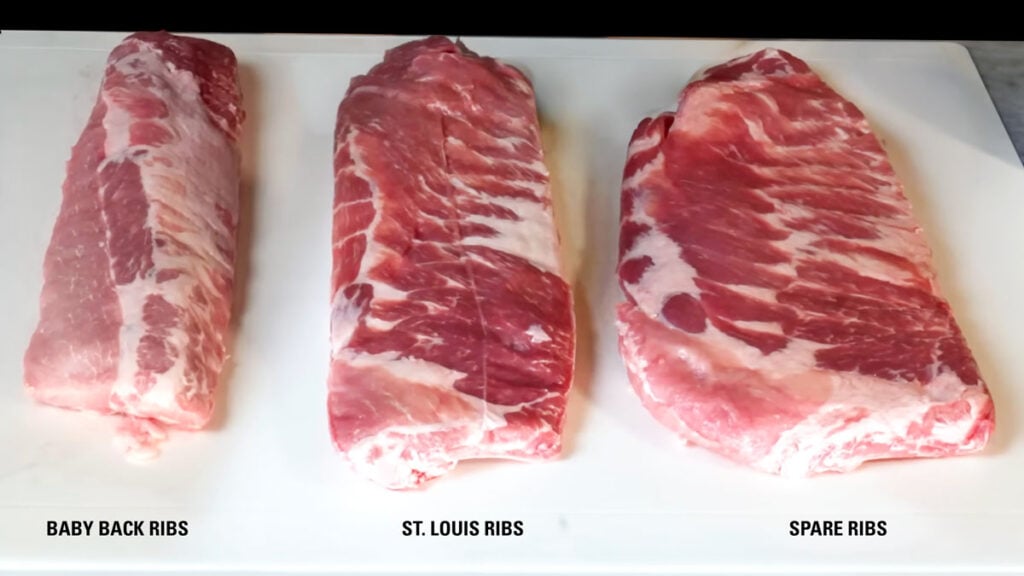
Baby back ribs
Baby backs are the shorter, leaner pork racks cut from near the loin. They cook a little faster, are easier to portion, and tend to be the easiest cut to find in most grocery stores. The main thing to know is that you usually need more racks to feed the same crowd compared to St. Louis or spare ribs. Fewer bones per rack, less meat per bone. They make sense when you want smaller racks and easier portions.
St. Louis ribs
St. Louis ribs are trimmed spare ribs. Squaring off the rack removes the sternum, cartilage, and flap meat, leaving a cleaner rectangle that is easier to compare side by side at the store. More meat per bone than baby backs, more consistent shape than untrimmed spares. For a crowd, St. Louis ribs are usually the easiest call at the meat counter.
Spare ribs
Spare ribs are the fuller, less-trimmed rack from the belly side of the hog. They are meatier than baby backs and fattier than St. Louis. For crowd planning, that usually means fewer racks for the same headcount. The shape is less uniform, so rack-to-rack comparisons at the store are less reliable. They make more sense when you care more about value than perfectly even racks.
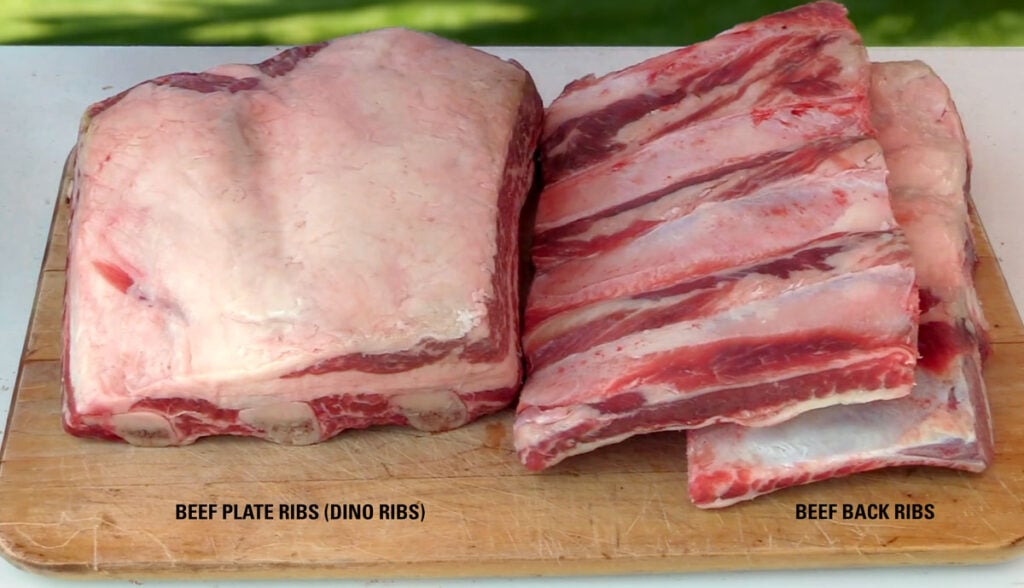
Beef back ribs
Beef back ribs are sold by the rack, but they do not eat like pork ribs. The bones tend to be longer and the meat sits largely between the bones rather than on top. They work well when you want beef ribs in a rack format without committing to giant single-bone servings. They work best when beef is one of several meats on the table, not the whole meal.
Beef plate ribs (dino ribs)
Beef plate ribs are the big, meaty beef ribs many people call dino ribs. One bone can be a full serving on its own, which is why the calculator treats them differently from the start. If you plan them like pork ribs, you will overbuy fast. They make the most sense when you are serving a smaller group and want big portions.
If you are still deciding between the two, compare beef back ribs vs dino ribs before you run the calculator.
How to shop the result
The calculator gives you a good number to start from, but the meat case does not always line up perfectly. Use it as your guide, then adjust for what is actually there. If you want help making that call at the store, the buying ribs for a crowd guide walks through racks, warehouse packs, butcher orders, label checks, and when to round up.
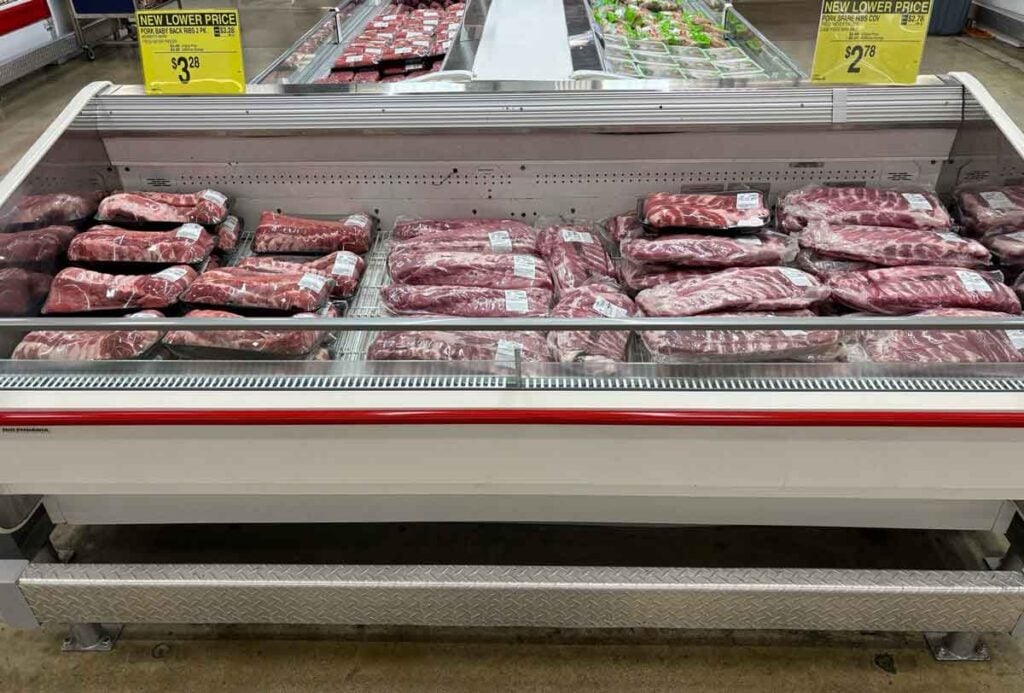
When in doubt, round up modestly. A slightly bigger pile of leftovers is usually easier to deal with than running short once people sit down to eat. If you are planning for leftovers, the reheat ribs guide can help you warm extras back up safely without drying them out.
Do not shop by package count alone. Two packages are not always equal. Check the weight and the cut, not just how many packs are in the cart.
Expect more variation with baby backs and spare ribs. Rack size can swing from brand to brand and from one store to the next. That is one reason the calculator gives you a range instead of pretending every rack is identical.
Warehouse packs can push you to buy in bigger jumps. Costco and Sam’s Club often sell ribs in multi-rack cryovac packs, so your real buying options may be two racks, four racks, or six racks rather than the exact number on paper.
Beef plate ribs usually take more planning. They are harder to find than pork ribs and are often sold by the bone or as a whole beef plate. If that is the cut you want, a butcher shop often gives you the cleanest path.
How many ribs are in a rack
Not always what people expect. Baby back racks are shorter and usually have fewer bones than spare rib racks. St. Louis racks are trimmed from spares, so they will not match a full untrimmed spare count bone for bone. Beef back racks are different again. Beef plate ribs are often sold by the bone or as a three-bone beef plate rather than as a rack at all. For the cut-by-cut breakdown, see how many ribs are in a rack.
That variability is why the calculator outputs a weight range alongside a rack count. Think of the rack as the thing you buy, not a fixed serving size.
Crowd examples
Use these for quick mental math, not as your final plan for what to buy. The calculator works that out once you factor in who’s eating, how you’re serving the meal, and which cut you picked. For detailed breakdowns at each crowd size, see How many racks of ribs for 10, 20, 25, and 50 people.
- 10 people: as a main dish, think about 5 baby back racks or about 4 St. Louis or spare rib racks. If ribs are one of several meats, that may drop to about 3 racks.
- 20 people: as a main dish, think about 10 baby back racks or about 8 St. Louis or spare rib racks. With another meat on the table, around 5 racks may be closer.
- 25 people: as a main dish, think about 13 baby back racks or about 10 St. Louis or spare rib racks. For a mixed spread, around 7 racks is often closer.
- 50 people: as a main dish, think about 25 baby back racks or about 20 St. Louis or spare rib racks. If ribs are sharing the spread, around 13 racks may be enough.
- Beef plate ribs: think in bones first. Ten adults eating plate ribs as a main dish can mean about 10 bones, or about 5 if beef is one part of a larger spread.
Once the racks are cooked, the next problem is timing. If you are cooking in batches or serving over a longer window, plan how you will keep ribs warm before the first rack comes off the pit.
Common rib planning mistakes
Most mistakes happen because people start with the wrong cut, not because they cannot do the math.
- Using baby back numbers for St. Louis ribs or spare ribs
- Assuming every rack at every store feeds the same number of people
- Forgetting that kids under 12 usually count lighter than adults
- Not adjusting for a mixed meal when ribs share the plate with another meat
- Shopping from the exact paper number with no buffer
- Planning beef plate ribs the same way you would plan pork ribs
Rib calculator FAQs
Treat ribs as part of a mixed meal, not the only main dish. That keeps you from buying like every guest plans to fill up on ribs alone. If one meat is clearly the star, lean a little heavier on that protein and lighter on the others. The goal is to match how people will actually build their plates.
Run the numbers separately for each cut instead of blending them together. Baby backs, St. Louis ribs, spare ribs, beef back ribs, and beef plate ribs do not feed a crowd the same way. Estimate how many people will likely choose each cut, then calculate each one on its own so the buying plan stays realistic.
Use it to size up what’s in the meat case, not as the only answer. The most useful part is still the rack count or bone count and the rounded-up number to buy. Weight helps you compare packages at the store and spot unusually small or large racks, but ribs vary too much for weight alone to be the whole plan.
Use the calculator’s result as your target, then buy the nearest practical package size above it. Warehouse stores and some butchers sell ribs in bigger jumps, so you may have to round up more than you would at a regular grocery store. That is normal, and it is usually safer than trying to buy too close to the minimum.
Think in bones first, then convert that into whatever the butcher is selling. Beef plate ribs are much meatier than pork ribs, so one bone can be a full serving. If the shop sells them individually, count bones. If it sells whole plates, use the bone count to judge how many full plates you need.
Usually yes, but keep it modest. The calculator already builds in some protection by rounding up, so you usually do not need to add much. Add a little more only when you know your crowd runs hungry, the menu is light on sides, or you are deliberately hoping to make ribs ahead for leftovers for the next day.
Sources and planning notes
Cut definitions on this page come from National Pork Board and Beef. It’s What’s For Dinner. Safe minimum temperatures come from USDA FSIS. The serving estimates are planning assumptions informed by practical crowd-feeding experience, which is why the calculator shows ranges instead of pretending every rack is the same.
For safety, USDA guidance says whole cuts of pork and beef should reach 145°F with at least a 3-minute rest. Tenderness for barbecue is a separate question, but safe and done are not always the same thing.
Corrections and editorial standards
- Spotted something wrong or outdated? Send a correction here: Corrections & Updates
- How we handle sources, testing, and updates: Editorial Standards
- Media or general notes: Email the publisher
Sources
- USDA FSIS Safe Minimum Internal Temperature Chart: Safe minimum temperature and rest guidance for whole cuts of pork and beef
- National Pork Board: Pork Ribs: Plain-language definitions for baby back, spare, and St. Louis style ribs
- Beef. It’s What’s For Dinner: Back Ribs: Reference for beef back rib cut identity and how it is commonly sold
- Beef. It’s What’s For Dinner: Plate Short Ribs: Reference for beef plate short ribs and why they should be planned differently from rack-style cuts
- USDA Table of Cooking Yields for Meat and Poultry: Background on retail-cut variability and why planning by ranges is more realistic than pretending every rack is identical
Serving estimates on this page are planning assumptions informed by practical crowd-feeding experience. They are not official USDA serving rules.
About the author
James Roller documents South Carolina barbecue for Destination BBQ and authored the SC BBQ cookbook Going Whole Hog. He and his wife, Heather, have spent years cooking and planning barbecue meals for home gatherings, including ribs for mixed spreads and larger groups. This guide combines published guidance on rib cuts, serving estimates, and food safety with the practical judgment that comes from feeding real people.
Looking for other planning help beyond ribs? Browse all our BBQ tools.