Buying Ribs for a Crowd
Buying ribs for a crowd gets easier when you know how to match your estimate to real racks, packs, labels, and what’s actually in the case
Rib planning usually falls apart at the store, not at the calculator. You run the numbers, you know roughly how many racks you need for a party, and then you’re standing in the meat case and the warehouse packs are the wrong size, the grocery racks all look different from each other, or the butcher is asking whether you mean beef back ribs or plate ribs and you’re not sure those are different things.
The calculator gives you a number. The store gives you racks, packs, labels, and whatever happens to be in the case that day. That gap is what this page is about. Running short on sides is one thing. Running short on ribs is another.
If you don’t have a number yet, start with our Rib Calculator. It accounts for crowd size, cut, whether ribs are the main meat or one of several things on the table, and your preferred leftover cushion, and it gives you rack counts, bone counts, and a raw-weight range to take to the store. That is where this page picks up.
A few things worth knowing before you walk in: rack size varies, package sizes vary, and a plan that looked clean on paper almost always needs a small adjustment at the case. That adjustment is usually modest and almost always in one direction.
Quick answer: how to buy ribs for a crowd
Quick answer
- Get your number first: Use the Rib Calculator for your rack count, bone count, and raw-weight range before you go shopping.
- Follow the rack count at the store: If the calculator says 7.2 racks, buy 8 racks, not 7. Follow the rounded rack or bone count first.
- Use weight as a range, not the only answer: Raw weight helps you check whether a package is in the right ballpark. It should not be the only number you lead with.
- Round up when packages don’t match exactly: Buy the next practical whole rack or pack above your estimate unless there is a strong reason not to.
- Grocery stores: Best for flexibility and smaller groups. Good when you need exactly one more rack.
- Costco and Sam’s Club: Useful for larger buys. Package sizes can force a bigger jump than you planned, and formats change by item, location, and date. Check what’s actually on the shelf.
- Butcher shops: Best for exact cuts, matched rack sizes, trim help, or beef plate ribs. Call ahead for larger orders.
If the package jump is small, round up. If the jump is huge, check another store or rerun the calculator with the ribs actually available.
Get your number first, then work with what the store has
Before you shop, you need a starting count. If you already know how many racks, bones, or pounds you are aiming for, this guide helps you turn that estimate into a real purchase. If you are comparing full racks, half racks, and multi-rack packs, it helps to know what a rack means before you shop. If you do not have that number yet, run the Rib Calculator first, then come back.
If you’re still working out how much each person is likely to eat, the ribs per person guide handles that side of the question. If you need help figuring out how many racks of ribs to buy by group size and cut, the how many racks of ribs page has those examples. Here, the job is getting as close as real life allows to the number you already have, then rounding in the safer direction.
What your estimate actually means at the store
Here is where the calculator’s output meets real life. The number you get is not wrong, but it almost certainly won’t match whatever pack size the store happens to carry. Here is how to use what the calculator gave you.
- Start with the rack count. For pork ribs, the rack is usually the most practical thing to follow at the store. If the calculator says 7.2 racks, the answer is 8 racks. The decimal is a rounding indicator, not a target. Round up to the next whole rack or pack. If the store sells ribs in multi-rack packs, round to whatever pack size gets you above the estimate without a massive jump.
- Use bone count for beef plate ribs. Beef plate ribs, the thick dino-style ones, simply aren’t the same as pork ribs. If you’re buying beef plate ribs for a crowd, follow the bone count. Don’t try to force them into a pork-style rack count. For a deeper look at why bones beat pounds for rib planning, that article works through the reasoning.
- Let raw weight double-check the package. The raw-weight range tells you whether the package you’re looking at is in the right ballpark, not whether it’s exactly right. Two packages with the same rack count can weigh different amounts depending on trim, bone density, and whether the meat contains added solution. Use the weight as a double-check, not the number you lead with.
When the packages in front of you don’t match the estimate cleanly, use the calculator’s rounded rack or bone count first, then check whether the weight is reasonable. If matching the rack count would force a much bigger jump than you planned, it is worth either checking another store or rerunning the calculator with the cut that’s actually available.
Where to buy ribs for a crowd
Grocery stores, warehouse clubs, and butcher shops each handle rib buying a little differently. Which one makes sense depends on your crowd size, the cut you want, and how much flexibility you need.
Most of the grocery store ribs vs butcher shop ribs decision comes down to flexibility versus predictability. The grocery store is easier for quick adjustments, while the butcher is better when you need a specific cut, matched racks, or a larger order held back for you.
| Store type | Best for | What to watch for | Pack-size issues | Trim variability | When it helps | When it complicates planning |
|---|---|---|---|---|---|---|
| Grocery store | Flexible buying, smaller groups, one-rack top-ups | Rack size can vary within the same label; check for added solution | Usually single-rack trays; easiest to match your count | Can be inconsistent; inspect each rack | When you need to buy close to your exact count | When stock is low before a holiday weekend |
| Costco | Larger buys when the pack size works in your favor | Multi-rack packs force bigger rounding jumps; formats change by item and date | Often multi-rack packs; verify count and weight on the package in front of you | Usually consistent within a pack, but varies by product and supplier | When your count falls close to a pack multiple | When the jump to the next pack is much larger than you need |
| Sam’s Club | Larger buys; members familiar with the location’s current stock | Formats vary by location and date; do not rely on what was there last time | Similar multi-pack situation to Costco; verify what’s actually on the shelf | Verify on the package; does not hold constant across products or dates | When you can verify what’s in stock before the trip | When pack counts or weights have changed since your last visit |
| Butcher shop | Exact cuts, matched rack sizes, trim help, beef plate ribs | May need to call ahead; not all butchers stock beef plate ribs regularly | You can often specify the count you need; no forced pack-size jump | Ask for matched racks; a good butcher will help you get consistent sizes | When predictability matters and the extra step is worth it | When you need ribs same-day and didn’t call ahead |
Bottom line: A grocery store handles most situations well. Warehouse clubs can work for larger buys when the pack size happens to be in your favor, but they require you to verify what’s actually on the shelf rather than assuming based on a previous trip. A butcher shop earns its place when you want matched racks, a specific cut, or beef plate ribs.
Grocery store ribs
For most backyard cooks buying ribs for a group, the grocery store is the right first stop. The selection is usually flexible enough to get close to your rack count without a big jump, and if you need one more rack to round up, you can usually grab it.
When you’re at the case, check a few things before you commit. Confirm the cut name on the label matches what you planned to cook. Baby back ribs, St. Louis ribs, and full spare ribs all require different amounts per person, so buying the wrong label can throw off the whole count. Check the rack size, especially when ribs are the main meat. Six technically correct racks that are all undersized are not the same as six normal racks. Try to pick ones that look similar to each other in size and weight.
Watch for packages marked as “seasoned” or “fully cooked.” These are different products from raw ribs going to the smoker, and they require a different plan. Check the label for added-solution language before you buy (more on what that means below).
Meat case checklist
- Cut name: Make sure the label matches what you planned to cook, whether that is baby backs, St. Louis ribs, spare ribs, beef back ribs, or beef plate ribs.
- Raw, seasoned, or fully cooked: For most smoking plans, you want raw ribs. Pre-seasoned or fully cooked ribs need a different plan.
- Rack or piece count: Confirm how many racks, bones, or pieces are actually in the package before you compare it to your estimate.
- Total weight: Use the package weight as a double-check, not the only buying number.
- Rack size: Pick racks that look similar in size and shape so they cook more evenly.
- Added solution: Check whether the label mentions added water, salt, broth, or flavoring solution.
If the racks look smaller than expected, buy the extra rack. The package in front of you matters more than the estimate on paper.
Buying ribs at Costco and Sam’s Club
Warehouse clubs can be a good option for larger buys, but they require more thought than the grocery store.
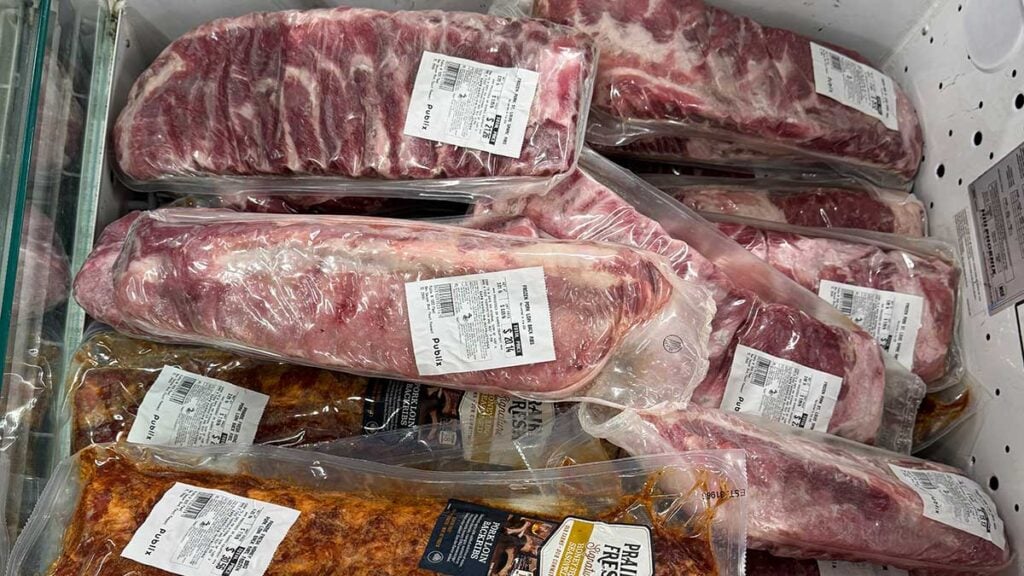
The main difference is how the ribs are packaged. At a grocery store, you can usually pick up individual racks to get close to your count. At a warehouse club, ribs are often sold in multi-rack or multi-piece packs, and what’s on the shelf can change by item, location, supplier, and the date you’re shopping.
In one limited snapshot checked at Costco Business Center in April 2026, one pork loin back rib item was listed as three pieces per package with a 4-pound average random weight. That is one item checked on one date. It is not a permanent rule about how Costco sells ribs everywhere.
If you’re buying Costco ribs for a party, the pack size matters as much as the rack count. If your count is 7 racks and the warehouse sells them in 3-packs, your options are two packs (6 racks, probably short) or three packs (9 racks, a bit more than you planned for). The right answer is usually three packs. Leftovers are easier to handle than an empty platter.
The same idea applies when you’re buying Sam’s Club ribs for a party. Do not plan from memory or from what another location carried. Check the actual rack count, package weight, and label on the pack in front of you.
Before you check out, confirm these things on the package in front of you:
- Is it raw, seasoned, or fully cooked? Raw is what you want for most cooking plans.
- What is the actual rack or piece count in the pack?
- What does the pack weigh, and does that match your raw-weight range?
- Does the label show any added-solution language?
When to call a butcher
A butcher shop is the right call when predictability matters more than convenience. You can ask for a specific cut, request matched rack sizes, ask about trim, and buy exactly the number of racks you need without being pushed into a multi-pack that doesn’t work with your count. For beef plate ribs, a butcher shop is often the best or only practical option.
For a larger order, call ahead. A butcher can prepare what you need, but they may not have twelve matched racks of St. Louis ribs sitting in the case.
When you call or walk in, keep it simple:
- “I’m feeding [X] people, ribs as the main meat. I need [X] racks of [cut]. Can you get me racks that are similar in size?”
That is enough for a good butcher to help you. If you’re not sure whether you need beef back ribs or beef plate ribs, sort that out before you make the call. A full comparison of these two beef cuts is in the beef back ribs vs dino ribs article.
How ribs are packaged and why that can change the plan
The store doesn’t sell ribs in partial racks. It sells real objects with whatever rack count and weight the packer put in them. Knowing which type of packaging you’re dealing with changes how you approach the rounding decision.
- Single racks on a tray are the most common grocery store setup. Each rack is its own package. This is the most flexible situation for getting close to your count, since you can add or remove individual racks.
- Cryovac or vacuum-sealed packs can hold one rack or multiple racks depending on the product. The vacuum seal is airtight, and the meat may look darker than you expect. That is normal. Check the label for the rack count and weight before you assume.
- Multi-rack rib packs are the norm at warehouse clubs. They may hold two, three, or four racks per pack depending on the item. These force a bigger rounding decision than single trays. If your count falls between pack sizes, round up to the next pack.
- Case buying comes up for very large events. Some stores and restaurant supply outlets sell by the case. Case quantities vary significantly, and this usually requires calling ahead or having a butcher relationship already in place.
- Actual-weight packages are labeled with the weight of the specific package in front of you rather than a guaranteed fixed weight. Two packages of the same product may weigh noticeably different amounts. Use both the rack count and the weight to evaluate what you’re getting.
The point is simple: your planning estimate is the target, but the store sells what it sells. Know which type of package you’re working with before you try to match a rack count to it.
Choose the rib cut before you compare packages
The cut you’re buying determines how you plan, how you compare packages, and how much you need per person. Here is what each cut means for buying for a crowd, without getting into the full cut science.
- Baby back ribs come from the upper portion of the rib cage where the ribs meet the backbone. They are smaller than spare ribs, which means they often require more racks to feed the same number of people. If baby backs look unusually small at the case, round up earlier than the calculator suggested.
- St. Louis ribs are spare ribs with the sternum, costal cartilage, and attached lean removed, producing a more rectangular rack that cooks evenly and is easier to compare across packages. According to Texas A&M Meat Science, a St. Louis rack typically carries 12 to 15 ribs, though counts vary. They are a reliable choice when you want consistent rack sizes for crowd cooking.
- Full spare ribs are the untrimmed version. They include the rib tips and may have more cartilage and uneven shape than a St. Louis rack. The weight will be higher, but not all of that weight ends up on anyone’s plate. More on that distinction below.
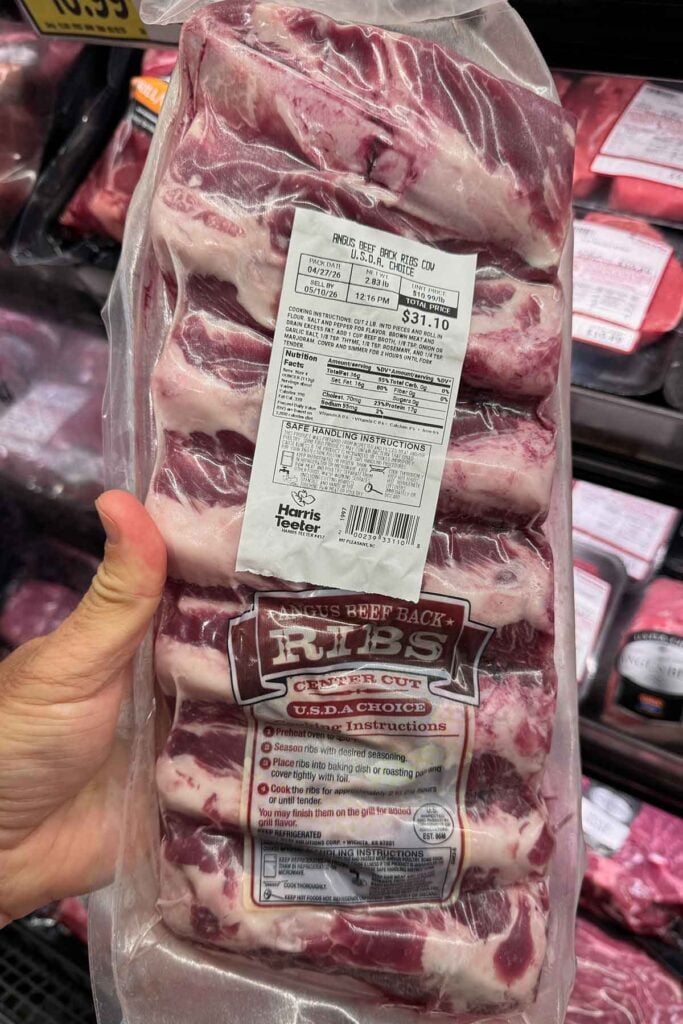
- Beef back ribs typically include seven rib bones, but Texas A&M Meat Science notes that beef back ribs have very little overlying meat because the ribeye roll has already been removed from that part of the animal. They look like a substantial product, but they don’t feed people the way beef plate ribs do. Don’t buy them expecting the same output.
- Beef plate ribs are the thick, meaty ones. Texas A&M Meat Science identifies beef plate short ribs (123A) as coming from ribs 6 through 8, with bones typically ranging from 8 to 12 inches. These are what most people mean by “dino ribs.” They are planned by bone count, not by the rack-counting approach you’d use for pork.
One rule worth keeping in your head at the store: if the cut changes, the number changes. Don’t force a baby back count onto spare ribs, or a pork rack count onto beef plate ribs. If you switched cuts after running the calculator, rerun it.
Trimmed vs untrimmed racks
St. Louis-style ribs are trimmed from full spare ribs. The trimming removes the sternum, costal cartilage, and attached lean section, leaving a cleaner, more rectangular rack. For crowd cooking, that trim matters in two practical ways.
First, trimmed racks are easier to compare across packages. Two St. Louis racks are more likely to be close in shape and cooking time than two untrimmed spare rib racks of the same listed weight. That consistency matters when you’re cooking a lot of racks at once.
Second, the trim changes what you’re actually weighing. An untrimmed full spare rib rack will weigh more than a St. Louis rack from the same animal, but part of that extra weight is cartilage, rib tips, and trim that won’t end up on anyone’s plate. Keep that in mind when comparing packages by weight across cut types.
Untrimmed spare ribs are not a bad buy. If you’re comfortable trimming them yourself, or if you plan to cook the rib tips separately, full spare ribs can be a good deal. Just don’t compare them by weight to a St. Louis rack and expect the same amount of food.
Read the label before you buy
The label on a rib package tells you more than just the cut name. A few things are worth checking before anything goes in the cart.
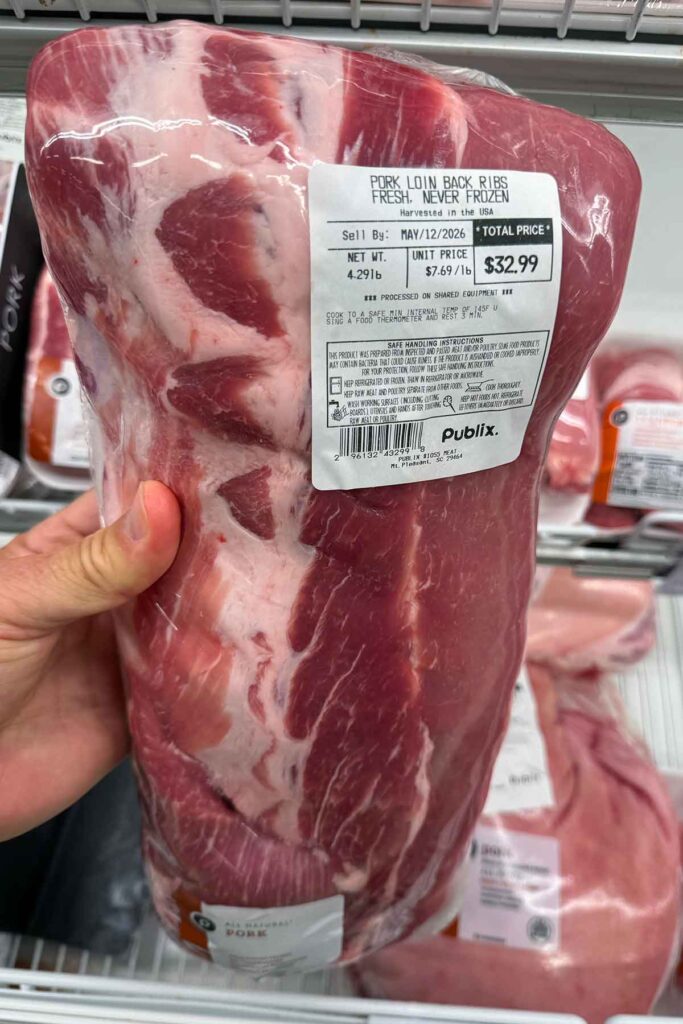
- Added solution. Federal labeling regulations require that raw meat sold with added solution state the percentage of added solution and its ingredients directly on the label. The specific rule is codified at 9 CFR § 317.2. What this means for your shopping: if the label says the ribs contain 12 percent added solution, a portion of the package weight is water, salt, and flavorings rather than meat. That doesn’t automatically make them unusable. But it means you’re paying for some of that weight in liquid, the salt level will be higher than with untreated ribs, and the weight range from your planning count may not translate cleanly. If you’re planning to mix treated and untreated racks on the same cook, the flavor results may be inconsistent.
- Raw vs. seasoned. Some rib packages are pre-seasoned with a dry rub or marinade. If that’s what you planned for, fine. If you want to season your own, you need raw. Check the label before you assume.
- Raw vs. fully cooked. A fully cooked rack is obviously not the same as a raw rack. It’s meant to be reheated, not smoked from scratch, and it will not behave the same way in a low-and-slow cook. If the label says “fully cooked,” put it back unless you specifically planned for that.
- Fresh vs. previously frozen. Some warehouse-club ribs may be previously frozen and then thawed. That doesn’t make them bad, but it means you’ll want to use them within a few days. Avoid refreezing unless you know they stayed properly cold, and even then the quality may suffer.
- Package weight. Use the weight to evaluate whether the package is in the right ballpark for your rack count. If it’s way off from what you expected, check whether the cut is what you thought it was, or whether the racks look much smaller or larger than normal.
- Piece count. On multi-rack packs, the label should tell you how many racks or pieces are inside. Confirm this before you buy, especially at warehouse clubs where what’s on the shelf can change.
What to look for at the meat case
If you have a choice between multiple racks in the case, a little visual inspection goes a long way, especially when you’re cooking a lot at once.
Look for similar rack sizes. Cooking very small racks alongside very large ones means they’ll finish at different times, which creates a timing problem. That timing problem is easier to manage if you plan how to keep ribs warm while later racks finish.
If you’re picking from a single tray at the grocery store, try to choose racks that are close to each other in size and shape.
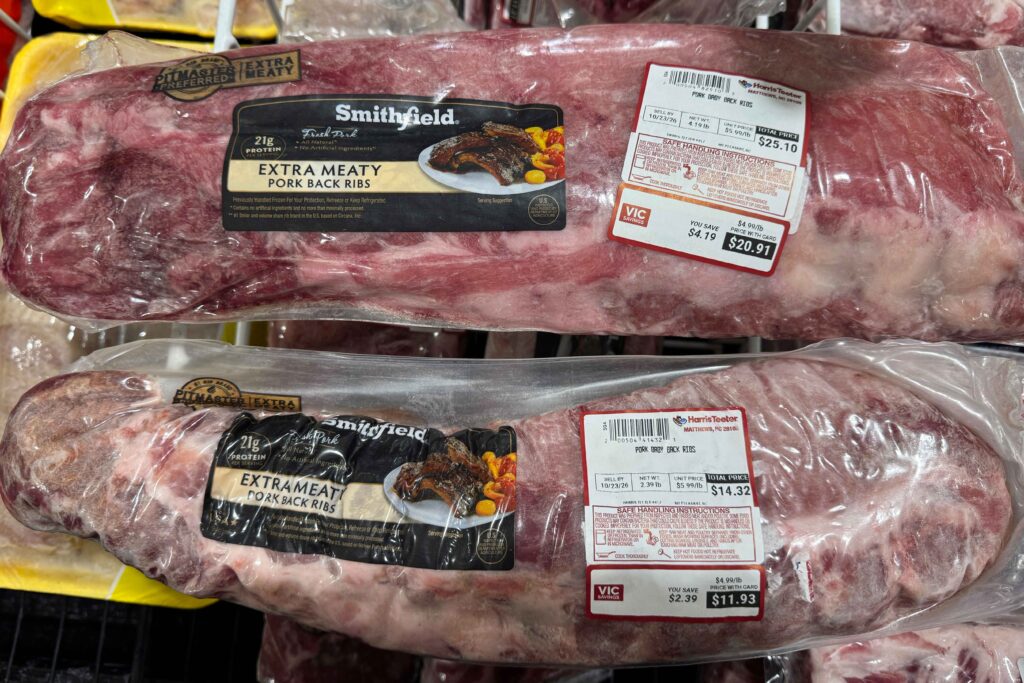
Check the meat coverage. A well-meated rack will have relatively even meat from end to end. A rack with a lot of exposed bone at the thin end (what some cooks call “shiners,” where the bone shows through) won’t give you much to work with there. You don’t need perfection, but obvious gaps across multiple bones are worth noting.
You don’t need to be obsessive about it. You’re buying ribs for a cookout, not judging a competition. A few minutes of looking while you’re at the case can save some uneven results at the cooker.
When to buy an extra rack
When the decision is close, buy more.
For a host, running out of ribs mid-meal is worse than having leftovers. An empty platter means some guests leave less satisfied than you’d hoped. Leftovers have options. If you end up with leftovers, our guide for reheating ribs can help you bring them back without drying them out.
Here is when to stop debating and grab one more rack:
- Ribs are the main meat. When ribs are the only protein, or the one everyone is most excited about, there is no backup when people want seconds. Plan with a cushion.
- Guests serve themselves. Self-serve eating almost always results in higher consumption than plated portions. People take more when they’re in control of the serving.
- The racks look small. If the racks in the case look undersized compared to what you planned around, your rack count may not produce the meal you expected. Trust what you see.
- Teenagers or big eaters are coming. The calculator is built around normal portions. A group of teenagers or others who came hungry may not eat normal portions.
- Sides are light. Heavy sides stretch ribs. If you’re only serving a few sides, or light ones, the ribs do more of the feeding.
- The pack size forces a modest round-up. If buying an extra rack or getting to the next pack only means one or two more racks above your count, that is an easy call.
- The event matters and getting more later won’t be easy. If you’re cooking ribs the day before, driving a long way, or the store had limited stock, buy the extra rack now.
The one counter to all of this: don’t stack buffers on top of buffers without thinking about it. If the only option at the store forces a very large jump above your estimate, compare another store or rerun the calculator with the cut that’s actually available. For a fuller look at how to think through the extra-rack decision, the when to buy one more rack of ribs article works through the scenarios.
Leftover ribs are fine the next day. Chill them promptly, keep them covered, reheat them gently, and the problem solves itself.
A note on country-style ribs
Country-style ribs have “ribs” in the name and show up in the rib section of most stores. They are not rack ribs. According to Texas A&M Meat Science, country-style ribs are typically cut from pork shoulder butt or pork loin rib end. They don’t have the same bone structure, they don’t cook the same way, and the rack-based planning math from the calculator doesn’t apply to them.
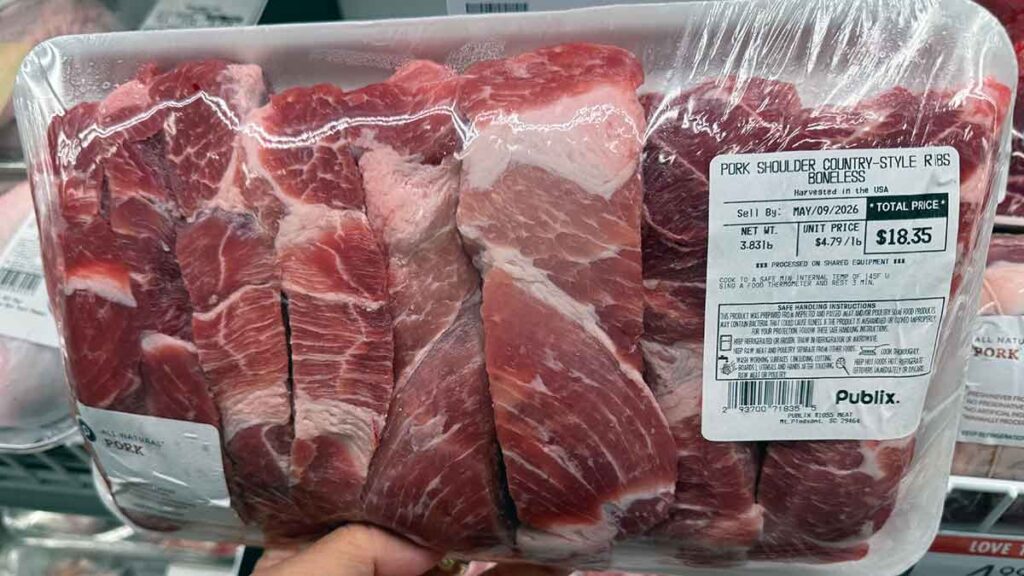
If your count says eight racks of baby backs and you’re tempted to substitute country-style ribs because they’re on sale, resist. You’ll need a completely different plan for a completely different product. Country-style ribs can be excellent. They’re just not a one-for-one stand-in for rack ribs, and no rib calculator result is going to translate.
Getting ribs home safely
Buying a lot of raw meat at once creates a food-safety situation worth handling correctly. None of this is complicated.
Shop for ribs toward the end of your store trip, not the beginning. Raw ribs sitting in a warm cart while you finish the rest of your shopping is not ideal.
Keep the raw ribs separate from ready-to-eat food in the cart and in your bags. This matters at checkout too: make sure the person bagging your groceries doesn’t put raw meat in with produce or anything you plan to eat without cooking.
If you have a long drive home, more errands ahead, or it’s a hot day, bring a cooler. According to FoodSafety.gov, perishable foods should be refrigerated within two hours of being removed from refrigeration, or within one hour if the temperature outside is above 90°F. A hot car is not a cooler. On a summer day, an ice chest in the trunk is worth the extra step.
When you get home, refrigerate the ribs promptly. Keep them in their original sealed packaging until you’re ready to prep them.
Do not rinse raw ribs. Rinsing does not make the meat safer. It spreads bacteria around your sink and onto any surrounding surfaces the water contacts. The bacteria are killed by cooking. Rinsing just moves them around.
For how far ahead you can buy: use FoodSafety.gov’s fresh pork guidance as the baseline. Keep raw ribs refrigerated at 40°F or below and plan to cook them within 3 to 5 days, unless the package date gives you a shorter window.
For leftover cooked ribs, get them into a container and into the refrigerator within two hours of the end of the meal. They are generally best kept 3 to 4 days and should be reheated to 165°F as measured with a food thermometer before serving again.
Common rib-buying problems
Most of the awkward situations at the meat case have a straightforward answer. Here is a quick reference.
| Situation | What to do |
|---|---|
| The calculator says 7.2 racks, but the store sells 3-packs | Two packs gets you 6 racks (probably short). Three packs gets you 9. Buy three packs if the jump is reasonable and leftovers are acceptable. If the jump is too large, compare another store or check whether they sell individual racks. |
| The racks look smaller than expected | Trust what you see. Add at least one more rack to your count. Small racks mean your per-rack feeding estimate was built around a normal rack, not this one. |
| The store has full spare ribs instead of St. Louis ribs | Spare ribs work, but they are heavier and less uniform. The weight range from your planning count will not match directly. You may need fewer racks by count, but more prep. If you’re not comfortable trimming, St. Louis ribs at another store are worth the trip. |
| The store has beef back ribs instead of beef plate ribs | These are not the same product. Beef back ribs have little overlying meat; beef plate ribs are the thick, bone-heavy ones. Don’t substitute one for the other using the same count. See the beef back ribs vs dino ribs article before you commit. |
| The label shows added solution | Not automatically a dealbreaker, but account for it. Part of the package weight is liquid. Season carefully. If you’re mixing these with untreated racks on the same cook, be aware the flavor results may differ. |
| Country-style ribs are on sale | Don’t substitute them for rack ribs. Country-style ribs are a different product from a different part of the animal, and your rack-based count doesn’t apply. Buy them for a separate plan if you want them. |
| Worried about buying too much | A modest overage is almost always the right call when the decision is close. Leftover ribs reheat well and are easy to deal with. Running short at a meal is harder to recover from than having a few extra racks in the refrigerator the next day. |
Rib buying FAQs
For pork ribs, start with the rack count and use package weight as a check. Weight can vary because of trim, bone size, and added solution. For beef plate ribs, bone count is the better guide. If the cut changes after you run your estimate, rerun the numbers before you buy.
Round to the pack size that gets you just above your estimate. If you need seven racks and the store sells three-packs, six is probably short and nine is usually safer. When the next pack would leave you with far more than you want, check another store or call a butcher before buying.
They are not automatically a bad buy, but they do change the plan. Added solution means part of the package weight is liquid, salt, or seasoning instead of meat. Season more carefully, avoid mixing treated and untreated racks if consistency matters, and do not rely on package weight alone.
You can, but do not count every rack the same way. Baby backs, St. Louis ribs, full spares, beef back ribs, and beef plate ribs feed people differently. Run separate estimates for each cut, or use one cut for the main count and treat the other as extra.
A day or two ahead is simplest for most home cooks. Keep the ribs sealed, cold, and refrigerated at 40°F or below until prep time. If you buy earlier, follow the use-by date on the package and avoid leaving raw ribs in a warm cart, car, or cooler without enough ice.
Corrections and editorial standards
- Spotted something wrong or outdated? Send a correction here: Corrections & Updates
- How we handle sources, testing, and updates: Editorial Standards
- Media or general notes: Email the publisher
Sources
- Destination BBQ Rib Calculator — primary planning tool used for rack counts, bone counts, raw-weight ranges, and leftover cushion logic
- Texas A&M Meat Science: 416A Pork Spareribs, St. Louis Style — source for St. Louis rib definition, trimming details, and typical rib-count range
- Texas A&M Meat Science: 123A Beef Plate Short Ribs, Trimmed — source for beef plate rib identity, rib numbers 6 through 8, and dino-rib framing
- Texas A&M Meat Science: 124 Beef Rib, Back Ribs — source for beef back rib identity, seven-bone count, and limited overlying meat
- Texas A&M Meat Science: Pork Country Style Ribs — source for why country-style ribs are not rack ribs and should not be substituted one-for-one
- eCFR: 9 CFR § 317.2 — primary federal labeling rule for raw meat products with added solution, including percentage and ingredient disclosure
- FoodSafety.gov: 4 Steps to Food Safety — source for keeping raw meat separate from ready-to-eat foods during shopping, storage, and prep, plus the 2-hour and 1-hour perishable food guidance
- FoodSafety.gov: Cold Food Storage Chart — source for refrigerator temperature and fresh meat storage guidance
- USDA FSIS: Leftovers and Food Safety — source for leftover storage and reheating cooked leftovers to 165°F
- Author retail snapshot, Costco Business Center pork loin back ribs, April 2026 — limited retailer example used to illustrate how multi-rack pack sizes can affect rib buying; availability and packaging may change
- USDA FSIS: Fresh Pork from Farm to Table — source for raw pork storage, handling, and why raw pork does not need to be rinsed before cooking
This guide combines firsthand rib-shopping experience, Destination BBQ planning tools, and authoritative source checks. Retail examples are snapshots, not permanent buying rules.
About the author
James Roller documents South Carolina barbecue for Destination BBQ and authored the SC BBQ cookbook Going Whole Hog. His BBQ guides focus on practical planning questions, including how much food to buy, how to avoid running short, and how to use reliable meat-cut and food-safety guidance without making backyard cooking more complicated than it needs to be.