Pork Butt Yield Explained: Raw Weight vs Finished Pulled Pork
Learn what pork butt yield really measures, where the weight goes, and why the final number depends on what you keep
For pulled pork planning, a bone-in Boston butt usually yields about 50% of its raw weight as finished pulled pork. That means an 8-pound pork butt gives about 4 pounds of pulled pork. Boneless butts often run higher, closer to 60%, depending on trim, moisture loss, and what you keep after pulling.
If you have ever put a pork butt on the smoker and ended up with a lot less pulled pork than you expected, you have already seen yield at work.
What causes confusion is not just the shrinkage. It is that different sources often are not counting the same thing. One source may point you to roughly 50% yield for a bone-in Boston butt, while another says an 8-pound butt can yield about 5 pounds cooked. Those numbers do not always conflict. Often, one source is counting meat only, while the other counts more of what ends up in the pan, like bark, soft fat, or juices.
Pork butt yield is not the same thing as serving size, sandwich count, or how much pork to buy. It is simply the relationship between the raw weight you started with and the usable cooked pork you finished with. Once you understand that part, the rest of your planning gets a lot easier.
How much does pork butt shrink when cooked?
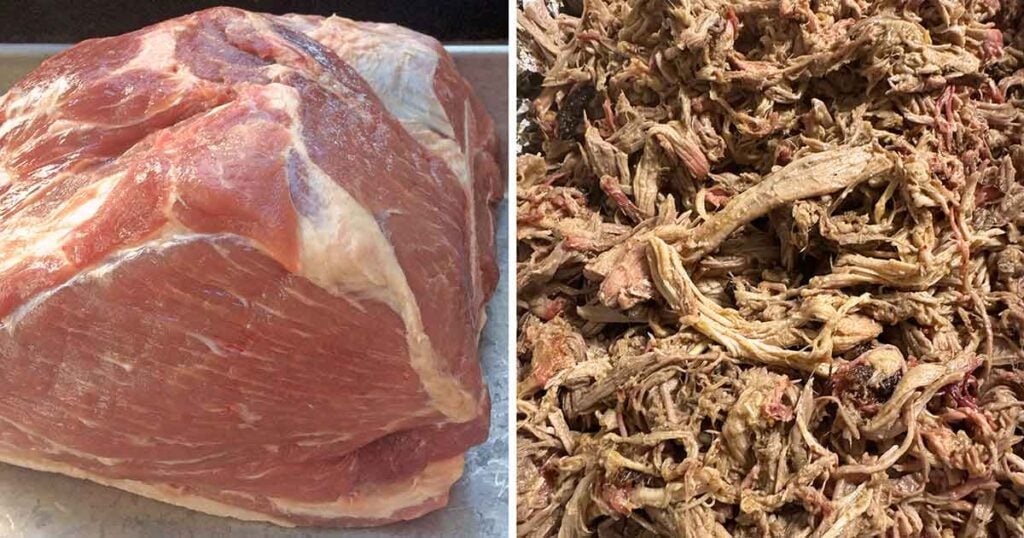
As a safe rule of thumb, expect a bone-in Boston butt to lose about half its raw weight during cooking. That means an 8-pound bone-in Boston butt usually gives you about 4 pounds of finished pulled pork.
That fits with the common “about 50% yield” rule, which is a conservative estimate many home cooks use. Using USDA numbers for cooked lean meat, the same 8-pound butt lands at about 4.16 pounds finished.
Could you end up with closer to 5 pounds on your own smoker? Yes, sometimes. But that usually means you are counting more of what came off the pit, like bark, soft fat, or juices mixed back in, not just the usable pulled meat. In our experience, what we keep and whether the juices go back in usually matter more than any rough rule of thumb.
Put simply, these numbers can both be right. Often, they are just counting the finished pulled pork differently.
In one of our recent cooks, an 8.37-pound bone-in butt yielded 4.42 pounds of pulled pork after the bone came out and the unwanted fatty bits were discarded. When we folded the reserved juices back in, the finished pan weighed 4.83 pounds. That is why yield depends on what you count.
What pork butt yield means
In plain English, yield is how much usable cooked pork you get from the raw piece you bought.
That sounds simple, but a lot of online confusion starts right there, because not everyone counts the same finished product.
What is being counted?
Some numbers are based on the USDA Food Buying Guide, which uses a meat-only way of measuring yield for many cuts. In other words, those numbers describe lean cooked meat, not a pan of loosely pulled pork with bark, soft fat, and juices mixed back in the way many backyard cooks serve it.
That is why one source may tell you a bone-in Boston butt yields about 52%, while another says an 8-pound butt gives you about 5 pounds finished. Often, they are simply counting the finished pulled pork differently.
It also helps to separate yield from other questions:
- Yield asks, How much usable cooked pork did this cut give me?
- Serving size asks, How many people will that feed?
- Sandwich count asks, How many sandwiches can I make from it?
If you already know how much cooked pork you have and only need to figure out how many sandwiches that will make, that is a different question covered in pulled pork sandwiches per pound.
Pork butt yield: a realistic range
Use the USDA yield numbers as your starting point, then plan a little conservatively.
For a bone-in Boston butt, the USDA lists 0.52 pounds cooked lean meat per pound as purchased. For a boneless Boston butt, it is 0.60 pounds cooked lean meat per pound as purchased. Picnic shoulder runs lower in bone-in form, and fresh ham varies by the exact cut you bought. That is why a simple blanket rule can mislead people. The cut matters. What you trim matters. What you keep after pulling matters.
Here is a practical way to look at the numbers. These USDA figures are for cooked lean meat, not for a finished pan of pulled pork with bark, soft fat, and juices mixed back in:
| Cut | USDA cooked lean yield | Use this for planning | Why it matters |
|---|---|---|---|
| Boston butt, bone-in | 0.52 lb cooked lean meat per 1 lb raw | About 50% | Best simple number for planning a typical pulled pork cook |
| Boston butt, boneless | 0.60 lb cooked lean meat per 1 lb raw | About 60%, if you do not trim or discard much | Higher return because you are not paying for bone weight |
| Picnic shoulder, bone-in | 0.43 lb cooked lean meat per 1 lb raw | About 40% to 45% | Plan lower than Boston butt so you do not come up short |
| Picnic shoulder, boneless | 0.57 lb cooked lean meat per 1 lb raw | About 55% to 60% | Better return than bone-in picnic, but still not the same cut as butt |
| Fresh ham, inside roast | 0.54 lb cooked lean meat per 1 lb raw | About 55% | Useful for yield, but it does not cook like pork shoulder |
| Fresh ham, leg tip | 0.62 lb cooked lean meat per 1 lb raw | About 60% | Leaner ham cut, not a direct substitute for pork butt |
Those USDA figures come from the Food Buying Guide yield table, and the guide’s Appendix B makes clear that its yield information is meant to account for the real losses that happen during cooking.
For most backyard cooks, the quick takeaway is this: for a bone-in Boston butt, about 50% is usually the safest estimate if you do not want to come up short. That stays close to the USDA cooked lean-meat number, is easy to remember, and leaves a little cushion so you do not run short.
Quick reference for bone-in Boston butt
- 6 lb raw → about 3 lb pulled pork
- 8 lb raw → about 4 lb pulled pork
- 10 lb raw → about 5 lb pulled pork
- 12 lb raw → about 6 lb pulled pork
These are conservative planning numbers based on roughly 50% yield from as-purchased weight. Boneless butts often run higher, and your finished weight can look different if you keep more bark, soft fat, or juices.
How much does a pork butt weigh on average?
Boston butts sold for home cooking commonly fall in the 6- to 10-pound range, though some run smaller or larger. For yield planning, the exact package weight matters less than the yield percentage. A bone-in butt at roughly 50% yield gives about half its raw weight as finished pulled pork.
Where the weight goes during cooking
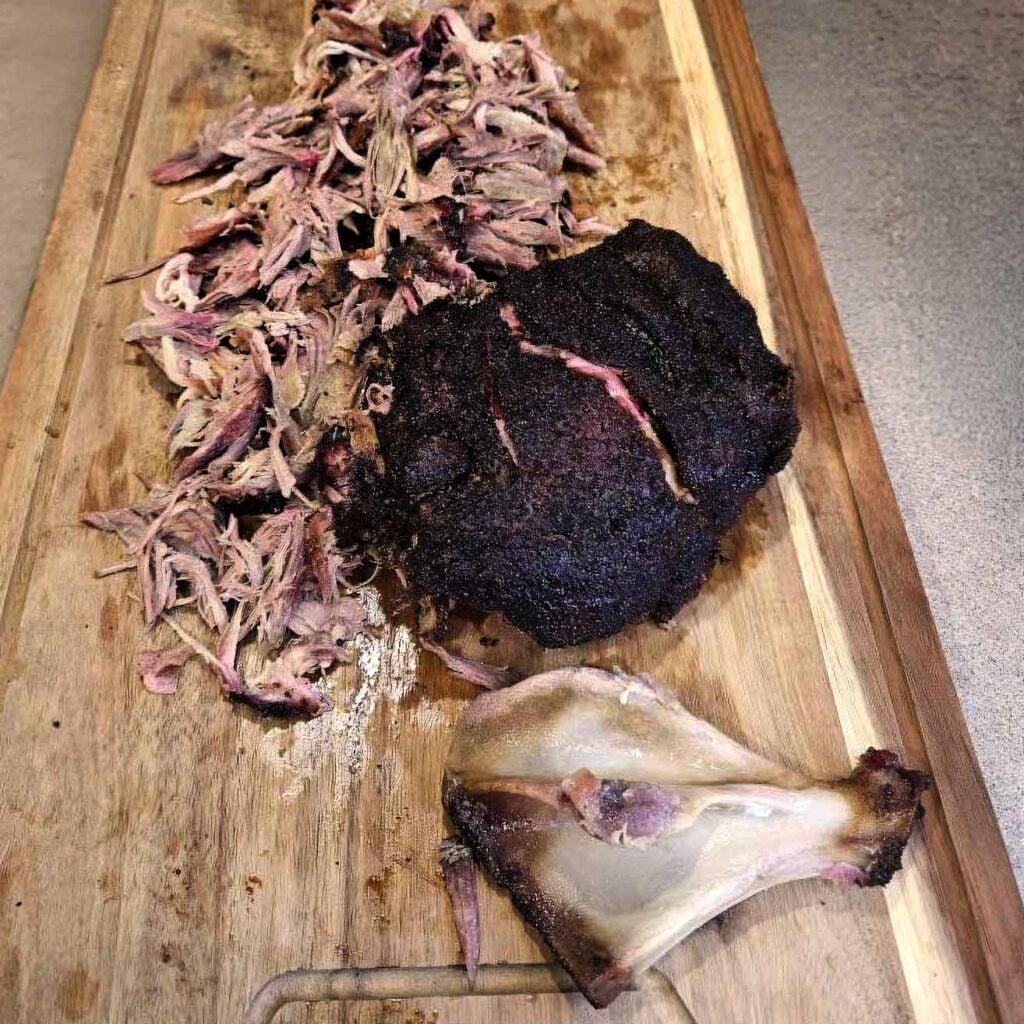
Pork butt shrinks for predictable reasons. Here is where the weight usually goes.
Bone and pre-cook trim
If the cut is bone-in, some of your starting weight was never going to become pulled pork in the first place.
The same is true for any fat cap or loose flaps you trim off before the cook. That is one reason bone-in vs. boneless and trimming choices can affect yield before the cook even starts.
Rendered fat
Pork butt carries a lot of fat, and part of the cook is about rendering that fat down.
Some of that fat stays in the meat in a useful way. Some of it leaves the roast entirely and ends up in the pan, foil, drip tray, or smoker. Once it has rendered out, it is no longer part of the pulled pork you are weighing.
Moisture loss
This is the big one most people notice.
As meat cooks, it loses water. Some loss is normal. Some loss is driven harder by a long unwrapped cook, dry heat, or a finish that lets more evaporation happen before the meat is protected. That evaporation is also what drives the pork butt stall, when the meat seems to stop climbing in temperature for a while even though the cook is still going.
Post-pull discards
After the butt is done, you still make choices that change yield.
If you pull everything and keep most of the bark, soft interior fat, and juices, your finished weight can look higher. That is especially true if you keep more of the darker exterior pieces that contribute to bark formation.
If you sort out soft fat, gristle, or bits you do not want to serve, your yield goes down. Neither approach is wrong. You just need to know which one you are measuring.
Boston butt vs picnic vs fresh ham
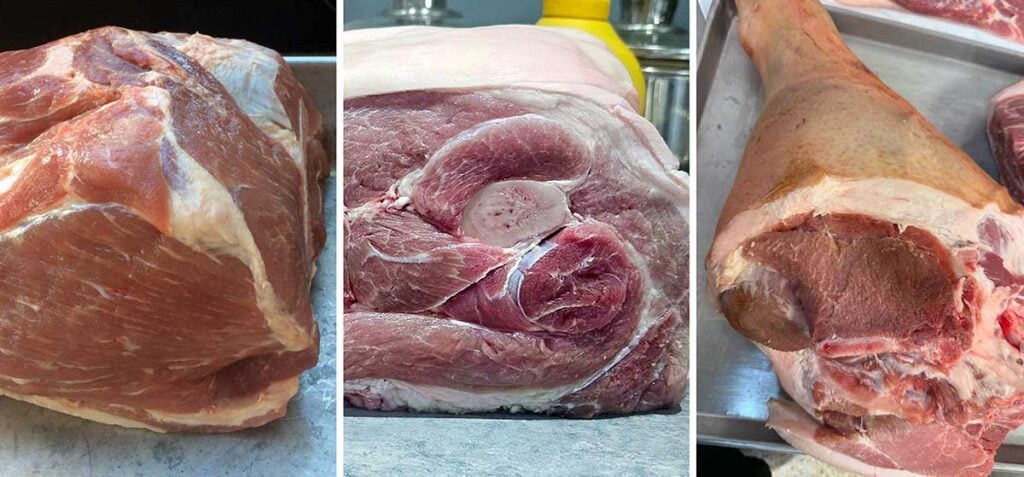
This is where cut choice begins to matter.
A Boston butt is usually the most forgiving and most familiar cut for pulled pork. In the USDA table, it also has a higher yield than bone-in picnic. If you are still deciding which shoulder cut makes the most sense for your cook overall, see best cut for pulled pork.
A picnic shoulder comes from the lower part of the shoulder. In USDA pork cut specifications, picnic and Boston butt are defined as different shoulder items, and that difference shows up in the yield table, too.
Bone-in picnic has a lower USDA-listed yield than bone-in butt, which is one reason many cooks feel like picnic gives them less usable pulled pork than expected. It is also one reason pork shoulder yield after cooking can vary more than many people expect, especially when people compare picnic shoulder and Boston butt as if they were interchangeable.
A fresh ham is different again. On paper, some fresh ham cuts can show respectable yield figures. But fresh ham is part of the leg, not the shoulder, and it does not behave like shoulder muscle. So it can be useful as a yield reference, but it is not a clean one-for-one substitute for pork butt if your goal is classic pulled pork texture.
Bone-in vs boneless pork butt yield: what actually changes
For yield, the main difference between bone-in and boneless is simple: with boneless, more of what you bought can end up as pulled pork.
A boneless butt starts with the bone already removed, so more of your as-purchased weight is meat. That is one reason the USDA yield for boneless Boston butt is higher than the bone-in version.
Bone-in cuts do have some practical advantages. They tend to hold their shape well during the cook, and many cooks like the structure they provide. But “bone-in automatically tastes better” is not a claim I would lean on. ThermoWorks makes the point plainly in its pork butt guide: the case for bone-in is structure, not some dramatic boost in flavor.
Here is the simple way to look at yield:
- Bone-in usually means lower raw-to-cooked return because part of the starting weight is bone
- Boneless usually means better yield on paper, but shape and thickness can still affect how the pork cooks
- Neither one guarantees the same result if trim, wrap, and post-pull sorting are different
How wrapping changes pork butt yield
Does wrapping pork butt change yield? Usually, yes, at least a little, because wrapping changes how much moisture the pork holds onto.
Foil usually holds onto more moisture. Butcher paper is more breathable, so it tends to land in the middle. No wrap usually allows more evaporative loss, which can mean a firmer bark and a somewhat lower finished weight.
Even so, wrap is not something you should treat like a fixed percentage boost. A safer way to think about it is:
- Foil usually gives you a higher finished weight on the scale because it limits evaporation more aggressively
- Butcher paper is a middle ground
- No wrap usually comes in lower because more moisture escapes during the cook
Bottom line: wrapping changes how much moisture stays with the meat, which can change the finished yield.
For an in-depth look at foil, butcher paper, and no-wrap tradeoffs, see our guide to wrapping pork butt.
What should count in your final yield number
Before you decide whether your cook “yielded well” or “yielded poorly,” decide what you are counting. When we cook pork for family or a crowd, what makes the biggest difference is usually what we keep after pulling and whether the juices go back in.
What should count in yield
- Best apples-to-apples method: weigh the pulled meat after the bone is removed and after anything you will not serve has been discarded
- If you are serving retained juices: note that clearly, because meat plus juices is not the same measurement as meat alone
- If sauce goes in before weighing: note that separately, because you are weighing meat plus added sauce, not the pork’s true cooked yield
- The important part: use the same counting method every time so your own notes stay comparable
A yield number is only useful when you know exactly what it includes.
This is also why holding and reheating can complicate the comparison a little. If a batch sits, juices collect, and you fold those juices back in later, the finished pan may weigh more than the plain pulled meat would have right off the pit. That is fine, but you are measuring something different at that point. The same issue can show up when you make pulled pork ahead, keep pulled pork warm, or reheat pulled pork.
One other quick distinction matters here: FoodSafety.gov lists 145°F with a 3-minute rest as the safe minimum for pork roasts, but pulled pork is usually cooked much higher than that because shoulder needs time and heat to break down connective tissue. Safe is not the same as pullable.
Why your result may be lower than expected
If your pulled pork yield came in lower than what someone online promised, one of these reasons is usually behind it.
- You cooked a picnic shoulder, not a Boston butt
- Your cut was bone-in, so more of the raw weight was never edible pulled pork
- You trimmed more aggressively before the cook
- You cooked fully unwrapped and lost more moisture
- You discarded more soft fat, gristle, or overdone bits after pulling
- You weighed meat only, while the number you were comparing against included juices or sauce
- You compared a home-pulled result to a USDA lean-meat yield, or vice versa
That last one catches a lot of people. A number can be technically right and still be the wrong number for the thing you are trying to measure.
Use the pulled pork calculator after you understand the yield
Once yield makes sense, the rest of the planning gets much easier.
If you now understand why a butt can lose so much weight, why one cut yields differently from another, and why “50%” and “about 5 pounds from an 8-pound butt” can both be reasonable depending on what is being counted, you are ready for the next step.
Use the pulled pork calculator when you need to turn yield into an actual plan for cooked pork, raw-buy amount, piece count, and timing. That is where you figure out how much to buy and how much cooked pork you need. If you are still trying to figure out how long the cook itself may take at different pit temperatures, see our pork butt timing guide.
Pork butt yield FAQs
Start with USDA-based or conservative planning numbers if you do not yet have your own track record. After a few cooks, your own notes usually become more useful because they reflect your smoker, trimming habits, wrap choice, and what you actually keep after pulling. Just make sure you use the same counting method each time.
Use as-purchased weight when figuring out how much pork to buy and when comparing your results with USDA tables, because that is the starting point those tables use. If you also track trimmed weight, record it separately. Mixing those two starting points can make one cook look better or worse than it really was and makes your notes harder to compare.
Weigh it after cooking, after removing the bone, and after discarding anything you do not plan to serve. That gives you a more honest usable-yield number. If you sometimes weigh meat alone and other times weigh meat plus juices or sauce, your results will not be apples to apples even if the cooks went equally well.
Yes. Once you mix reserved juices, finishing liquid, or sauce into the meat, you are no longer measuring plain cooked pork alone. That does not make the number wrong, but it does make it a different number. The fix is simple: note exactly what was included so future cooks can be compared fairly.
It can leave more weight in the roast, but not always more usable pulled pork. Shoulder needs enough time and heat to loosen connective tissue and become easy to pull. A roast that finishes heavier on the scale can still be worse for serving if it shreds poorly or leaves more tough meat behind.
Corrections and editorial standards
- Spotted something wrong or outdated? Send a correction here: Corrections & Updates
- How we handle sources, testing, and updates: Editorial Standards
- Media or general notes: Email the publisher
Sources
- USDA Food Buying Guide yield table — Cut-specific as-purchased to cooked lean yield figures for Boston butt, picnic shoulder, and fresh ham.
- USDA Food Buying Guide Appendix B — Background on how cooking loss, fat loss, and usable cooked weight affect how much pork to buy.
- USDA Institutional Meat Purchase Specifications, Fresh Pork Series 400 — Definitions and specifications for pork cuts including Boston butt, picnic shoulder, and fresh ham.
- FoodSafety.gov safe minimum internal temperatures — Supports the distinction between a safe pork roast and pork cooked to pulled texture.
- ThermoWorks pork butt guide — Practical guidance on stall behavior, wrapping, and bone-in versus boneless cooking considerations.
This page draws first on USDA and FoodSafety.gov references, then adds practical barbecue guidance and notes from our own cooks to explain how yield works in the real world.
About the author
James Roller documents South Carolina barbecue for Destination BBQ and authored the SC BBQ cookbook Going Whole Hog. He and his wife, Heather, have cooked pork for family meals, parties, and larger gatherings for years, so they know firsthand that raw weight and finished pulled pork are not the same thing. On this page, he combines USDA yield guidance, practical barbecue sources, and notes from his own cooks to explain where the weight goes and how to think about pork butt yield before planning a cook.