Can You Make Pulled Pork the Day Before?
Learn when making pulled pork the day before makes sense, plus how to cool, store, and reheat it safely without drying it out
Yes, you can make pulled pork the day before, and for a lot of cooks, it is the easier way to stay ahead. The key is cooling and reheating it in a way that keeps the pork moist and makes tomorrow easier, not harder.
For most cooks, this is the safer, easier plan: pull the pork, save the juices, portion it into shallow containers or shallow foil pans, refrigerate it promptly, then reheat it covered to 165°F before service.
If you still need to figure out how much pork to buy, how many pieces to cook, or when to start, use the pulled pork calculator.
Then comes the real decision: pull it before chilling, or leave it in larger pieces until the next day? Both can work. One makes tomorrow easier. The other holds texture a little better. The right choice depends on what matters most to you.
Yes, and here’s what works best for most cooks
With pulled pork, finishing early is usually the better problem to have. Making pulled pork the day before gives you more control, less stress on serving day, and fewer chances to get caught by a late finish.
- Best choice for most cooks: pull the pork while it is still warm enough to handle, save the juices, cool it in shallow portions, refrigerate it promptly, then reheat it covered to 165°F
- If texture matters most: chill it in large chunks, then reheat and pull closer to service
- Biggest safety rule: refrigerate within 2 hours, or within 1 hour if you are outside in heat above 90°F
- Best way to reheat a large batch: reheat covered in the oven, then hold hot if needed
- What you give up: some bark softens overnight, especially once the pork is pulled and stored
For a party, that is usually a fair trade. Softened bark is easier to forgive than dry pork, rushed pork, or pork that finishes late.
If you are serving 2 to 4 days from now, the same basic plan still works. Just tighten up storage and reheat only what you need. If your timing slips beyond that refrigerated window, freezing is the better choice.
Should you pull before refrigerating or leave it whole?
Most folks want one question answered first: should you pull pork before refrigerating, or chill it whole or in large chunks instead? There is not one right answer every time. Pulling first is usually the more forgiving option for most cooks. Chilling it in large chunks is the better fit when texture matters most. Chilling one whole hot cut is not the best choice for most home cooks, even though some do it.
Before you choose, look at the tradeoffs side by side:
| Factor | Pull before chilling | Chill whole or in large chunks |
|---|---|---|
| Day-of service speed | Faster. Reheat, stir in juices, and serve. | Slower. You still need to reheat, then pull or chop closer to service. |
| Cooling safety | Easier to cool safely in shallow pans or containers. | Harder to cool safely if left as one large hot mass. |
| Moisture and texture | Still very good if you save juices and reheat covered. | Can protect texture a bit better, especially in larger pieces. |
| Bark | Softens sooner once pulled and stored. | Usually holds up a little better until reheating and pulling. |
| Storage footprint | Takes more pan or container space. | Can take less space if stored in larger pieces. |
| Day-of labor | Less work on serving day. | More work on serving day. |
| Best for | Crowds, buffet service, tailgates, and hosts who want fewer moving parts. | Smaller groups or cooks who care most about texture and do not mind more day-of work or more cooling attention. |
| Biggest risk | Some bark loss and slightly softer texture. | Cooling too slowly or underestimating the day-of labor. |
| Best fix | Save juices, reheat covered, and sauce late. | Split into manageable pieces, cool aggressively, and leave extra time the next day. |
Pull first if you want the easier, more forgiving plan
I’d usually pull it first. Cooling is simpler, and there is less to do before serving.
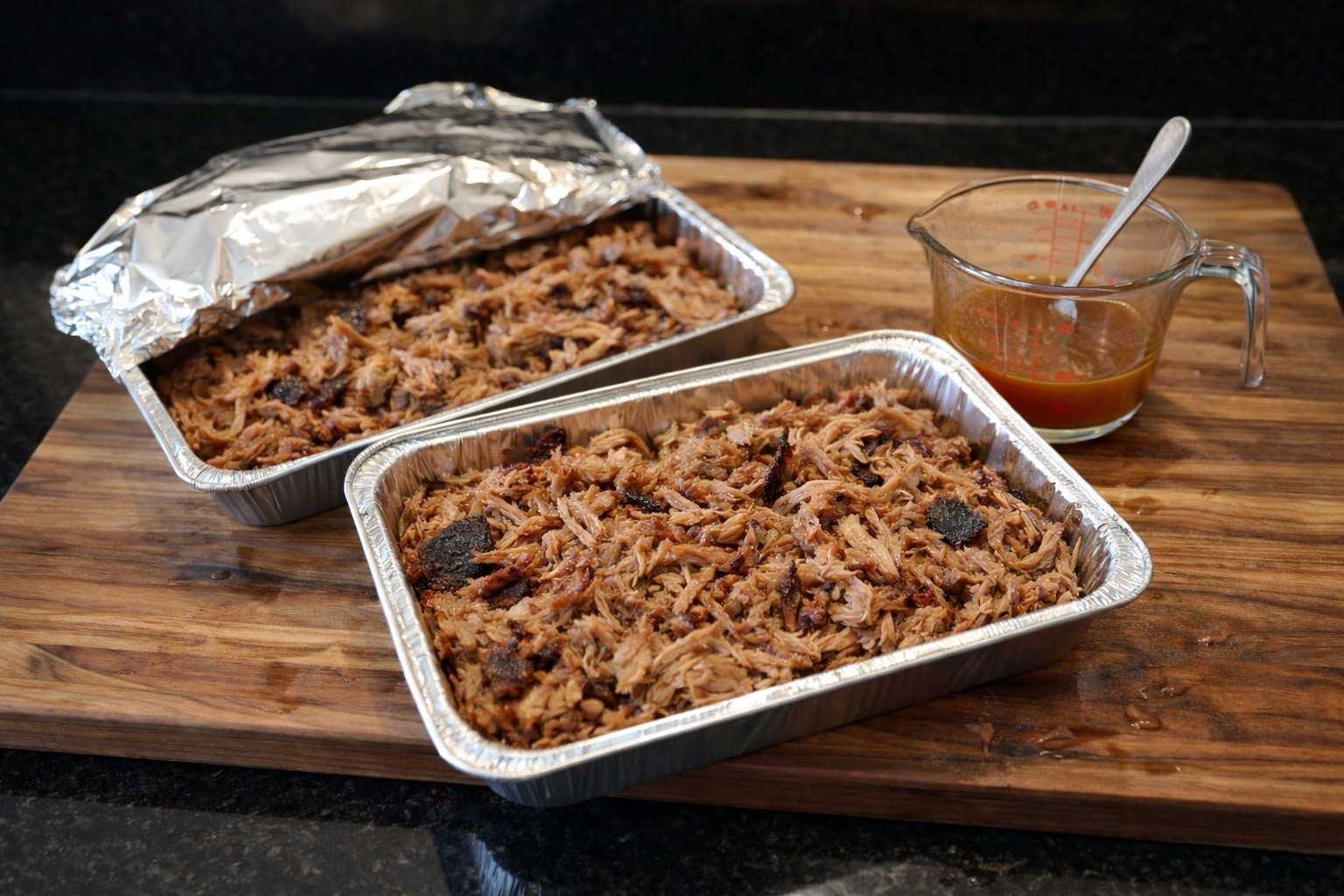
Once the pork is tender and rested enough to handle, pull it, save the juices, and spread it into shallow containers or shallow foil pans. That makes it easier to cool quickly, easier to portion, and much easier to reheat the next day.
It also reduces the number of jobs waiting for you when people are about to eat. That matters when you are trying to get food on the table.
Chill in large chunks if texture matters most
This can work well, especially if you are serving a smaller group and want to pull the pork closer to the meal. The upside is slightly better texture and a little more protection for the bark. The catch is that it asks more of you.
Large pieces cool more slowly. They also create more work the next day, because you still have to reheat them thoroughly and then pull or chop them before service. You can do it that way, but you have less room for error.
What about cooling it whole?
Some cooks cool a pork butt whole, especially when they plan to pull it closer to serving and want to protect texture as much as possible.
I get the appeal. The problem is that one big hot piece of meat cools more slowly than pulled pork spread into shallow pans or pork divided into a few large chunks.
That does not automatically mean it cannot be done. It does mean it is not the safer choice for most home cooks, and it gives you less margin for error on the cooling side.
Resting is still part of the process. That is not the issue. The issue is what happens after the rest, once you move from holding hot food to cooling it down. A whole cut is a big, dense mass that is tough to chill safely.
For most folks, I would not recommend cooling it whole. The safer version if texture is most important to you is to divide the pork into a few large pieces, get it chilled promptly, and reheat and pull it the next day. That still gives you some of the texture benefit without asking one giant hot piece of pork to do all the cooling work at once.
Day before vs. 2 to 4 days ahead vs. frozen
The day-before plan works best for most cooks who want to make pulled pork ahead of time. It keeps things simpler, keeps quality strong, and takes some pressure off the timing.
If you are trying to decide how far ahead to cook, here is how I’d think about it:
- The day before: best overall balance of quality, safety, and easier service
- 2 to 4 days ahead: still workable if you cool it well, store it tightly, and reheat it properly
- Longer than that: freeze it
Cooked pulled pork generally keeps 3 to 4 days in the refrigerator when stored properly. If you are planning farther ahead than that, freezing is the better move. For most folks, though, the sweet spot is cooking today and serving tomorrow.
If your bigger concern is whether to smoke pork butt the day before or try to finish it on serving day, that is a different question. For that, see the pork butt timing guide.
Which make-ahead option fits your situation?
If you are torn between the two methods, start with the problem you are trying to solve. Most of the time, that clears it up.
How to choose
- Serving a crowd and want the least stressful day? Pull the pork, save the juices, cool it in shallow pans, and reheat covered the next day.
- Care most about texture and do not mind extra work tomorrow? Chill it in a few large pieces, then reheat and pull closer to service.
- Need the most reliable way to cool it? Pull first and spread it into smaller, shallower portions.
- Need the fastest buffet setup? Pull first.
- Cooking more than a day ahead? Refrigerate for up to 3 to 4 days, or freeze if it will be longer.
- Need to hold it after reheating? Reheat it to 165°F first.
For holding after reheating, USDA guidance says to keep hot food at 140°F or warmer.
How to cool and store it safely
Food safety matters most here. Tomorrow is not the problem. Letting a big mass of hot pork sit too long tonight is. Big, dense pieces cool more slowly, so the larger the mass, the less forgiving the cooling gets. That is why I’d usually split the pork into shallow portions or a few large pieces instead of trying to cool one whole hot roast.
Follow these rules:
- Refrigerate promptly. According to USDA leftovers guidance, cooked food should be refrigerated within 2 hours, or within 1 hour if the temperature is above 90°F.
- Use shallow containers or shallow foil pans. Large batches cool faster and more safely when you divide them up instead of leaving them deep and packed tight.
- Do not count on a deep pan cooling quickly in the refrigerator. It often will not.
- Save the juices separately or with the pork. Those juices help a lot the next day.
- Store it tightly covered. You are trying to protect moisture, not let the surface dry out overnight.
- Keep refrigerated leftovers to 3 to 4 days. If your plan slips past that, freeze it instead.
If you are cooling a very large batch, it can help to borrow FDA’s stricter cooling benchmark: cool the pork from 135°F to 70°F within 2 hours, then to 41°F or below within 6 total hours. That is a foodservice-style standard, not a special home-kitchen rule, but it is a smart benchmark for deep pans and big party batches.
The CDC also recommends dividing warm food into smaller, shallow containers for faster cooling. That is one reason the pull-first method is usually the safer make-ahead choice.
How to reheat pulled pork for a party
Reheating is not the same job as holding. Reheating brings cold pork back up to serving temperature. Holding keeps already hot pork hot until people eat. Those are not the same thing.
The goal is simple: reheat the pork to 165°F, keep it covered so it does not dry out, and add saved juices back as needed.
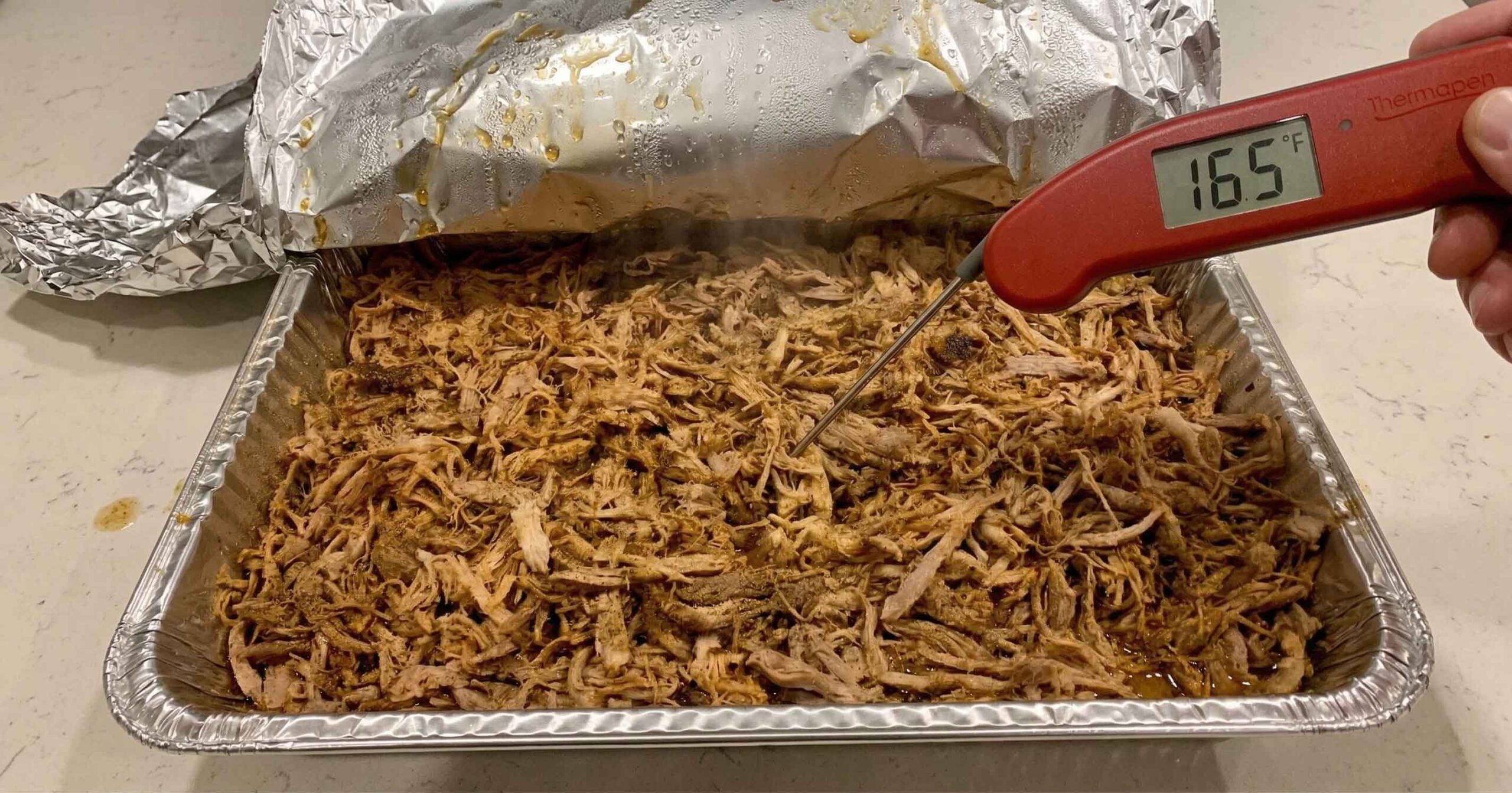
If you want a fuller method-by-method breakdown, see how to reheat pulled pork without drying it out.
Use the oven for big batches
For large batches, the oven is usually the most forgiving method.
Spread the pork in a foil pan or baking dish, add some reserved juices, cover tightly, and reheat until it reaches 165°F in the middle. Stir once or twice if needed so the heat and moisture move through the pan more evenly.
This is usually the easiest way to handle next-day pork for a party, church meal, or tailgate.
Use the stovetop for smaller batches
If you are reheating just a few pounds, the stovetop works well. Put the pork in a covered pot or deep skillet with some saved juices or a small splash of other liquid, warm it gently, and stir as needed until it reaches 165°F.
This is faster than the oven for small amounts, but it is not the method I would choose for a full crowd batch.
Use the smoker only if you want a little pit flavor back
You can reheat pork on the smoker if you want a little smoke refresh or you are already cooking outside anyway. Just do not turn it into a long dry hold.
Covered pans work well here too. The key is still the same: get the pork to 165°F, protect its moisture, and do not assume outside heat is doing you favors just because it smells good.
Use the slow cooker for holding, not for reheating from cold
This is where people often run into trouble. The USDA does not recommend reheating leftovers from cold in a slow cooker.
The safer way is this:
- Reheat the pork first in the oven, on the stovetop, or another direct reheating method
- Verify it has reached 165°F
- Then move it to a preheated slow cooker only if you need to hold it for service
That is a different job, and using the slow cooker only for holding is the safer approach. If you need help with the next step, see how to keep pulled pork warm for a party without drying it out.
How to keep reheated pulled pork moist
Dry reheated pork usually is not a make-ahead problem. It is a moisture problem.
Here is what helps most:
- Save the drippings and juices
- Reheat covered
- Add moisture back gradually, not all at once
- Stir or toss gently so dry edges get back in contact with the juices
- Do not cook it a second time while reheating
If the juices have a thick fat cap after chilling, you can remove some of that fat before mixing the liquid back in. You want moist pork, not greasy pork.
This is where pork butt has an advantage. It is rich in fat and connective tissue, and as Texas A&M Meat Science explains, collagen converts to gelatin in the higher finishing range. That is one reason pulled pork can reheat well when you handle it right.
If you are still deciding which roast to buy, see the best cut for pulled pork.
When to add sauce and when to leave it plain
Sauce is usually better late.
If you sauce all the pork before storing it, you give up flexibility the next day and you can soften the texture even more. That is especially true if you are serving a crowd with mixed tastes.
A better plan is to store and reheat the pork mostly plain, using the saved juices to keep it moist. Then sauce it lightly before service or let people sauce their own.
That works especially well if some people want sandwiches and others want a plate. It also gives you room to adjust the flavor once the pork is hot and loosened back up.
For bun counts and serving ranges, see sandwiches per pound of pulled pork.
Bark and texture will change overnight
Here is the simple truth. In our own cooks, bark softens overnight, especially once the pork is pulled, mixed, covered, chilled, and reheated.
That does not mean next-day pulled pork is bad. It still eats very well. It just means you should not expect the exact same bark you had when the meat first came off the pit.
If bark is the thing you care about most, chill the pork in large chunks and pull it closer to service. If an easier, less stressful serving day matters more, pull it first and accept the tradeoff. For most people making it ahead, that is worth it. Foil, butcher paper, and no wrap all behave differently, so this pork butt wrapping guide can help if you are still deciding how to handle the cook.
Cook today, serve tomorrow
Once you decide to make it ahead, how you handle it matters more than anything else. This is the simplest version I’d hand to most people.
Cook today, serve tomorrow
- Cook the pork until it is tender enough to pull cleanly.
- Rest it long enough to handle without fighting it.
- Decide whether you are pulling now or chilling in a few large pieces.
- Save the drippings and juices.
- If pulling now, spread the pork into shallow pans or containers. If not, divide it into a few large pieces rather than one giant hot mass.
- Refrigerate within 2 hours, or within 1 hour if the weather is above 90°F.
- The next day, reheat covered to 165°F.
- Mix juices back in as needed and toss gently.
- Add sauce late, if using.
- If service is delayed, hold the pork hot at 140°F or above.
That is usually the simplest way to stay ahead without making tomorrow harder.
If you like to work backwards from serving time, or you are still deciding how many butts to cook, the pulled pork calculator is the right next stop. And If you are trying to figure out how much finished pulled pork you will get, see our pork butt yield guide.
Pulled pork make-ahead FAQs
A few common questions come up once you decide to make it ahead:
Usually no, not as your main way of doing it. A whole pork butt is a big, dense hot piece of meat, and it cools more slowly than pork divided into smaller portions or shallow pans. If texture matters most to you, chill it in a few large chunks instead, then reheat and pull it the next day.
Save the juices, chill them, skim excess fat if needed, and add them back gradually during reheating or just before serving. That lets you control how moist and rich you want the pork. If you keep the juices with the pork from the start, use shallow portions so the batch still cools quickly and evenly.
Usually no. Store and reheat the pork mostly plain, then sauce lightly before serving or let people sauce their own. Keeping sauce separate holds texture better over time and gives you more flexibility for a mixed crowd. If you know the whole batch will be served one way, a light finishing sauce can work, but it is not the best way to handle most batches.
Bottom line: yes, you can make pulled pork the day before. For a lot of cooks, you probably should. Pulling first is usually the safer, easier plan. Chilling the pork in larger pieces can protect texture a bit better, but it is less forgiving on the cooling side and takes more work the next day.
Corrections and editorial standards
- Spotted something wrong or outdated? Send a correction here: Corrections & Updates
- How we handle sources, testing, and updates: Editorial Standards
- Media or general notes: Email the publisher
Sources
- USDA FSIS: Leftovers and Food Safety — for refrigerating cooked food within 2 hours, or within 1 hour above 90°F, for the usual 3 to 4 day refrigerator window, for reheating leftovers safely, and for keeping hot food at 140°F or warmer after reheating
- USDA FSIS: Slow Cookers and Food Safety — for not reheating cold leftovers in a slow cooker and for using a slow cooker as a holding setup only after proper reheating
- FDA Food Code cooling guidance — for the stricter 135°F to 70°F to 41°F cooling benchmark used here as a safety backstop for large batches and deep pans
- Texas A&M Meat Science: Barbecue Science — for the collagen-to-gelatin explanation that helps explain why pulled pork can still reheat well when handled properly
- CDC: Food Safety Prevention Basics — for guidance on dividing warm food into smaller, shallow containers for faster cooling
- USDA FSIS: Kitchen Companion — for food-safety handling benchmarks including hot holding and temperature guidance that support make-ahead serving workflows
We use authoritative sources here and note when guidance is based on first-hand cooking experience. Safety guidance on this page is reviewed against USDA FSIS and FDA guidance when the page is updated.
About the author
James Roller documents South Carolina barbecue for Destination BBQ and authored the SC BBQ cookbook Going Whole Hog. He and his wife, Heather, have cooked pork for family meals and gatherings where the hard part was not just getting it done, but cooling it safely, reheating it well, and getting it on the table without stress. This page combines published food-safety guidance with practical lessons from real cooks at home.