How Long to Smoke Pork Butt at 225, 250, 275, and 300
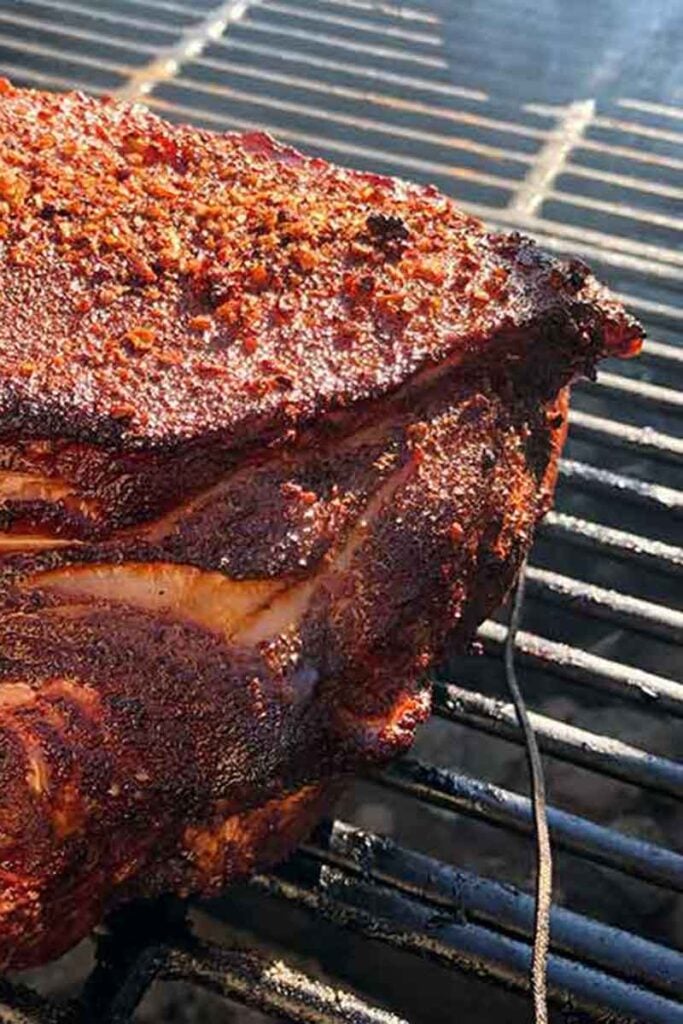
Compare pork butt timing ranges at 225, 250, 275, and 300°F so you can plan around the stall and give yourself enough time to finish
Quick Answer
- 225°F: often about 12 to 18+ hours for an 8 lb butt, and about 12 to 20+ hours for a 10 lb butt
- 250°F: often about 9 to 14 hours for an 8 lb butt, and about 12 to 16 hours for a 10 lb butt
- 275°F: often about 7 to 10 hours for an 8 lb butt, and about 9 to 12 hours for a 10 lb butt
- 300°F: when run hot and fast, often with wrapping or panning once bark is set, about 5 to 8 hours for an 8 lb butt, and about 7 to 10 hours for a 10 lb butt
- Important: these are planning windows, not guarantees. Pork butt is done when it is tender, not when the timer says it should be.
These ranges are for a bone-in Boston butt cooked to pull-apart tenderness. Rest and hot hold time are separate.
Pork butt timing gets talked about like it is a simple hours-per-pound formula, but that is only part of the story. Pit temperature matters. Wrapping matters. The stall matters. And if you are cooking more than one butt, the biggest piece matters more than the total pounds on your smoker.
The faster 300°F timings generally assume a hot-and-fast approach, often with wrapping or panning once the bark is set. A wrapped or panned 300°F cook does not behave like an unwrapped 225°F cook, and treating them the same can make you late fast.
Start with the chart below for rough smoke-time planning by weight and pit temperature. If you want a backward cook plan built around your serve time, wrap method, buffer, and piece size, use the pulled pork calculator.
Pork butt time chart at 225, 250, 275, and 300
Most readers just want to know how long the cook is likely to take and which temperature best fits their timeline. Start here for rough timing at 225, 250, 275, and 300°F.
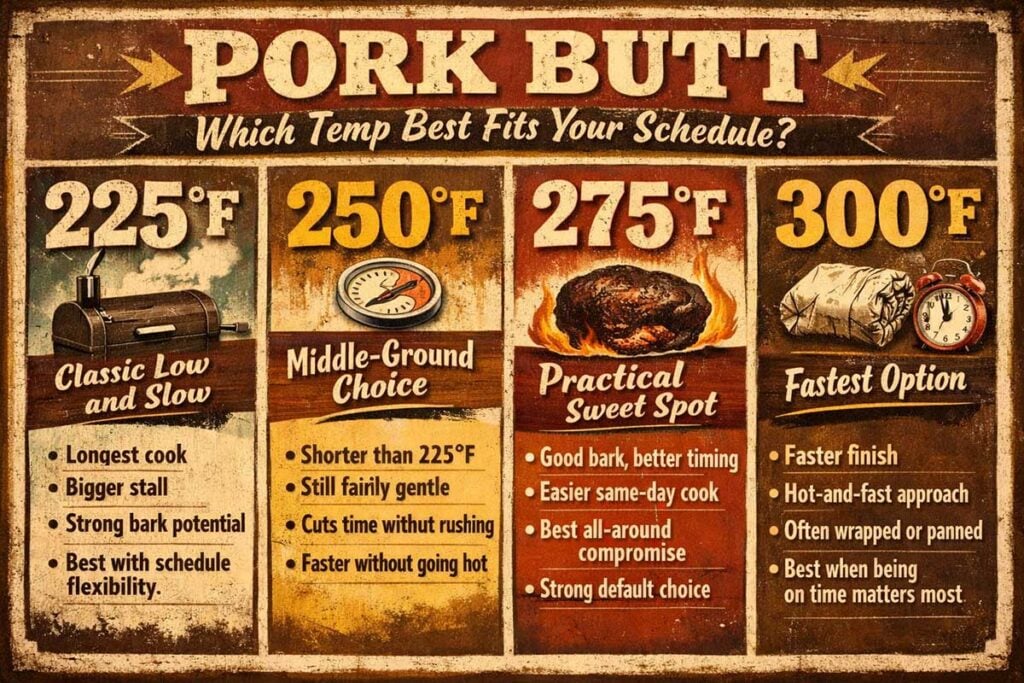
| Temp | Rough shortcut | Likely range for 8 lb | Likely range for 10 lb | Stall and bark | Best for |
|---|---|---|---|---|---|
| 225°F | Often around 2 hr/lb as a rough planning guide, but wide variation is common | About 12 to 18+ hr | About 12 to 20+ hr | Longest stall risk and strongest bark potential, especially unwrapped | Maximum bark, flexible schedule, overnight cooks, cooks who can finish early and hold |
| 250°F | Often somewhere around 90 min/lb as a rough guide, though real-world results vary | About 9 to 14 hr | About 12 to 16 hr | Still has stall risk, but usually less punishing than 225°F | A good middle-ground option when 225°F feels too slow |
| 275°F | Often around 1 hr/lb as a planning shortcut | About 7 to 10 hr | About 9 to 12 hr | Stall still happens, but it tends to be shorter; bark forms faster | The best compromise for many backyard cooks who want good bark and a same-day finish |
| 300°F | Usually best treated as a hot-and-fast range. Faster results often assume wrapping or panning once the bark is set. | About 5 to 8 hr | About 7 to 10 hr | Shortest stall impact, but bark can soften if you wrap too early | Cooks who want to shorten the schedule, are managing the cook closely, or need a faster finish |
If you remember one thing from that table, let it be this: for many backyard cooks, 275°F is the practical sweet spot, while 300°F is often more of a deadline tool. That alone can save you from a late dinner.
Important: An 8-pound and 10-pound pork butt do not always cook in neat proportion to their label weight. The thickness and shape of the biggest piece usually matter more to your timeline than the package weight alone.
Why pork butt times vary so much
This is where a lot of online advice goes wrong. Two cooks can both say they smoked a pork butt or pork shoulder at 225°F and still be talking about very different situations. One thing I’ve learned is that pork butt rarely cooks on a neat hours-per-pound schedule.
Here are the biggest reasons the clock moves around:
- The cut matters. This article is centered on a bone-in Boston butt. Some people say “pork shoulder” when they really mean Boston butt, and others mean the whole shoulder or the picnic portion. Those do not always cook the same.
- Thickness matters more than total pounds. A thick 10-pound butt and two smaller butts totaling 10 pounds are not the same problem.
- Bone-in vs boneless can matter too. The bone can change how heat moves through the roast, while a boneless butt is often tied or netted into a different shape, so the two do not always cook exactly the same.
- The stall matters. That is the long plateau that can make your cook feel stuck.
- Wrap choice matters. Foil, butcher paper, and no wrap create different timelines.
- Cooker conditions matter. Airflow, humidity, weather, and how steady your smoker runs can all change the feel of the cook.
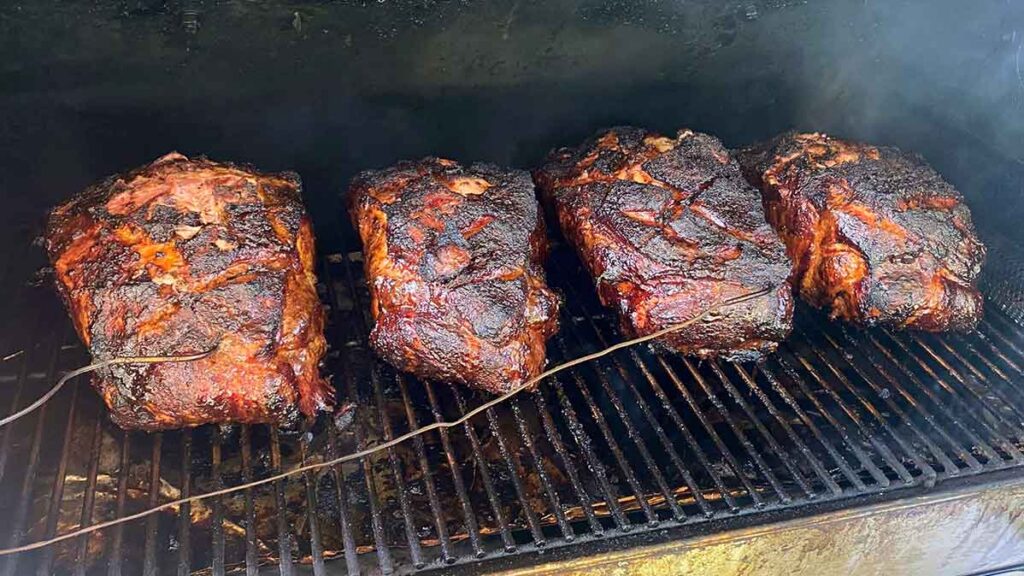
For most cooks, that means starting earlier than the chart suggests and giving yourself room to hold the pork if it finishes ahead of schedule. If it does finish early, here’s how to keep pulled pork warm without drying it out. If you are serving the next day instead, see how to make pulled pork ahead.
Boston butt vs pork shoulder
People often use pork butt and pork shoulder like they mean the exact same thing, but that is not always true. A University of Minnesota meat literacy guide explains that the pork shoulder is divided into the upper shoulder, or Boston butt, and the lower shoulder, or picnic. So when someone says “pork shoulder,” they may not be talking about the exact same cut you are cooking.
That matters because shape, thickness, fat, and bone structure can affect how the cook feels, so timing ranges make the most sense when you know which cut you actually have.
Wondering which roast to choose? Learn which is the best cut for pulled pork.
The pork butt stall and how it affects cook time
The barbecue stall is the biggest reason a pork butt can seem “late” even when you thought you had plenty of time. In plain English, moisture evaporating from the surface cools the meat and slows or even stalls the rise in internal temperature.
For pork butt, the stall often shows up somewhere around 150 to 170°F internal, and on a big cut it can last for hours. That does not mean your smoker has failed. It means you have reached the part of the cook where patience, heat, and wrap choice start to matter more than your original guess.
A few practical truths help here:
- At 225°F, the stall can be long and frustrating.
- At 250°F, it is still very real, just a little less punishing.
- At 275°F, it tends to be easier to live with.
- At 300°F, especially when the cook is wrapped or panned after the bark sets, it may feel much less dramatic.
This is also why cooks who swear by a single hours-per-pound rule are often talking past one another. If one cook rode a full stall unwrapped and another wrapped at bark set, their timelines were never going to match. For a deeper look at what causes the stall and when to wait, wrap, or raise the pit, see our pork butt stall guide.
Wrapping changes the clock and the bark
Wrapping is your main schedule-control move after pit temperature. If you are new to the term, our BBQ glossary can help, but this is the basic idea behind the Texas Crutch.
Once the bark is set and color looks right, many cooks wrap around 155 to 165°F internal to reduce evaporative cooling and push through the stall faster. That usually helps, but it comes with tradeoffs.
 Foil wrapped
 Wrapped in butcher paper
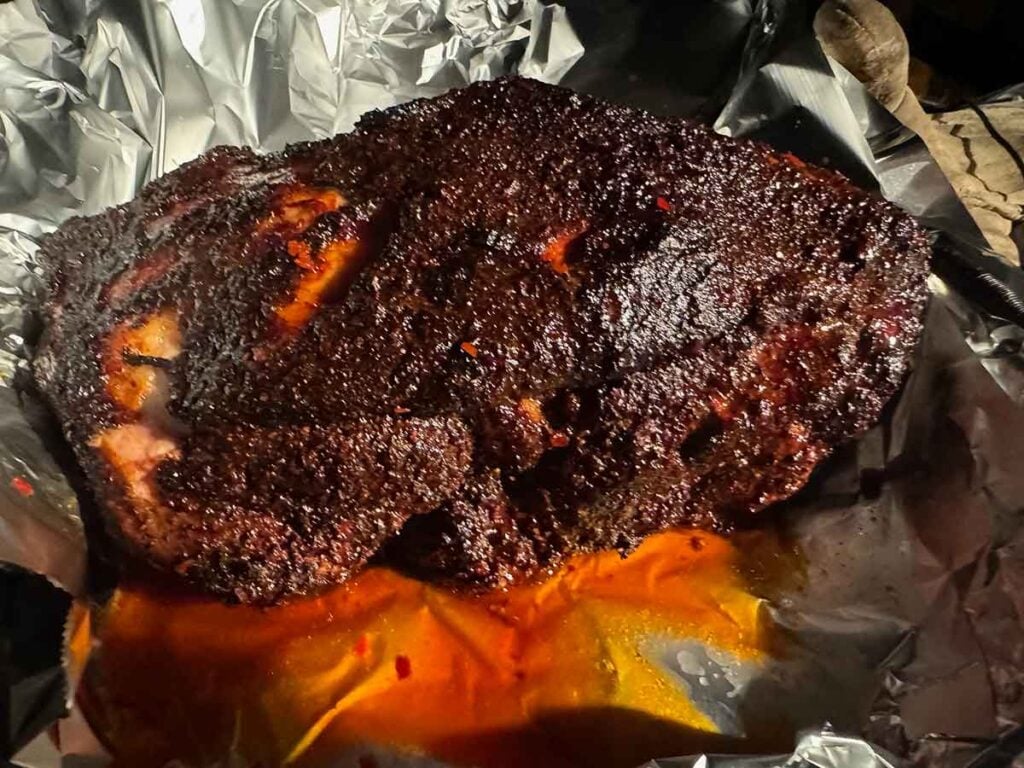
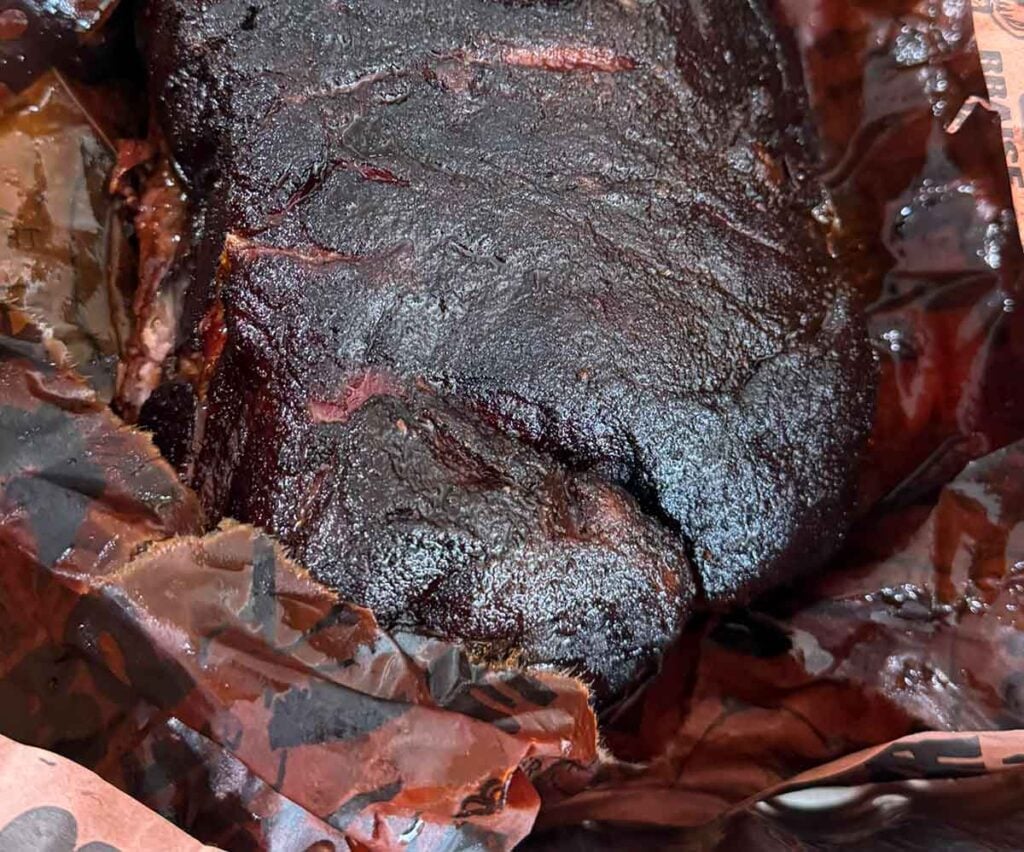
Foil
Foil is often the fastest route through the stall. It traps the most moisture, shortens the middle of the cook the most, and is often the best choice when you are staring at a hard serving deadline.
The tradeoff is bark. Foil can soften it, especially if you wrap early or leave it wrapped too long.
Butcher paper
Butcher paper is the middle ground. It often speeds the cook compared with no wrap, while usually preserving bark better than foil.
If you want help with the stall but still care a lot about bark texture, paper is often the better compromise.
No wrap
No wrap gives you the longest timeline and the strongest bark potential. It also leaves you most exposed to the stall.
If dinner needs to be on the table at a certain hour, no wrap is the riskiest option unless you are giving yourself a generous finish-early buffer.
Smoke choice will not move the clock as much as pit temperature or wrapping your pork butt, but if you are still choosing fuel, our wood selecting tool can help.
Biggest piece controls the schedule
Your cook ends when the thickest part of the biggest butt is tender.
That means if you are cooking multiple butts:
- the biggest or thickest piece sets the finish line
- total batch weight does not set the finish line
- extra butts create more smoker crowding and logistics, but not a simple “double the time” situation
So if you have one 10-pound butt and one 7-pound butt on the smoker, plan around the 10-pound butt. The smaller one may finish earlier. The bigger one is the one that can make you late. Once you start thinking that way, crowd cooks get a lot easier to manage.
Common pork butt timing ranges by weight
If you already know roughly how big your pork butt is, this table gives you a better planning window across common smoker temperatures. Use it as a starting point. Thickness, wrap choice, stall length, weather, and pit stability can all move the clock.
| Butt size | 225°F | 250°F | 275°F | 300°F |
|---|---|---|---|---|
| 6 lb | About 9 to 14 hr | About 7 to 11 hr | About 6 to 9 hr | About 4 to 6 hr |
| 7 lb | About 10 to 16 hr | About 8 to 12 hr | About 6 to 9 hr | About 5 to 7 hr |
| 8 lb | About 12 to 18+ hr | About 9 to 14 hr | About 7 to 10 hr | About 5 to 8 hr |
| 9 lb | About 12 to 19+ hr | About 10 to 15 hr | About 8 to 11 hr | About 6 to 9 hr |
| 10 lb | About 12 to 20+ hr | About 12 to 16 hr | About 9 to 12 hr | About 7 to 10 hr |
| 11 lb | About 13 to 21+ hr | About 12 to 17 hr | About 10 to 13 hr | About 8 to 11 hr |
| 12 lb | About 14 to 22+ hr | About 13 to 18 hr | About 10 to 14 hr | About 8 to 11 hr |
Notice how the ranges widen as the cut gets bigger and the temperature drops. That widening spread is one reason bigger pork butt cooks deserve more cushion on the front end.
How long does a 10-pound pork butt take to smoke?
At 225°F, a 10-pound pork butt often takes about 12 to 20 hours or longer. At 250°F, plan on roughly 12 to 16 hours; at 275°F, about 9 to 12 hours; and at 300°F, about 7 to 10 hours when using a hot-and-fast approach that often includes wrapping or panning after the bark sets.
Those ranges cover smoker time only. A thick 10-pound butt can spend hours in the stall, especially at 225°F, so add rest or hot-hold time separately and build in enough cushion to finish early on purpose.
How to choose 225, 250, 275, or 300
All four can work. The right one depends on your deadline, the bark you want, and how much wiggle room you have.
Choose 225°F if bark and tradition matter more than speed
This is the classic low-and-slow lane. It can produce excellent bark and a deep smoked feel, but it gives the stall more room to drag the day out. Choose 225°F when you have real schedule flexibility and are comfortable finishing well early and holding. If you want a real-world 225°F example, see this Pawleys Island pulled pork recipe.
Choose 250°F if you want to shorten the cook without going hot and fast
250°F is still a fairly gentle cook, but it usually shortens the day compared with 225°F. It makes sense as a middle-ground option if you want some extra speed without jumping to a hotter, more aggressive cook. If your pit naturally settles in around 250°F, I’d go with that rather than trying to force 275°F. A steadier cook usually matters more than hitting one exact number. Even so, pork butt at 250°F can still vary quite a bit from one cook to the next.
Choose 275°F if you want the best all-around compromise
For many backyard cooks, this is the practical sweet spot. It is still slow enough to make good pulled pork, fast enough to avoid an all-nighter, and common enough that a lot of experienced cooks build their method around it.
If someone asked me for one default temperature that balances quality and scheduling, 275°F would be very hard to beat. It’s my preferred target temperature for pork butt. ThermoWorks treats roughly 225 to 275°F as the core low-and-slow range for pork butt and notes that cooks can still get excellent results at 275°F while avoiding some of the longest 225°F timelines.
Choose 300°F if being on time is the top priority
Yes, you can smoke a pork butt at 300°F. In fact, it can be a smart move when you have a hard deadline or want to shorten the schedule. Just do not treat it like the same cook as an unwrapped 225°F butt.
Most of the faster 300°F timelines assume a hot-and-fast method, usually with wrapping or panning after the bark sets. It can save you a lot of time and still turn out good pulled pork.
Plan backward from serve time, not forward from wishful thinking
A lot of late cooks start with the same mistake: somebody picks a temperature, multiplies pounds by a rough rule, and assumes dinner will happen right on cue. Pork butt does not always reward that kind of optimism.
A better approach looks like this:
- Pick your serving time
- Choose your pit temperature
- Decide whether you are wrapping
- Estimate a realistic window based on your biggest piece
- Add rest and hot hold time
- Plan to finish early on purpose
That last step is the difference between a calm day and a stressful one. A pork butt that finishes early can be held safely. A pork butt that is still fighting the stall when guests are waiting cannot be rushed into tenderness. Once it’s done, this sandwich yield guide helps you turn cooked pork into realistic sandwich counts.
If you want a backward plan that includes your serve time, wrap method, buffer, and piece size, build a useful timeline with this pulled pork calculator. That is where the planning gets more specific. If you also need to know how much finished meat that roast will actually give you, see our pork butt yield guide.
What internal temperature is pork butt done?
At this point, stop worrying so much about the numbers or the time. Cook it until it feels tender.
For safety, pork roasts are safe at a much lower temperature than pulled pork is usually cooked. But that is not the same thing as pull-apart pork. According to FoodSafety.gov, pork roasts are safe at 145°F with a 3-minute rest, which is much lower than the range most cooks target for pulled pork. Texas A&M notes that pork butts are loaded with collagen, and that collagen converts to gelatin in a higher internal range, around 185 to 195°F. That helps explain why pork can be safe well before it is tender enough to pull.
For pulled pork texture, most cooks are aiming more for the 195 to 205°F range, because the connective tissue needs time to soften and render. ThermoWorks also notes that pork butt is commonly cooked to about 203°F so the collagen has melted enough for the meat to shred easily. That is why pork can be safe to eat before it is ready to pull.
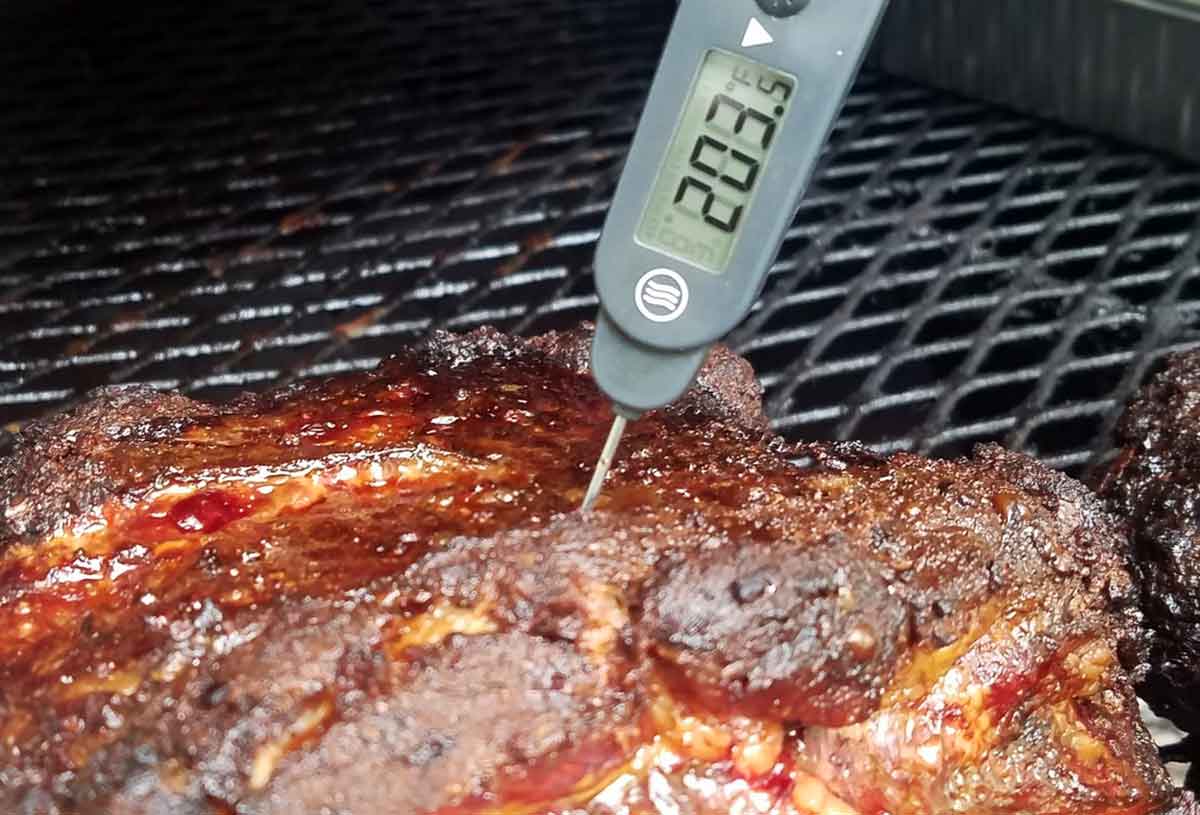
Even so, that range is a guide, not a hard rule. Tenderness is the real finish test.
A few useful finish cues:
- the probe slides in with very little resistance
- the bone, if present, loosens easily
- the meat feels soft and ready to pull, not tight and springy
So do not pull a butt just because the math said it should be done by now. Let tenderness make the call.
How to rest and hold smoked pork butt safely
Holding is not an afterthought. It is part of the plan. Hot holding guidance is clear: FoodSafety.gov says hot food should be held at 140°F or above if you are not serving it right away. That is why finishing early is usually the smarter play.
You have a few common holding options:
- a preheated cooler hold
- a warm oven that can truly stay in the safe zone
- another warming setup that you verify with a thermometer
The key word there is verify. Coolers, ovens, and weather conditions vary, so check that the meat is actually staying hot enough.
If you are holding for service, the goal is simple: buy yourself schedule insurance without drifting into unsafe temperatures. And if you have leftovers, cool and refrigerate them promptly instead of letting a big pan of pulled pork sit out. USDA advises dividing large roasts or leftovers into smaller portions or shallow containers so they cool more quickly.
If some of that pork is headed to the fridge, here’s how to reheat pulled pork without drying it out.
Pork butt FAQs
At 225°F, an 8-pound pork butt often takes about 12 to 18 hours or longer, while a 10-pound butt may take about 12 to 20 hours or longer. The stall can consume several hours at this temperature, so treat those as planning windows, start early, and cook until the butt is tender rather than relying on the clock alone.
At 275°F, a pork butt often runs around 1 hour per pound as a rough estimate, but the real range is wider than that. For an 8-pound butt, think more like 7 to 10 hours in many backyard setups, with stall behavior, wrapping, weather, and pit stability all affecting the clock.
Yes, 300°F can work well, especially when you are cooking hot and fast and managing the bark closely. It is usually best for cooks with a deadline, and it often works better when you wrap or pan the butt after the bark has set.
Sometimes, but not enough to treat it as a simple rule. Overall thickness, shape, and the size of the biggest piece matter more than whether the blade bone is present. That is why planning around piece size is more useful than guessing by total pounds alone.
Most cooks wrap once the bark looks right and the internal temperature is somewhere around the mid-150s to mid-160s. Wrapping earlier can soften the bark too much, while waiting longer keeps the bark firmer but usually lengthens the cook.
You can hold smoked pork butt for service as long as you keep it at 140°F or above, per FoodSafety.gov. The key is to verify that it is actually staying hot enough, not just assume your cooler or oven is doing the job. Refrigerate leftovers within 2 hours, or within 1 hour if temperatures are above 90°F.
Corrections and editorial standards
- Spotted something wrong or outdated? Send a correction here: Corrections & Updates
- How we handle sources, testing, and updates: Editorial Standards
- Media or general notes: Email the publisher
Restaurant owners and authorized reps should use the listing update form: Restaurant Listing Update.
Sources
- FoodSafety.gov: Safe minimum internal temperatures – supports the 145°F with 3-minute rest safety baseline for pork roasts
- FoodSafety.gov: 4 steps to food safety – supports hot holding at 140°F or above and leftover timing guidance
- USDA FSIS: Leftovers and food safety – supports dividing large roasts or leftovers into smaller portions or shallow containers for faster cooling
- Texas A&M Meat Science: Barbecue science – supports the collagen-to-gelatin explanation and why pork butt becomes tender in a higher internal range
- University of Minnesota Extension: Meat literacy – explains the shoulder breakdown into Boston butt and picnic
- ThermoWorks: How to Cook BBQ Pork Butt: A Guide – supports 225°F to 275°F as the core low-and-slow range and reinforces 275°F as a practical temperature for many cooks
- ThermoWorks: BBQ 101 – An Introduction to Smoked Meat Part 2 – supports cooking pork butt to about 203°F for collagen breakdown and shreddable texture
We cite authoritative references and note when timing guidance is based on published sources plus James Roller’s barbecue reporting and cook experience.
About the author
James Roller documents South Carolina barbecue for Destination BBQ and is the author of the SC BBQ cookbook Going Whole Hog. He has spent years reporting on pitmasters, pork butt cooks, and the cook-planning details that matter to backyard cooks. In this guide, he draws on published meat science, food-safety guidance, barbecue sources, and his own reporting to help readers compare smoking times and plan a pork butt cook with more confidence.

This is a helpful guide for anyone looking to master the art of smoking pork butt to tender, flavorful perfection. I love how understanding the right cooking time and temperature can make a big difference in achieving delicious barbecue results. A fantastic resource for BBQ enthusiasts looking for practical smoking tips and mouthwatering pulled pork ideas!