Pork Butt Stall Explained
Understand what causes the pork butt stall, how long it can last, and when to wait, wrap, or raise the pit temperature
If you have ever watched a pork butt climb steadily and then seem to hit a wall in the 150s or 160s, you have met the stall. It is one of the most common reasons backyard cooks start second-guessing the thermometer, the smoker, and sometimes themselves.
The good news is that the stall is normal. It can be frustrating, and it can absolutely throw off dinner plans, but it is not a sign that something is wrong. Once you understand what is happening, you can decide what to do next instead of overreacting every time the thermometer stops moving.
Quick answer
- The stall is normal. A pork butt can stop climbing, inch upward, or even drop a few degrees during the cook.
- Evaporative cooling is the main reason. Moisture reaching the surface cools the meat almost as fast as the smoker is heating it.
- 150°F to 170°F is common. The stall often shows up in that range, but it can start earlier or later.
- Plan for hours, not minutes. Some stalls are shorter, but a stubborn pork butt can remain in the stall for three hours or longer.
- Bark and timing decide your next move. If bark matters most and you have time, wait it out. If dinner is getting close, wrap or bump the pit temp.
- Safe pork is not pull-apart pork. Whole cuts are safe at 145°F with a 3-minute rest, but pulled pork usually needs a much higher finish temperature for shreddable texture.
What the pork butt stall is
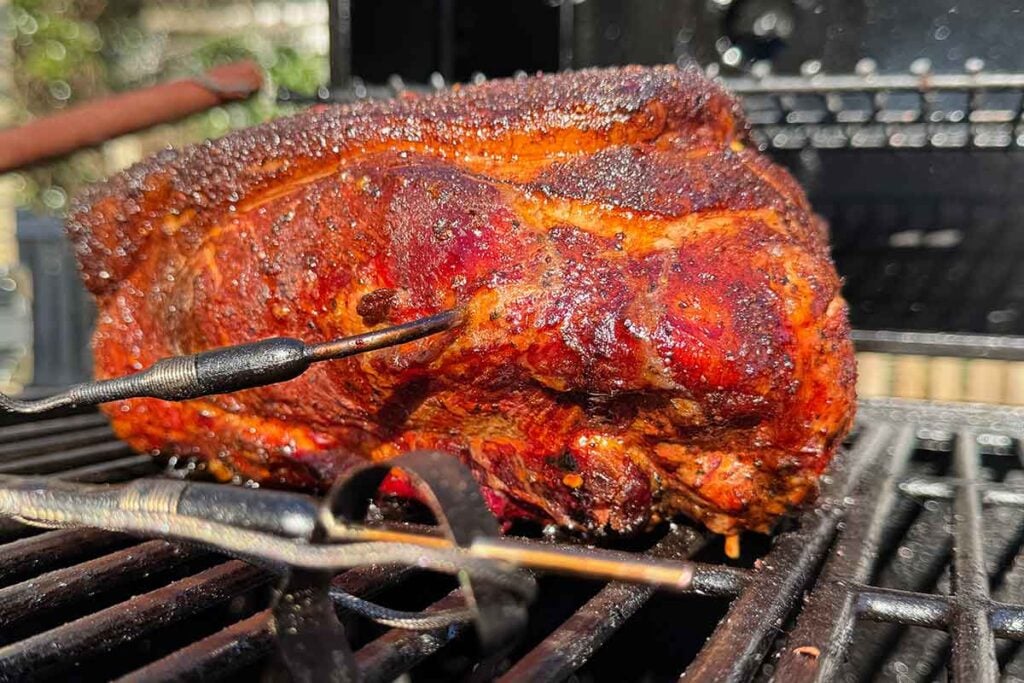
The stall is the part of a low-and-slow cook where the meat stops gaining temperature the way you expected. Instead of rising steadily, the internal temperature may sit in place for a long stretch, creep up painfully slowly, or drop a few degrees before moving again.
That is why the stall feels so maddening. You are doing the same things you were doing before, but the thermometer no longer rewards your patience in a nice straight line.
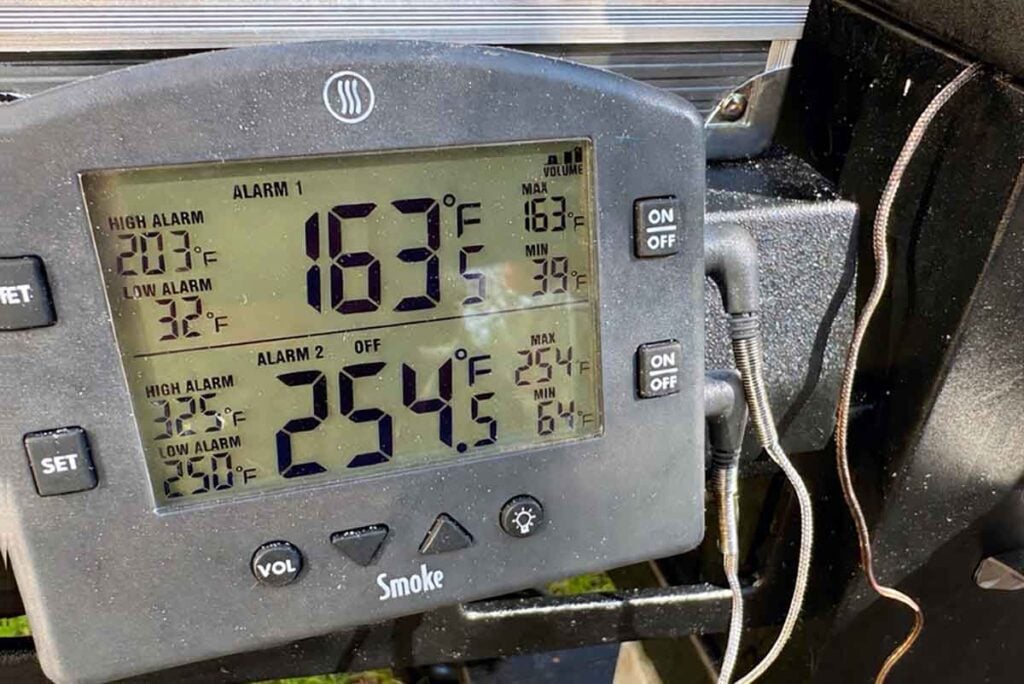
On a real cook, normal stall behavior can look like this:
- 158°F for what feels like forever
- 161°F, then 160°F, then back to 161°F
- a long slow crawl through the mid-160s
- one butt moving while another beside it barely changes
All of that can still happen. The stall is not always dramatic, and it does not look exactly the same from one cook to the next.
Why pork butt stalls
Here’s the simple version: as the pork heats up, moisture moves toward the surface. When that moisture evaporates, it cools the meat. In other words, the smoker is adding heat while evaporation is pulling heat away.
That evaporative cooling effect is the main reason the stall happens. Texas A&M Meat Science points to evaporative cooling as the reason the temperature stops climbing, and that matches what cooks see when a pork butt suddenly parks itself in the 150s or 160s.
Collagen and fat are part of the cook, but they are not the main reason the stall happens. Collagen is breaking down, and fat is rendering too. Those things matter for texture and help explain why pulled pork gets tender later in the cook. They just do not explain why the temperature stops climbing nearly as well as evaporative cooling does.
If you want the short version, think of the stall this way: your cooker is heating the pork, but surface moisture is cooling it at nearly the same rate.
What temperature does pork butt stall?
The stall commonly shows up somewhere around 150°F to 170°F internal, but that is a range to watch for, not a promise. Some cooks notice it earlier. Some swear it starts later. The important thing is not whether the stall starts at exactly 155°F or 165°F. It is noticing when the temperature stops climbing the way it had been.
How long does the pork butt stall last?
Plan for the pork butt stall to last several hours, not a few minutes. Some butts move through it sooner, while a stubborn stall can last three hours or longer. Pit temperature, airflow, humidity, surface moisture, wrapping, and the size and shape of the roast can all change the duration.
A few things can make the stall feel longer or shorter from one cook to the next:
- pit temperature
- airflow inside the cooker
- humidity
- cold, wind, or other weather
- how wet the surface of the meat is
- whether you are spritzing
- whether you wrap
- the size and shape of the individual butt
That last point matters more than many people expect. Two butts with the same label weight can still move at different speeds because they are shaped differently. The thickest part of the biggest piece often drives the cook more than the sticker on the package.
Cooker style matters too. Higher-airflow cookers can make the stall feel a little different than tighter, more humid cookers. That does not mean one setup is right and another is wrong. It just means the same stall can show up a little differently depending on the setup.
A long stall is usually more of a timing problem, not a food-safety problem, as long as the cooker is running where it should. The pork still needs to reach a safe internal temperature, but pulled pork is not done until it is tender enough to pull.
Cook note
In one of our recent cooks, an 8-pound butt spent more than 3 hours in the stall before it finally started climbing steadily again. Nothing was wrong with the pork, the probe, or the cooker. It was just a reminder to build extra time into the cook, especially when dinner needs to be on the table at a specific time. That is why it usually pays to finish early rather than late.
The stall is only one piece of the timing puzzle. For the bigger picture, how long to smoke pork butt covers pit temperature and overall cook time. If dinner has to happen at a set time, the pulled pork calculator can help you work backward.
Can you avoid the stall?
Not completely. On a low-and-slow pork butt, some slowdown is a natural part of the cook. You usually cannot count on a big pork shoulder to climb in one smooth line from start to finish.
What you can do is make the stall matter less by planning extra time, opening the cooker less, and deciding ahead of time whether bark or schedule matters more on this cook.
What to do when the stall hits
You really have four choices when the stall shows up:
- Wait it out
- Wrap in foil
- Wrap in butcher paper
- Raise the pit temperature
None of those choices is automatically wrong. The right move depends on what you are trying to protect: bark, moisture, or dinner timing.
If you have plenty of time, the simplest answer is often to leave it alone and let the cook work. If dinner is getting close, you can wrap, bump the pit temp, or do both. None of that is cheating. It is just choosing the tradeoff you prefer.
Use the table below as a tradeoff guide, not a rulebook. The same choice can be right or wrong depending on your bark, your clock, and how the pork is actually cooking.
| Method | Bark | Moisture | Timing help | Best when | Tradeoff |
|---|---|---|---|---|---|
| Wait it out | Best chance at firm, fully developed bark | More moisture can keep leaving the surface | None. This is the slowest choice | You have time and bark matters most | Dinner may be later than planned |
| Wrap in foil | Softens bark the most | Holds in the most moisture | Most help. Usually the surest push through the stall | Dinner is getting close and you need control | The outside can get softer and more braised |
| Wrap in butcher paper | Keeps bark better than foil, but not as firm as no wrap | Protects the pork some, but not as much as foil | Some help. Faster than no wrap, slower than foil | You want timing help without giving up as much bark | It will not push through the stall as quickly as foil |
| Raise pit temp | Can darken and firm the bark faster | Depends on whether you also wrap | Some help, especially if you are already behind | The bark is set and you need the cook to move | The outside can darken or dry before the inside is ready |
Should you wrap pork butt during the stall?
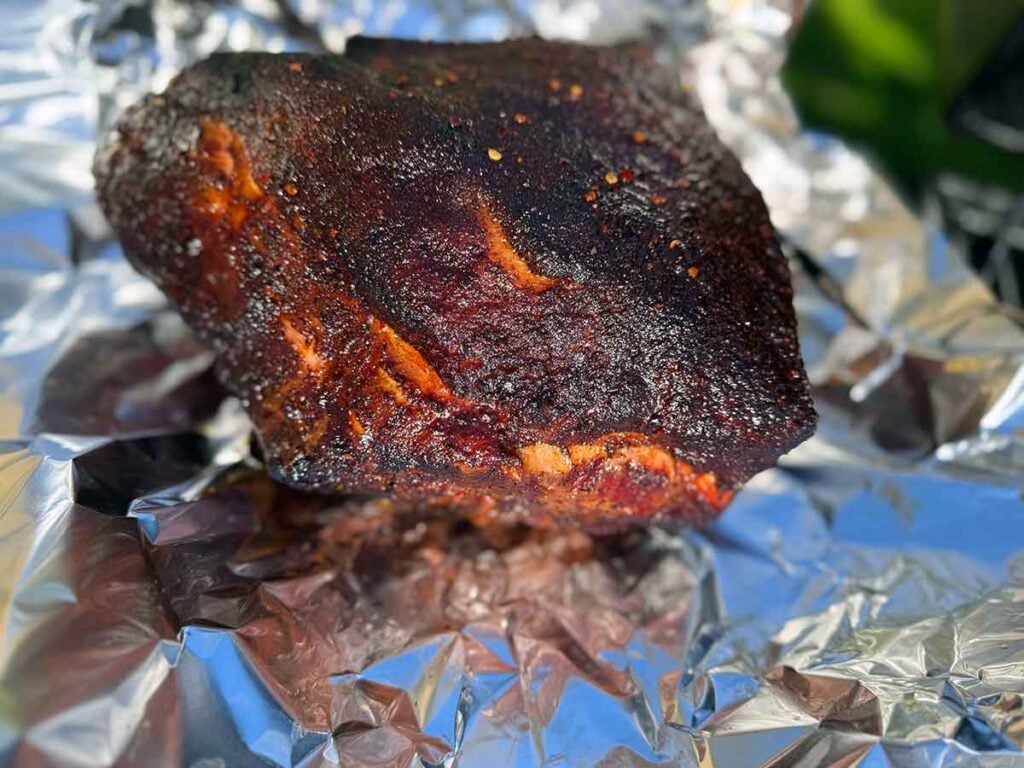
If you are thinking about wrapping, I would not use a strict “wrap at exactly X degrees” rule. A better rule is bark first, temperature second.
Internal temperature can tell you when to start paying attention, but the bark should make the final call. If the bark is not set yet, wrapping too early can leave you with a softer exterior than you wanted. If the bark looks right and feels attached, wrapping becomes a much better option.
That is why you will hear several different wrap temperatures from good cooks. They are not always disagreeing as much as it sounds. They are often looking for the same thing and just seeing it happen at different points in different cooks.
So instead of wrapping by temperature alone, let bark make the first call and your schedule make the second:
- If the bark is not set yet, stay unwrapped a while longer
- If the bark is where you want it and time is comfortable, you can still stay unwrapped
- If the bark is where you want it and dinner is coming, wrap
- If schedule pressure is real, foil is the most dependable choice
- If you want a middle ground, butcher paper is a fair compromise
If you want a closer look at foil, butcher paper, and no wrap, see wrapping pork butt. And if you have heard pitmasters talk about the Texas Crutch, this is the part of the cook they usually mean.
Quick decisions when pork butt stalls
If you do not want to overthink it, use this quick gut-check before you change anything.
The stalls that have caused us the most trouble were usually the ones where we started fiddling too much. The temperature would stall, dinner would get closer, and we’d make the mistake of changing three things when one would have been enough.
What should I do right now?
- Bark not set yet: stay unwrapped, keep the pit steady, and stop opening the cooker every few minutes.
- Bark set and time is relaxed: wait it out if bark is your priority.
- Bark set and time is getting tighter: use butcher paper if you want some help without giving up as much bark.
- Bark set and dinner is getting too close: use foil for the most reliable push through the stall. A moderate pit increase can help too.
- Temperature dropped after wrapping: do not panic. Check for a probe shift or a leak in the wrap, then give it a little time before making another move.
Troubleshooting common stall problems
The stall starts messing with your head and the questions pile up. They sound different, but the answer is usually the same: slow down, check the basics, and make one choice.
Pork butt stuck at 150 to 170
This is the classic stall zone, and it usually does not mean anything is wrong. If your pit is steady and your probe is in a good spot, a butt hanging in this range does not mean the cook has failed.
Start with three questions:
- Is the pit temperature actually stable?
- Is the probe in the thickest part of the meat, not riding close to bone, fat, or a soft pocket?
- Is the bark where I want it yet?
If those checks look good, you are usually just deciding between patience and speed, not solving a mystery.
Can spritzing make the stall last longer?
It can. The stall is mostly about evaporative cooling, so adding more surface moisture can give that cooling effect more to work with. That does not mean spritzing is always wrong. It just means frequent spritzing can slow the cook, especially once the stall has already settled in.
If your main goal is getting through the stall faster, this is not the time to keep opening the cooker and wetting the surface every few minutes. If you like to spritz for bark development earlier in the cook, that is one thing. Once timing starts getting tight, steady heat usually helps more than extra moisture on the outside.
In practical terms, the stall is usually a better time to spritz less, not more. If the bark looks good and dinner timing matters, wrapping or raising the pit temperature will do more to move the cook along.
Temperature dropped after wrapping
A small dip after wrapping is not automatically a disaster. Sometimes the probe moved. Sometimes the wrap leaks a little steam. Sometimes the cooker changed enough that the line on the graph looks worse than the meat actually is.
Give it a little time before you change course again. Check the wrap. Check the probe. If the bark was ready when you wrapped and the pit is steady, that dip often works itself out without drama.
If the reading keeps acting strange, replace or reposition the probe before you assume the meat is doing something impossible. FSIS recommends using two thermometers when smoking meat, one for the cooker and one for the food, which is a good habit here.
Bark looks right but dinner is late
When the bark looks right but dinner is running late, the question is not what is happening. The question is what matters more right now: keeping that bark exactly where it is or getting the pork done in time to eat.
If timing matters more, wrap in foil, raise the pit temperature moderately, or do both carefully. You may give up a little bark texture, but that is often the right trade when the cook needs to move. For the bigger timing picture, see how long to smoke pork butt.
Can I move pork butt to the oven after the stall?
Yes. Once the bark is where you want it, moving the pork butt to the oven is a perfectly practical way to finish the cook. At that point, the meat mainly needs steady heat. The oven will not add more smoke, but it can help you get through the stall or finish the butt without fighting weather, fuel, or cooker swings.
If you still want more bark or more smoke, leave it on the smoker longer. But if the color looks right, the bark is set, and dinner timing is starting to matter, the oven is a reasonable move. I would usually wrap first if the goal is to keep the cook moving and protect the outside from drying too much.
The main thing is to treat the oven like a steady finish, not a panic button. Pick your move, keep the temperature consistent, and cook until the butt is tender, not just until it hits a certain temperature. The stall is frustrating enough without bouncing back and forth between the smoker and the kitchen.
Two pork butts cooking at different speeds
That is normal too. Similar weight does not guarantee identical timing. Shape, thickness, fat distribution, exact placement in the cooker, and the fact that one piece may simply cook differently than another all matter.
Do not force two butts into the same timeline just because they started together. Cook each one by what it is actually doing. The bigger problem is usually comparing them too often rather than letting each one cook at its own pace.
If you are still earlier in the process and deciding what kind of shoulder to buy, best cut for pulled pork can help you start with the cut that makes the most sense, while pork butt yield handles how much pork you need to buy and how much pulled pork you’ll get.
Is this really the stall or is my probe the problem?
Sometimes the problem is the stall. Sometimes the problem is the probe.
A quick checklist helps:
- make sure the probe tip is in the thickest part
- keep it away from bone, fat, and gristle
- confirm the cooker temperature separately
- avoid judging by one weird reading
- trust tenderness later in the cook more than one odd thermometer reading
FSIS guidance on food thermometers says to place the thermometer in the thickest part of the food, away from bone, fat, or gristle. That matters a lot with pork butt because there are plenty of places to get a misleading reading if you are not careful.
What about a second stall?
Some cooks describe a second slowdown later in the cook. Whether you call it a second stall or not, handle it the same way: check the wrap, the pit, and the probe, then stick with one plan.
Safety and doneness
Keep this distinction clear: safe pork and pull-apart pork do not share the same finish line.
USDA and FSIS say whole cuts of pork are safe at 145°F with a 3-minute rest. That answers the food-safety question. It does not mean the pork is ready to pull.
Pulled pork usually needs a much higher finish temperature because tenderness comes from time, rendered fat, and collagen changes that happen later in the cook. A common barbecue target is the 195°F to 205°F neighborhood, and ThermoWorks uses that same range for collagen-rich cuts like pork butt. Still, tenderness matters more than a target temperature. If the probe still feels tight, it is probably not ready yet.
That is also why the stall can be so misleading. A butt can sit in the 160s for a long time, be past the food-safety temp for a whole pork roast, and still be nowhere close to the texture you want for pulled pork.
If you finish early, keep the meat safely hot. FSIS says hot food should be held at 140°F or above. For the practical side of holding a finished butt without drying it out, see how to keep pulled pork warm.
What not to do when the stall hits
Most stall mistakes come from trying to force the cook instead of reading what is actually happening. Here are the ones I would avoid.
- Do not assume something is broken just because the thermometer stopped moving
- Do not wrap before the bark is ready unless timing matters more than bark texture
- Do not keep spritzing to speed things up because extra surface moisture can work against you here
- Do not open the cooker over every small temperature change
- Do not confuse safe with tender because pork can be safe long before it is ready to pull
- Do not treat one temperature as the stall rule because the slowdown can start earlier or later from one cook to the next
The stall is not a riddle with one perfect answer. It is a normal part of the cook where you may have to choose between waiting for better bark and making sure dinner is not late.
A calm way to think about the stall
The stall feels dramatic because the thermometer stops giving you easy reassurance. But once you know what it is, it becomes much easier to manage.
Evaporative cooling is the main reason the stall happens. The exact temperature and length vary too much to promise a neat answer. That is why the best response is usually to worry less about the thermometer and decide what matters most on this cook: better bark or getting dinner served on time.
If you’re planning the whole cook, the pulled pork calculator can help you work backward from your serve time. If same-day timing keeps biting you, it may be easier to make pulled pork ahead and take the stall out of the serving-day equation. And if you go that route, here is how to reheat pulled pork without drying it out.
FAQs about the pork butt stall
The stall is usually over when the internal temperature starts climbing steadily again after a long pause or slow crawl. Do not judge it by one degree or one quick reading. Look for a consistent upward trend while the pit is steady and the probe is in a good spot. From there, keep cooking until the butt is tender enough to pull.
Not by itself. Tenderness comes from time, heat, rendered fat, and connective tissue breaking down later in the cook. A long stall may give the pork more time in a warm range, but the stall is not the goal. Do not try to stretch it. Manage the cook calmly and finish when the pork feels tender when probed.
You can, but only if bark texture matters enough to accept the tradeoff. Unwrapping later may help the outside firm up some, but it can also slow the finish and dry the surface if pushed too far. For most cooks where timing and moisture matter, keeping the wrap closed is the more predictable choice.
Corrections and editorial standards
- Spotted something wrong or outdated? Send a correction here: Corrections & Updates
- How we handle sources, testing, and updates: Editorial Standards
- Media or general notes: Email the publisher
Sources
- Texas A&M Meat Science: BBQ Science — supports the evaporative-cooling explanation for the barbecue temperature plateau and the role of collagen in tenderness
- ThermoWorks: Pulled Pork Time and Temperature — supports the common 195°F to 205°F pulled-pork finish range used as a tenderness guide
- USDA FSIS Safe Minimum Internal Temperature Chart — supports 145°F with a 3-minute rest for whole cuts of pork
- USDA FSIS Danger Zone — supports holding hot food at 140°F or above
- USDA FSIS Smoking Meat and Poultry — supports smoker-safety basics and using separate thermometers for the cooker and the food
- USDA FSIS Food Thermometers — supports placing the thermometer in the thickest part of the food, away from bone, fat, or gristle
We cite authoritative references and note when guidance is based on first-hand cooking experience.
About the author
James Roller documents South Carolina barbecue for Destination BBQ and authored the SC BBQ cookbook Going Whole Hog. He and his wife, Heather, have cooked pork for family meals and gatherings for years, including plenty of cooks where a pork butt seemed to park itself in the 150s or 160s right when dinner timing started to matter. This page draws on published food-safety guidance, meat science, practical barbecue advice, and notes from their own cooks to help readers understand the stall, make calmer decisions, and get the pork to the table with less stress.