Brisket Calculator: Cook Time, How Much to Buy, and Altitude
Use this brisket calculator to work out how much meat to buy, plan when to start cooking, and adjust for altitude
Work out how much brisket to buy, then plan your cook around the time you want to eat. Use the calculators below to estimate portions, choose a start time, or adjust cooking temperatures for altitude.
Choose a brisket calculator
- How much brisket to buy: Estimate how much raw brisket to buy for your guests.
- Plan my brisket cook: Work backward from the time you want to eat.
- Cooking at altitude: Adjust targets based on elevation.
Tip: Plan for the brisket to finish early enough to rest, or to hold at 140°F or warmer, before slicing.
How much brisket per person should I buy?
Plan ⅓–½ lb cooked brisket per person for most meals. Enter guests and serving size; the calculator converts that to raw pounds to buy based on your expected yield. Planning a crowd? This brisket yield calculator answers “brisket per person for 20” but scales for any headcount.
Want the chart version first? See our guide to how much brisket per person, with cooked serving amounts and raw whole-brisket estimates for 5 to 50 guests.
How Much Brisket to Buy (Quick Calculator)
How Much Brisket Calculator
Calculate portions and purchase weight for your crowd.
Typical Brisket Sizes:
- Whole packer: 10-18 lbs (most common: 12-16 lbs)
- Large packer: 18-22 lbs (less common)
- Flat only: 5-10 lbs
- Whole packer: 4.5-8 kg (most common: 5.5-7 kg)
- Large packer: 8-10 kg (less common)
- Flat only: 2-4.5 kg
About These Estimates
How We Calculate Purchase Weight
We work backward from your desired cooked portions:
- Calculate total cooked weight needed (guests × portion per guest)
- Apply your expected yield % to determine raw weight
- We show a 45-57% yield range as typical. The USDA Food Buying Guide (Section 1: Meats/Meat Alternates) reports ~46% purchase-to-plate yield for brisket, which falls within and validates our observed range for BBQ-style low-and-slow methods.
Why Yield Varies
- Heavy trimming + no wrap: closer to 45% yield (less retained fat and more evaporative loss; baseline yields reference: Virginia Tech study, PDF)
- Standard prep + butcher paper: ~50% (balanced moisture retention)
- Light trimming + foil wrap: closer to 57% (tighter wrapping reduces evaporation and speeds heat-up)
- Most cooks see 50-55% with standard prep, which tracks well with the USDA's ~46% figure
Note: Separate from purchase-to-plate yield, cooked-meat yield for brisket (after trimming) commonly falls in the mid-60% range. Reference values: ~69% average with a range (~65-76%) for brisket flat, braised (USDA ARS cooking yields, PDF).
💡 Our estimates lean slightly conservative. It's better to have leftover brisket (which never goes to waste!) than to run short at serving time.
Accuracy notes
- Yields vary with trim level, grade, and whether you serve more flat or point. Typical trimmed-to-plate ranges are about 45–57 percent; use the yield slider to match your style.
- Serving style changes portions. Sandwiches or heavy sides often need less meat; meat-centric plates or big appetites may need more.
- The leftovers toggle is a planning buffer. Add it if you want seconds or next-day meals.
See “About these estimates” for methods and sources.
More BBQ planning tools
Need help with another part of the cook? Our BBQ Tools & Calculators page has tools for planning portions, timing cooks, choosing wood, seasoning by weight, and serving barbecue without running short.
When should I start my brisket?
Enter your brisket’s weight, cut, smoker temperature, wrap choice, rest or hold time, and serving time. The planner estimates when to start and gives you a schedule to print or save.
Brisket Cook Time Planner (Start-to-Finish Calculator)
Brisket Cook Time Calculator
Plan your complete smoking timeline from prep to plate.
Plan your cook
Pick your target serve time; we'll suggest a planned start time for your start-to-serve schedule.
Cook Summary
Timeline
All times in Eastern Time
Fill in your details and generate a plan to see your cook schedule.
Yield & servings
About These Estimates
How We Calculate Your Timeline
Our planner combines field-tested BBQ heuristics with meat-science fundamentals and federal safety guidance. Minutes-per-pound is a planning estimate, not a doneness test (see principles from Texas A&M Meat Science). Higher pit temperatures shorten time per pound, consistent with general roasting references (USDA/FoodSafety.gov roasting charts).
Cook Rate by Temperature
Wrap Method Effects
Wrapping reduces evaporative cooling and speeds heat transfer (mechanism support: Virginia Tech study, PDF). Paper is more breathable than foil, so the speed-up is smaller (permeability context: USDA Forest Service, PDF):
Cut Type Adjustments
Yield Factors
Expected cooked-meat yield (after trimming) varies by wrap method. These sit within typical ranges reported for brisket (e.g., flat, braised ~69% average, ~65-76% range; USDA ARS cooking yields, PDF):
Note: Overall purchase-to-plate yield ranges 45-57% depending on trimming and wrap method.
A Note on Thickness
Thickness affects cook time more than total weight because heat penetration scales with thickness, not mass (heat equation (thickness scaling)). If your brisket is unusually thick or thin, adjust expectations accordingly.
Doneness and Safety
Always probe for tenderness (often 195-205°F for brisket) rather than relying only on time. Use a reliable thermometer and follow federal guidance for safe internal temperatures (FoodSafety.gov).
Learn More
These estimates include a modest safety buffer to ensure you're not rushed. Your brisket may finish 1-2 hours early—that's normal and better than running late.
Need the rough time chart first? See our brisket smoking time chart for general ranges at 225, 250, and 275.
- Plan by serve time or start time.
- Works for whole packers, flats, and points.
- Accounts for pit temperature, wrap method, thickness, stall behavior, and rest or hold time.
- Connects your cook plan with servings and portion estimates.
- Builds a printable cook-day timeline.
How to Use the Planner
- Choose your planning method: Plan by serve time when dinner is fixed, or plan by start time when you already know when the brisket will go on.
- Enter brisket details: Weight, cut, pit temperature, thickness, wrap method, and bark preference all affect the timeline.
- Set your timing: Add your target serve date and time, plus the rest or hold window you want to build in.
- Review your timeline: The calculator provides a planning schedule for when to light the fire, put the brisket on, wrap, check tenderness, rest or hold, and slice.
- Print or save: Take the timeline to the smoker, then adjust based on how your actual brisket and pit behave.
New to this? Our brisket guide explains the cut and why the flat and point cook differently.
Accuracy notes
- Cook time is an estimate. Pit stability, brisket thickness, weather, and wrap choice can move the finish by hours.
- Cook to tenderness, not a clock. Start checking when the brisket is close, then use probe feel in the flat before you stop the cook.
- Build in enough time for the brisket to finish early, then rest or hold safely until slicing. Longer holds require measured temperature control.
See “About these estimates” for methods and sources.
Rest and hot hold safety
A rest is the pause before slicing. A hot hold means keeping the cooked brisket at 140°F or warmer, verified with a thermometer.
A preheated insulated cooler can slow heat loss during a same-day hold, but it does not control temperature. Continue a cooler hold only while the brisket remains at or above 140°F. Once the brisket is no longer being held hot, follow the two-hour food-safety window, or one hour when the air temperature is above 90°F.
Quick Gear Picks
- Leave-in probe thermometer: Monitor pit and meat temps during the cook and the hold without lifting the lid.
- Instant-read thermometer: Verify doneness and check for probe-tender feel in the flat.
- Pink butcher paper (24″): Breathes and preserves more bark when wrapping.
- Heavy-duty foil (18″): Speeds the stall and softens bark when you need to push through.
- Curved boning/trimming knife: Safer, controlled fat trimming; aim for a roughly ¼-inch cap on the flat.
- Insulated cooler/Cambro: Slows heat loss during a same-day hold. Use a thermometer and continue the hold only while the brisket remains at or above 140°F.
- Heat-safe gloves (nitrile + cotton liners): Grip hot wrapped brisket and trays with confidence.
- Optional: Meat injector: If you inject, it helps distribute broth evenly without pockets.
Links may earn us a commission at no cost to you. We recommend gear we trust. As an Amazon Associate, I earn from qualifying purchases.
Do I need to adjust brisket temps for altitude?
Yes, high altitude brisket requires some adjustment. Higher elevation lowers the boiling point, so wrap and finish targets need to be nudged a few degrees; enter your altitude and the adjuster calculates altitude-aware temps for consistent tenderness.
Altitude Adjustments for Brisket (Automatic Calculator)
Altitude Adjustment Calculator
Adjust target temperatures for your elevation.
About Altitude Adjustments
Why Altitude Matters
At higher elevations, atmospheric pressure drops and water boils at a lower temperature, which reduces the effective temperature of simmering and moist-heat cooks (CSU Extension).
The Science
- Water boils at 212°F at sea level
- Boiling point drops about 1°F per 500 ft of elevation gain (CSU Extension; corroborated in NMSU Extension, PDF)
- At Denver (5,280 ft), practical boiling sits around ~201-203°F (CSU Extension)
- Tenderization depends on collagen transitions that occur across roughly 140-176°F (60-80°C) with time and moisture, so lower boiling points slow that conversion (NCSU thesis; WSU research)
Our Calculation Method
We adjust your target temperatures using a conservative rule of thumb: we apply ~70% of the local boiling-point reduction. This preserves a safety margin, aligns with high-altitude practice, and reflects the physics documented above on boiling point and collagen behavior (boiling-point data: CSU Extension).
Additional High-Altitude Tips
- Moisture evaporates faster; consider a water pan in the smoker
- Wrap earlier to limit evaporative cooling
- Plan ~15-25% longer cook times for simmered/braised meats at altitude (CSU Extension)
- Fuel use increases; keep extra on hand
Learn More
Accuracy notes
- Higher elevation lowers the boiling point of water, which can change moisture loss, stall behavior, and tenderness targets.
- You may need a slightly higher pit temperature or an earlier wrap to keep rendering on track. Always verify tenderness before you finish.
- Humidity, wind, and cooker design also affect results. Use these adjustments as guidance, then dial in for your pit.
See “About these estimates” for methods and sources.
How to Slice Your Brisket
After a long brisket cook, don’t let the last few minutes work against you. The single most important rule for cleaner, more tender slices is to slice against the grain.
A brisket is a muscle made of long, parallel fibers.
- Slicing with the grain leaves those long fibers intact, which makes each bite seem tougher and stringier.
- Slicing against the grain cuts those fibers into shorter pieces, which gives the brisket a more tender bite.
The 3-Step Slicing Guide
The trick is that a whole packer brisket has two different muscles—the flat and the point—and their grains run in different directions.
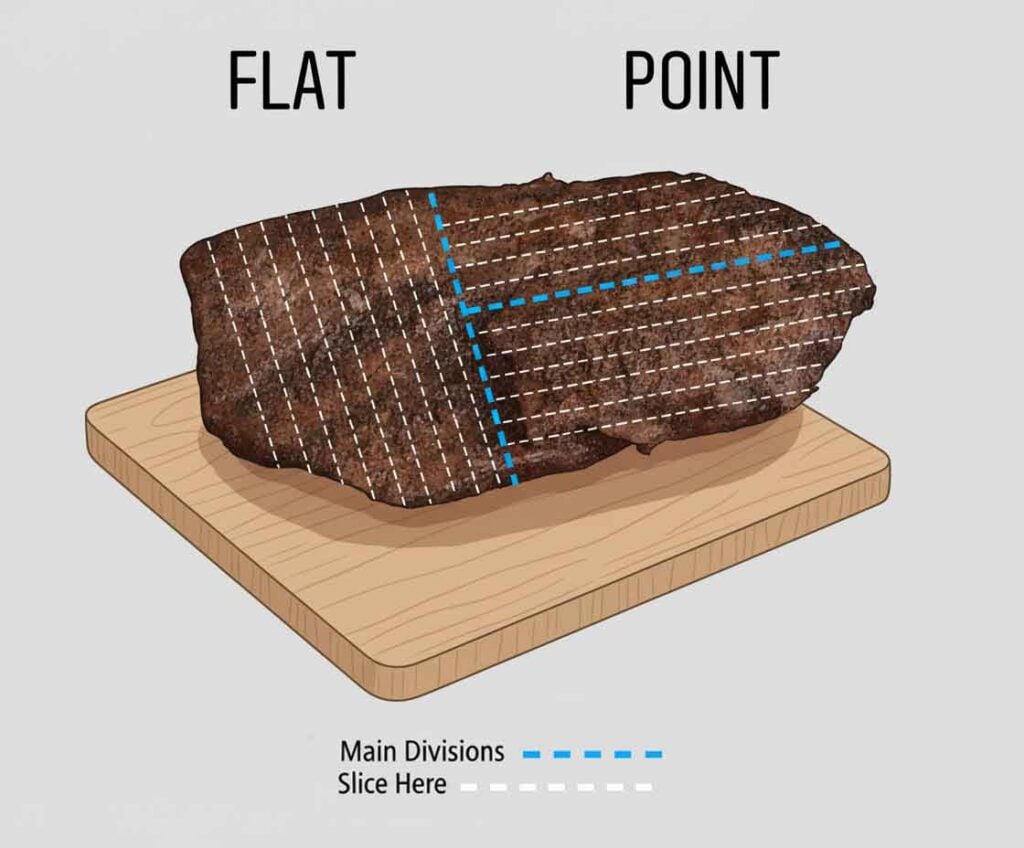
- Identify and separate: Look for the thick, fatty seam that separates the leaner flat from the thicker, fattier point. Slide your knife along that seam to divide the brisket into two manageable pieces.
- Slice the flat: Look at the flat and find the direction of the muscle fibers. Position your knife across that grain and slice the flat into pencil-thick slices, about 1/4 inch.
- Slice the point: The point’s grain usually runs a different direction. Rotate the point, identify the grain, and slice against it. You can also cube the point for burnt ends.
The Right Tool for the Job
A standard 8-inch chef’s knife is usually too short for clean brisket slices. A serrated bread knife can also tear the surface and bark.
For cleaner, full-width slices, use a long, sharp 12- to 14-inch brisket slicing knife.
Our Go-To Slicer: 12-Inch Granton Edge Slicing Knife
A long, non-serrated blade helps make clean slices without tearing the bark. This link is an affiliate link, which means we may earn a commission at no cost to you. We only recommend gear we trust.
How to Store and Reheat Leftover Brisket
Leftover brisket is one of the best parts of a long cook. The key is to store it safely and reheat it gently so it does not dry out.
Storing Your Leftovers
Do not slice the whole brisket unless you need to serve it. Larger unsliced pieces usually hold moisture better than individual slices.
- In the refrigerator:
- Do not leave cooked brisket sitting out. Once it is no longer being held at 140°F or warmer, refrigerate leftovers within 2 hours, or within 1 hour when the air temperature is above 90°F.
- Divide large leftover pieces into smaller portions and use shallow containers so the meat cools faster.
- Wrap tightly or vacuum seal, and store any jus or drippings in a separate airtight container.
- Use refrigerated leftovers within 3 to 4 days.
- In the freezer:
- Portion the brisket into meal-sized pieces, wrap tightly or vacuum seal, and freeze flat when possible.
- For best quality, use frozen brisket within a few months.
The Best Way to Reheat Brisket Without Drying It Out
Your goal is to warm the brisket gently without drying it out. Saved jus, beef broth, or a small splash of water can help protect the meat while it reheats.
- Method 1: Oven with covered moisture
- Place the brisket in a foil pan or baking dish.
- Add a small splash of jus, beef broth, or water.
- Cover the pan tightly with foil.
- Heat gently until the brisket is hot throughout. For general leftover food safety, reheat leftovers to 165°F.
- Method 2: Sous vide for vacuum-sealed leftovers
- If the brisket was vacuum-sealed and chilled properly, sous vide can warm it evenly without drying the surface.
- Follow your sous vide device’s food-safety guidance, and make sure the brisket is heated through before serving.
- Method 3: Skillet for slices, tacos, or sandwiches
- Slice the cold brisket only when you are ready to reheat.
- Warm the slices gently in a skillet with jus or broth until hot throughout.
How long does it take to smoke a brisket?
Brisket cook time is a range, not a promise. Weight matters, but thickness, pit stability, wrap choice, weather, and the stall can move the finish by hours.
For rough timing ranges by weight and pit temperature, see our brisket smoking time chart. Use the planner on this page when you need a custom start-to-serve timeline for your brisket and serving time.
Brisket Smoking Timeline Tips
Plan to Finish Early
It is usually easier to hold a finished brisket safely than to rush one that is still tight. Build cushion into the schedule so dinner does not depend on the brisket finishing at the exact minute you want to slice.
Do Not Treat the Cooler as a Clock
A towel-lined cooler can slow heat loss, but it does not guarantee a safe hold for a fixed number of hours. Use a thermometer and continue the hold only while the brisket remains at or above 140°F.
Track Your Cook
Use this calculator before your cook, but keep notes during the cook, too. Tracking your actual times helps you dial in future briskets on your specific smoker.
Brisket Planner & Tool FAQs
This calculator is a planning guide, not a guaranteed finish time. It uses brisket weight, cut, pit temperature, thickness, wrap method, and rest or hold settings to build a timeline. Every smoker and brisket behaves differently, so cook to tenderness and use the timeline as a planning window.
Choose Plan by serve time when dinner is fixed and you need a planned start time. Choose Plan by start time if you already know when the brisket will go on; the tool estimates your serve window. Set cut, weight, pit temp, wrap choice, and rest or hold target so the timeline has room for the brisket to finish early.
Most cooks land between 45–57% purchase-to-plate yield. Use about 50% as a safe default. Go closer to 45% if you trim heavily or skip wrapping; closer to 57% for lighter trims or foil. Add a leftovers buffer if you want seconds or next-day meals.
Build in enough time for the brisket to finish early, then rest or hold safely until slicing. If you use a cooler, warm oven, or holding cabinet, check the brisket with a thermometer and continue the hold only while the meat stays at or above 140°F. A cooler slows heat loss, but it does not guarantee a safe hold for a fixed number of hours.
Wrap choice affects both time and bark. Foil is fastest but softens bark. Butcher paper is a balanced middle ground. No wrap cooks longest and keeps bark firmest. Use the tool’s wrap and bark preference settings to align speed and crust with your target serve time.
Yes. Select Flat, Point, or Whole packer, then fine-tune with Thickness relative to typical. A noticeably thinner flat tends to cook faster; a short, stocky brisket often needs longer. If your 14-lb packer is much thicker than typical, choose Thicker than typical to avoid cutting timing too tight.
Use the Altitude Adjustment Calculator to set wrap and finish targets for your elevation, then plan your cook with those temps. Higher elevation lowers the boiling point and can lengthen stalls. Always verify doneness by feel with a probe; use the adjusted numbers as guidance rather than absolutes.
Was this information accurate for your pit? Tell us what you’d tweak next time in the comments below.
Sources
- USDA FSIS — Danger Zone — hot-holding and food-safety temperature guidance.
- USDA FSIS — Leftovers and Food Safety — two-hour/one-hour rule, leftover cooling, and storage guidance.
- FoodSafety.gov — 4 Steps to Food Safety — safe chilling, cooking, and food-handling basics.
- FDA — Serving Safe Buffets — hot-hold guidance for keeping hot food hot.
- FoodSafety.gov — Safe Minimum Internal Temperatures — beef roast baseline and rest information for context.
- USDA ARS — Cooking Yields for Meat & Poultry (PDF) — cooked-meat yield reference informing the calculator’s ranges.
- USDA Food Buying Guide — Yield Tables — purchase-to-edible yield context for planning servings.
- Texas A&M Meat Science — Cooking and Smoking Barbecue — pit-temperature norms and time-per-pound guideline context.
- Texas A&M Meat Science — Barbecue Science — evaporative stall explanation used in timeline logic.
- Colorado State University Extension — High-Elevation Food Preparation — boiling-point drop context informing altitude adjustments.
We cite authoritative references and note when estimates depend on pit behavior, meat shape, and first-hand cook tracking.
Corrections and editorial standards
- Spotted something wrong or outdated? Send a correction here: Corrections & Updates
- How we handle sources, testing, and updates: Editorial Standards
- Media or general notes: Email the publisher
About the author
James Roller is the co-founder and publisher of Destination BBQ and author of Going Whole Hog. Since 2012, he has written about South Carolina barbecue restaurants, recipes, history, and traditions and created practical guides and tools for home cooks.