Before You Buy a Grill or Smoker
Make sure a grill or smoker will actually work at your home by checking fuel, power, clearances, delivery access, storage, and the exact model’s requirements before you buy
A grill or smoker can fit the way you cook and still be wrong for your home. You may not have the fuel or power it needs, the clearances it requires, or a delivery route wide enough to get it into place. Those are the problems to catch before you spend the money.
If you’re still deciding what type of cooker fits your cooking, start with our Grill & Smoker Finder and our companion guide, How to Choose a Grill or Smoker.
Once you have a model in mind, check the manufacturer’s current manual for that exact model and use the checks below to see whether it will work at your home. Use official safety sources for broader guidance on placement and use.
Quick Answer
Before you buy a specific grill or smoker, check these seven things:
- Fuel and power: The required fuel, outlet, circuit, or gas connection is available, permitted, and usable without an unsafe workaround.
- Location and clearances: Your outdoor spot meets the manual’s side, rear, and overhead clearances, along with local, landlord, condo, HOA, and insurance rules.
- Delivery access: The boxed cooker and any separate pieces can pass through the narrowest gates, doors, halls, stairs, turns, and elevators along the route.
- Assembled size and mobility: The finished cooker fits the space and can be positioned, cleaned, serviced, stored, or moved later.
- Storage and weather: You have appropriate space for the cooker, dry storage for charcoal, pellets, or wood, outdoor storage for propane, and room for accessories and maintenance supplies.
- Complete setup cost: You have added up the cost of required installation, delivery, assembly, final placement, approved accessories, and possible return freight along with the cooker itself
- Model and seller checks: You have read the current manual and confirmed included equipment, warranty coverage, replacement parts, return terms, delivery service, and recall status.
Already know which cooker type fits? Compare our current grill and smoker recommendations before checking the exact model against the requirements below.
Start With the Exact Model
Knowing you want a pellet grill, offset smoker, or kamado is only the first step. The requirements can change from one model to another, even within the same brand.
Find the current manual for the exact model you’re considering, using its model number, and read it before you buy. Manufacturers post manuals on their websites, usually searchable by model name or number. The manual is where you confirm fuel configuration, electrical needs, clearances, approved surfaces, assembly, and what is and isn’t in the box. Retailer pages, forum posts, and summary articles like this one are starting points, not the authority for a specific model’s safety requirements.
If you can’t find the manual, slow down. Without it, you can’t be sure the cooker will work at your home. Throughout this article, “check the manual” means the current manual for that exact model.
Confirm Fuel and Electricity
Every cooker needs something to run on, and some need more than one thing. Sort this out first, because a fuel or power problem can make an otherwise perfect cooker unusable.
Propane and natural gas are not interchangeable. Gas grills are built at the factory for one fuel: liquid propane in a refillable cylinder, or natural gas piped from your utility. Do not assume you can convert one fuel type to the other. Some manufacturers don’t permit conversion at all. For example, Weber says it does not allow conversions or provide conversion kits and warns that converting a grill voids the warranty and may create an unsafe situation. Others allow conversion only with a specific manufacturer-approved kit and procedure. Confirm the model’s factory fuel configuration and buy the version that matches what you have. Convert only when the manufacturer explicitly allows it and you follow their approved method.
Natural gas usually means professional installation. A natural-gas grill needs a gas line run to the cooking spot. In many places that work has to be permitted, done by a licensed plumber or gas fitter, and inspected. Requirements vary by jurisdiction, so confirm locally before you count on a natural-gas cooker. If you rent, you’ll also need the property owner’s permission to alter the gas supply.
Propane means storage and refills. A propane grill is portable and needs no gas line, but you take on refilling or exchanging cylinders and storing them safely. Confirm you have a suitable outdoor spot for the cylinder before you buy, plus a nearby place to refill or exchange.
Electric cookers depend on a suitable outlet. Pellet grills, electric smokers, and electric grills all need electricity, and “there’s an outlet out back” isn’t enough detail. Check the manual and verify: voltage; amperage or wattage; outlet type; grounding; weather protection; GFCI requirements where they apply; and whether the circuit can carry the load without tripping when other appliances are running. Never bypass or disable a required GFCI or other electrical protection just to keep the cooker running. And don’t assume an extension cord is acceptable; use one only if the manufacturer permits it, and then only the type and length they specify. Some manufacturers advise against extension cords entirely.
Charcoal, pellets, and wood need a dry, ongoing supply. You’ll need to keep buying these fuels, so make sure they’re easy to find near you. Pellets are especially sensitive to moisture. Traeger says old or wet pellets can have difficulty igniting properly, and its auger-jam guidance says most jams are caused by wet or compromised pellets. Charcoal and split wood also need to stay dry. A pellet grill needs both pellets and electricity, so make sure you have a reliable supply of each.
Confirm a Suitable Operating Location
Before you buy, choose the exact outdoor spot where you plan to use the cooker. Even a well-chosen cooker can be unusable or unsafe in the wrong place.
Fuel-burning cookers belong outdoors. Using charcoal, gas, pellet, or wood-burning cookers in an enclosed space risks fire and carbon monoxide poisoning, which can be fatal. The U.S. Consumer Product Safety Commission warns that charcoal should never be used indoors, even with ventilation, and should not be burned in a garage even with the door open. Gas grill manuals carry the same message, telling owners to use the grill outdoors only and never in a garage, shed, breezeway, or other enclosed area. An open door or window does not make a garage, tent, or enclosed room safe. Screened porches, carports, breezeways, and covered areas are not automatically acceptable outdoor locations. Check the exact manual along with local and property rules; if you cannot clearly confirm the location is allowed, choose another spot.
Follow the model’s clearances; there is no single universal number. Manufacturers specify minimum distances from the cooker to anything that can burn, and these differ by model, covering the sides, the back, and overhead. Don’t apply one distance you read somewhere to every cooker. Find the numbers in your model’s current manual and confirm your intended spot actually provides them.
Three feet is general safety guidance, not the required clearance for every model. The U.S. Fire Administration advises placing a grill at least three feet from siding, deck railings, eaves, and overhanging branches. It also recommends keeping a three-foot safe zone around the grill for children and pets, while the National Fire Protection Association gives the same people-and-pets guidance. Those are useful general starting points, but they do not replace the exact model’s required side, rear, and overhead clearances or any stricter local or property rules. Check all of them rather than treating one three-foot measurement as approval for every cooker and location.
Watch overhead structures and combustible surfaces. Covered patios, pergolas, carports, overhangs, siding, and deck railings are where clearance problems often hide. Some grills prohibit operation under unprotected combustible overhead construction, and some built-in installations call for large overhead clearances and special conditions. Whether a covered area works depends on the model’s manual, the construction materials, and local rules, so verify rather than assume. Use a mat, pad, stand, hood, or heat shield only if the manufacturer allows it for that setup. None of them lets you ignore the manual or the property’s rules.
Mind doors, windows, vents, and air intakes. Keep the cooker away from doors, open windows, vents, and outdoor-air intakes where smoke or combustion products could enter the house.
Use a stable, level surface. A heavy cooker on a slope or soft ground can tip, which is both a fire risk and an injury risk. Confirm your spot is firm and level, and that the surface is one the manual allows.
Check what supports the cooker. A listed weight alone doesn’t tell you a deck, balcony, platform, or other surface can safely support it. For unusually heavy equipment, masonry units, built-ins, or any structure you’re unsure about, confirm that the surface and structure are appropriate and get qualified help when needed.
Apartments, condos, and rentals often face stricter limits. If you don’t live in a single-family home or duplex, expect tighter rules. Many locally adopted fire codes restrict grills, fuel storage, and open-flame cooking on balconies or near combustible multi-family buildings, and screening or partially enclosing a porch does not automatically make grill use okay. The exact rule depends on the code adopted where you live and the rules governing the property. Your landlord, condo board, HOA, or insurer can add their own restrictions, and those may be stricter than any general guidance. Check your building’s actual rules and your local fire code before buying. If a cooker can’t be operated where you live, that’s a reason not to buy it.
Think about your neighbors. In close quarters, a smoker running for hours can genuinely bother the people next door. It’s worth considering before you commit to a long-cook cooker in a tight space.
Check Delivery and the Complete Access Route
This is an easy step to miss, and it can lead to some of the most expensive surprises. The problem is rarely the patio. It’s everything between the truck and the patio.
Boxed size and weight are not the same as assembled size and weight. Cookers often arrive in a heavy box, then take up even more room once assembled. Check the boxed dimensions and weight for getting it home and into place, and the assembled dimensions and weight for the final spot. Many large cookers also arrive needing assembly, sometimes with a separate stand or nest.
Curbside is not the same as final-location delivery. Some large cookers ship by freight, and delivery may be limited to the curb or driveway. That service may not include moving the shipment across grass, gravel, slopes, or into a building, and unpacking, assembly, and final placement may cost extra. If you need it brought to the backyard or assembled, that’s usually a separate, paid service you arrange in advance. Confirm the retailer’s and carrier’s exact delivery terms, including where they’ll leave the shipment and whether assembly or final placement is included, before you order.
Know how to inspect the shipment. Ask what you must do if the box arrives damaged, whether visible damage should be noted on the delivery receipt, and how quickly a problem must be reported. Photograph the shipment before unpacking, inspect the cooker before discarding the packaging, and follow the seller’s written claim and return instructions.
Measure the whole route, not just the destination. Before buying a large cooker, measure the narrowest point along the complete route it must travel: gates, doorways, hallways, tight turns, stair widths, elevator dimensions, and any slopes or steps. A cooker that fits your patio perfectly is no good if the box can’t clear the side gate. Ask whether the unit arrives assembled or flat-packed, and whether components can be moved separately, since some cookers break down into more manageable pieces.
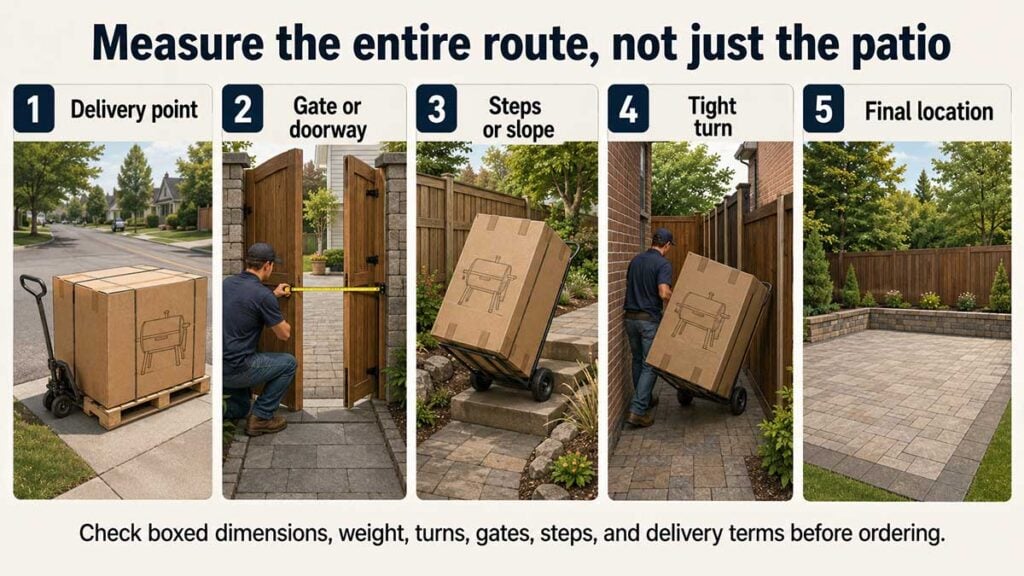
Line up the help and any equipment you’ll need before delivery. Follow the manufacturer’s handling instructions and arrange enough capable help, suitable moving equipment, or professional placement for the cooker’s size and weight. For a very heavy unit, professional placement and assembly can be money well spent, both to avoid injury and to protect the cooker.
Think about moving it later, too. A cooker you can barely get into place is a cooker you’ll struggle to move for cleaning, storms, storage, or service. If you may need to relocate it, favor a model with sturdy wheels or a cart, and confirm those are included.
Plan for Storage, Weather, Fuel, and Maintenance
A cooker can fit the space and still leave too little room to use, clean, service, or store it.
Can it stay outside, and should it? Many cookers are built to stay outdoors, but weather still causes corrosion and wear, and the controllers on pellet and electric units are vulnerable to moisture. Confirm what the manual says about weather exposure and whether the controller needs extra protection. Charcoal, pellets, and wood don’t require climate-controlled storage; they mainly need to be kept dry.
Covers help, but they aren’t a cure-all. A cover keeps rain and debris off. Let the cooker cool as directed before cleaning or covering it, and treat a cover as one part of weather protection rather than the whole answer.
Fuel and accessories each have their own storage needs. Propane cylinders belong outdoors. The Propane Education & Research Council says to keep cylinders outside, away from sources of ignition and heat, and never to use or store them in an enclosed area such as a basement, garage, shed, or tent. Store them upright where they won’t fall, shift, or roll. Pellets and charcoal need dry, protected storage. Follow any storage guidance provided by the fuel supplier and cooker manufacturer. Add up the space for the cooker plus fuel, an ash container for charcoal or wood, grease-management supplies, and cleaning tools.
Plan for drainage, ash, and grease. Standing water invites corrosion, so keep the cooker off wet ground and make sure it can drain. Charcoal and wood produce ash, and most cookers produce grease, both of which need safe handling and regular removal. Leave yourself real access to clean and service the unit, not just to cook on it.
Plan for severe weather and seasons. Know in advance how you’ll secure or move the cooker in high winds or storms and whether you’ll store it seasonally. That plan is much easier to carry out with a cooker you can actually move.
Price the Complete Setup, Not Just the Cooker
Before you order, add up what it will take to get the exact model delivered, installed, running, stored, and maintained at your home. A cooker that looks affordable on the product page may cost much more once the full setup is included.
Fuel or electrical work can change the budget quickly. A natural-gas grill may require a new gas line, permits, and professional installation. A pellet grill, electric smoker, or electric grill may need a properly located outdoor outlet or electrical work to provide the circuit and protection required by the manual. Get local quotes before treating either upgrade as a minor expense.
Delivery, assembly, and final placement may be separate charges. Freight delivery may stop at the curb or driveway, while backyard placement, assembly, packaging removal, and moving a heavy cooker through gates or up steps can cost extra. Confirm exactly what the seller includes before comparing one retailer’s price with another.
Add the equipment the cooker actually requires. Depending on the model, that may include a stand, cart, nest, installation kit, weather cover, fuel storage, or other accessories not included in the box. Only count mats, shields, cords, conversion kits, and similar products when the manufacturer permits them for that exact model and setup.
Also consider the cost of getting the cooker back to the seller if it arrives damaged or does not work for your home. Once you have added up the cooker, required work, delivery, setup, and essential accessories, you can compare what each model will actually cost, not just its listed price.
Where to Verify Exact-Model Requirements
The manual is the main source for model-specific requirements, but delivery, returns, recalls, installation work, and property rules must be confirmed elsewhere. Use this table to find the right source for each check.
| What to check | Where to confirm it |
|---|---|
| Current manual | Manufacturer’s website, searched by model number |
| Fuel configuration | Manual and manufacturer specification sheet |
| Whether fuel conversion is allowed | Manual and manufacturer conversion policy |
| Electrical requirements | Manual, including voltage, amperage or wattage, outlet type, grounding, GFCI protection, and extension-cord rules |
| Boxed and assembled dimensions | Manual, manufacturer specification sheet, and retailer listing |
| Weight and mobility | Manual and manufacturer specification sheet |
| Side, rear, and overhead clearances | Current manual for the exact model |
| Approved surfaces and installation conditions | Current manual for the exact model |
| Delivery terms | Seller, including curbside delivery, final placement, and assembly |
| Assembly requirements | Manual and seller |
| Warranty coverage | Manufacturer, including actions or modifications that could void coverage |
| Replacement parts and service | Manufacturer and seller |
| Return policy | Seller, including opened or assembled products, restocking fees, pickup, and large-freight return costs |
| Recall status | Official CPSC recall database, searched by brand and model |
| Required accessories | Manual, manufacturer specification sheet, and list of items included in the box |
Checking recalls the right way. Don’t rely on search results or a retailer’s note. Check the official government source at cpsc.gov/Recalls before you buy, searching by brand and model. If a model has been recalled, stop and confirm the remedy before spending money. Recalls cover specific production runs, so match the model and date codes in the notice against the unit.
Final Pre-Purchase Checklist
Fuel and power
- ☐ Fuel type confirmed, permitted where you live, and available nearby
- ☐ Propane vs. natural gas matches your supply; conversion only if the manufacturer approves
- ☐ Suitable, properly located outlet or gas connection; extension cord only if permitted
- ☐ Dry storage for pellets, charcoal, or wood; outdoor storage for propane
Placement
- ☐ Outdoor operating spot allowed by the exact-model manual and local or property rules; no garage or other enclosed-space use
- ☐ Model-specific clearances met on sides, back, and overhead
- ☐ General three-foot guidance checked, including the safety zone for children and pets, in addition to the model’s required clearances
- ☐ Away from siding, eaves, windows, doors, and air intakes; level and stable
- ☐ Local, landlord, condo, HOA, and insurance rules checked
Delivery
- ☐ Boxed and assembled dimensions and weight known
- ☐ Full route measured (gates, doors, halls, turns, stairs, elevators, slopes)
- ☐ Delivery type confirmed (curbside vs. final placement; assembly or not)
- ☐ Enough people and equipment lined up to move it safely
- ☐ Damage-reporting steps understood and shipment inspection planned
Storage and ownership
- ☐ Room for the cooker, fuel, ash container, grease supplies, and cleaning tools
- ☐ Weather plan, including covering only after the cooker cools and securing or moving it during storms
- ☐ A realistic way to move it later for cleaning, storage, or service
Model and seller
- ☐ Full cost added up, including required work, delivery, assembly, accessories, and possible return freight
- ☐ Current manual read; warranty, parts, and return policy understood
- ☐ Recall status checked at the official CPSC source
- ☐ Confirmed which required accessories come in the box
If the model passes every check, you can go ahead with the purchase or compare it with our current grill and smoker recommendations. If it fails because of fuel, placement, power, or access, return to the Grill & Smoker Finder and consider a cooker type that better fits your home.
What to Confirm When Buying as a Gift
A grill or smoker is a generous gift and a risky surprise. Almost every check in this article depends on facts only the recipient knows: the cooker type they actually want, a specific model preference, the fuel or power they can supply, where it could legally and safely go, whether it can be delivered and stored, and how much maintenance they’ll tolerate. Get any of those wrong and the gift becomes a heavy, hard-to-return problem.
If you can’t confidently verify those details on the recipient’s behalf, involve them, or give something that lets them choose: a gift card, a smaller accessory, or a promise to shop together. Our choosing guide covers gift decisions in more depth.
Grill and Smoker Buying FAQs
These answers are general starting points, so always check the current manual for the exact model and the rules that apply where you live.
A wood deck may be suitable for some cookers, but do not assume it is safe for every model. Check the manual for approved surfaces and required clearances, then confirm local and property rules. The deck must be stable and level, with enough room from railings, siding, doors, windows, eaves, and anything else that can burn. A grill mat does not replace those requirements.
You must meet both sets of requirements. The manual explains where and how the cooker can be used safely, but a landlord, condo association, HOA, insurer, or local code can still prohibit that cooker or fuel type. If the property rule is unclear, get a written answer before buying. A manufacturer’s clearance does not give you permission to use the cooker there.
Paid delivery or assembly is worth considering when the cooker is very heavy, arrives by freight, must be moved up or down stairs or through a tight space, or requires tools and lifting you cannot handle safely. Confirm whether the service includes unpacking, assembly, final placement, packaging removal, and inspection for damage. After assembly, check the finished setup against the manual rather than assuming the service covered every requirement.
Check the return deadline, whether an opened or assembled cooker still qualifies, whether the original packaging is required, and who pays return freight or pickup costs. Also look for restocking fees and deadlines for reporting shipping damage. Large cookers can be expensive to send back, so save the seller’s written policy and inspect the shipment before discarding the box or signing off on damage.
Identify the exact model, find its manual, and check the CPSC recall database before judging the price. Look for heavy rust, missing parts, damaged cords or controls, and unauthorized changes. For a gas cooker, uncertain conversion or repair history is a reason to get qualified help or walk away. Do not connect or light a questionable unit just to test it. Confirm replacement-parts availability and fuel compatibility.
Sources, method, and safety note
This guide draws on experience owning grills and smokers, along with research from official safety sources, manufacturer guidance, manuals and specification sheets, and seller policies. It is a planning guide, not a test of every cooker or installation.
- U.S. Fire Administration: outdoor grill placement and general three-foot safety guidance
- National Fire Protection Association: grill-fire prevention and child-and-pet safe-zone guidance
- U.S. Consumer Product Safety Commission: charcoal and carbon-monoxide safety
- CPSC Recalls: official recall notices searchable by brand and model
- Propane Education & Research Council: portable propane-cylinder handling and storage
- Weber: manufacturer policy on propane and natural-gas grill conversion
- Traeger pellet-quality guidance and auger-jam guidance: wet-pellet ignition and feed problems
Requirements vary by model, installation, property, and jurisdiction. Before buying or operating a cooker, confirm the current manual for the exact model, applicable local and property rules, and the seller’s current delivery and return terms.
Corrections and editorial standards
- Spotted something wrong or outdated? Send a correction here: Corrections & Updates
- How we handle sources, testing, and updates: Editorial Standards
- Media or general notes: Email the publisher
About the author
James Roller has documented South Carolina barbecue for Destination BBQ since 2012 and authored the SC BBQ cookbook Going Whole Hog. This guide draws on his experience researching grills and smokers, along with manufacturer manuals and official safety guidance, to help readers identify fuel, placement, delivery, and setup problems before buying.