Best BBQ in South Carolina: The Definitive Guide
Ask where to find the best BBQ in South Carolina, and the first question probably ought to be: What kind of barbecue are you looking for?
That matters here more than it might in most places. Maybe you want whole hog cooked over wood and dressed with a peppery vinegar sauce. Maybe you’re after mustard sauce and hash, an old-school barbecue buffet, or brisket that would be right at home in Central Texas. Maybe you care as much about the setting and the story as you do about what comes off the pit. Or maybe none of that matters and you just want somebody to point you toward really good barbecue.
We’ve been eating our way around South Carolina and documenting its barbecue since 2012, and if there’s one thing those years have made clear, it’s that there isn’t one restaurant that checks every box for everybody. The state’s barbecue traditions are too varied for that, and the scene has only grown more interesting as a new generation of pitmasters has added to what was already here.
South Carolinians don’t agree on a single favorite, either. In our 2025 South Carolina BBQ Survey, 1,263 people gave us a valid answer when asked to name their favorite barbecue restaurant in the state. The ten most-mentioned names accounted for only about half of those responses. The rest were scattered among dozens of restaurants. That’s not how we chose the places below, but it does reinforce something we’ve seen over and over: folks have very different ideas about what makes barbecue worth going out of the way for.
Still, saying barbecue is subjective doesn’t mean shrugging our shoulders and declaring everything equal. Some places simply rise above the crowd. There’s a small group in South Carolina that we think most folks who know good barbecue would recognize as top-notch, even if they argue about which one they like best. There are plenty of others serving really excellent barbecue that we’d gladly send you out of your way to try. And there are places worth visiting because they give you something harder to find—a particular kind of hash, an old family tradition, a wood-fired cooking method, a classic barbecue buffet, or a glimpse of the way South Carolinians have eaten barbecue for generations.
So instead of pretending there’s one correct answer, start with what sounds good to you.
South Carolina BBQ Quick Picks
Not sure where to begin? Pick the experience you’re after.
| If you want… | Start with… |
|---|---|
| Classic Pee Dee whole hog | Scott’s Bar-B-Que |
| Central Texas brisket | Lewis Barbecue |
| Carolina and Texas barbecue on the same tray | City Limits Barbeque |
| Carolina barbecue with Puerto Rican influence | Palmira Barbecue |
| Old-school whole hog and a barbecue buffet | McCabe’s Bar-B-Q |
| Pee Dee traditions in a more modern restaurant | Elliott’s BBQ Lounge |
| All-wood Upstate barbecue with plenty worth ordering | Fork Grove Barbecue |
| The Bessinger-family mustard-barbecue tradition | Melvin’s BBQ |
| The classic big South Carolina barbecue buffet | Shealy’s Bar-B-Que |
| Upstate beef hash | Midway BBQ |
South Carolina BBQ at Its Best
Taste is subjective. We’ve already admitted that. But that doesn’t mean every answer is equally good.
There are a handful of barbecue joints in South Carolina that rise above the rest. They don’t all cook the same way, and we wouldn’t expect everybody to put them in the same order. In fact, putting them in order misses the point.
These are the places where the cooking and the food coming across the counter put them in another class. Some are rooted deeply in old South Carolina barbecue traditions. Others are part of a much newer chapter. What they have in common is simpler: we’d send just about anybody who cares about good barbecue to these places without hesitation.
They’re listed alphabetically, not ranked.
Our Picks for the Best BBQ in South Carolina
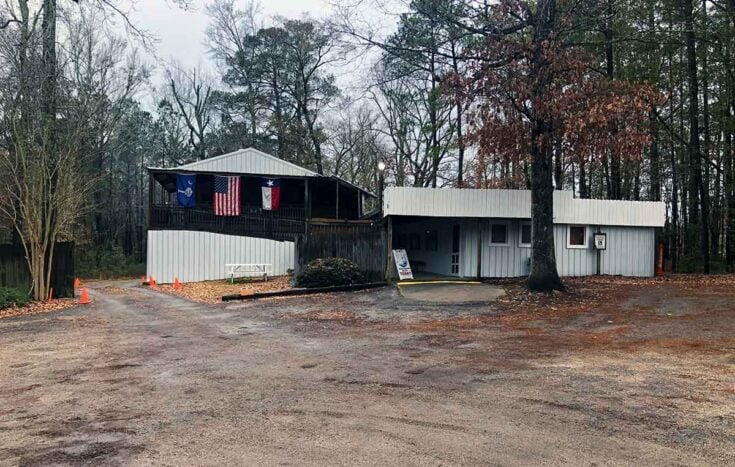
You’ll want to visit City Limits Barbeque because Robbie Robinson has figured out how to put South Carolina and Central Texas barbecue on the same tray without making either one feel like an afterthought.
Start with the pork and spare ribs, then make room for brisket if it’s on the board. The ribs are cooked over coals, and Robinson’s Lexington-style hash pulls from both sides of his barbecue education, combining smoked pork, pork belly, and brisket. Sausage and the occasional beef rib can stretch the meal even further.
That mix makes City Limits different from most barbecue joints in the state. Robinson grew up around Lexington County barbecue before becoming fascinated with the Central Texas approach, and you can taste both influences rather than simply read about them on the menu.
By now, plenty of folks outside South Carolina have noticed. Robinson was a James Beard Award finalist for Best Chef: Southeast in 2025, and Southern Living named City Limits the No. 1 barbecue joint in the South that same year. Those honors didn’t put it here, but they certainly reinforce what has been happening in West Columbia.
City Limits is generally a weekend operation, and the menu can change, especially on Sundays, so check before making the trip.
However, you might not choose City Limits if what you want is an old-fashioned South Carolina barbecue joint where pork, hash, rice, and mustard sauce have been served pretty much the same way for generations. City Limits is rooted here, but it’s very much barbecue of the present.
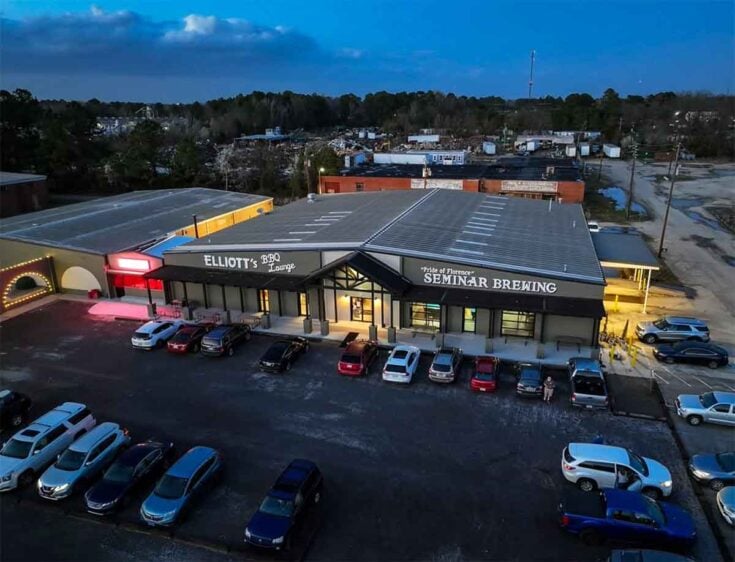
You’ll want to visit Elliott’s BBQ Lounge because Elliott Moss came home to Florence knowing how to cook the barbecue he grew up around—and with enough experience to take it somewhere of his own.
Whole hog is the place to begin. Then try the hash and rice, because that combination puts you squarely back in the Pee Dee even though you’re sitting in a decidedly modern restaurant. Smoked wings, sausage, and other meats give you plenty of reasons to order more widely, but the Carolina side of the menu is what makes Elliott’s especially interesting.
Moss grew up around family barbecue in Florence before eventually making his name at Buxton Hall Barbecue in Asheville. Coming home didn’t mean recreating an old roadside joint. Elliott’s is a restaurant and brewery, and you can walk outside and see the pit where the hogs are being cooked.
That contrast works. The food has roots, but it doesn’t feel like anybody is trying to preserve those roots under glass.
Southern Living has since named Moss among a small group of pitmasters it sees shaping the next generation of Southern barbecue. That seems fitting, because Elliott’s feels less like a revival than a continuation.
However, you might not choose Elliott’s if your ideal South Carolina barbecue stop is a tiny country place with a short buffet, a screen door, and no interest whatsoever in being modern. The food may come from many of those traditions, but the experience is something different.
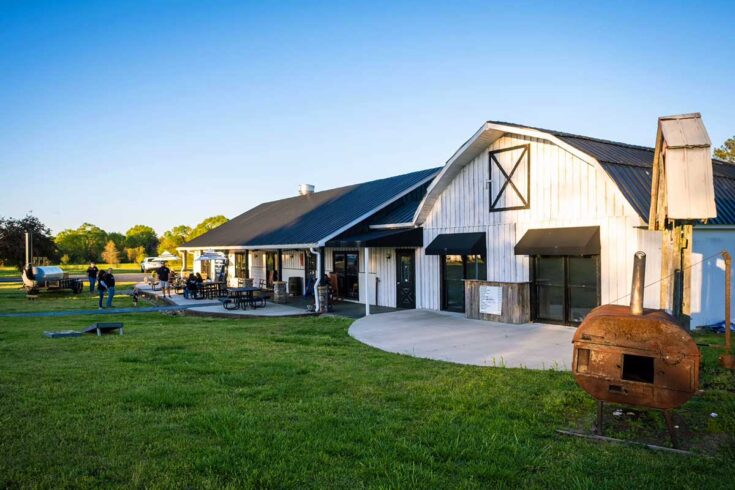
You’ll want to visit Fork Grove Barbecue because the barbecue is really, really good across a remarkably deep menu.
Brisket is the obvious starting point. Get some fatty slices if they’re available, then add house-made sausage and whatever else your appetite will allow. Spare ribs, pulled pork, turkey, chicken, burnt ends, and other specials mean this is one of those places where bringing a few people and building a big tray makes a lot of sense.
Everything is cooked with wood, and that matters here because Fork Grove isn’t leaning on one signature meat while the rest of the menu rides along. The praise has been remarkably consistent across brisket, ribs, pork, sausage, and turkey.
Dylan Cooke’s approach owes plenty to Central Texas barbecue, which is easy enough to see when you look at the menu. What puts Fork Grove this high isn’t the style, though. It’s the execution.
There’s no generations-old family barbecue story to tell here. Fork Grove grew out of the pandemic years and eventually became a brick-and-mortar restaurant. That may not sound romantic, but barbecue history has to start somewhere.
However, you might not choose Fork Grove if the reason you’re traveling through South Carolina is specifically to experience mustard sauce, whole hog, hash, or another old local tradition. Fork Grove’s strongest argument is much simpler: what comes off the smoker.
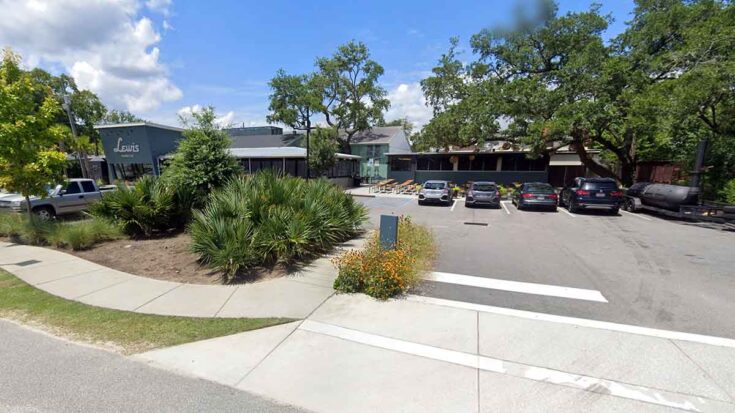
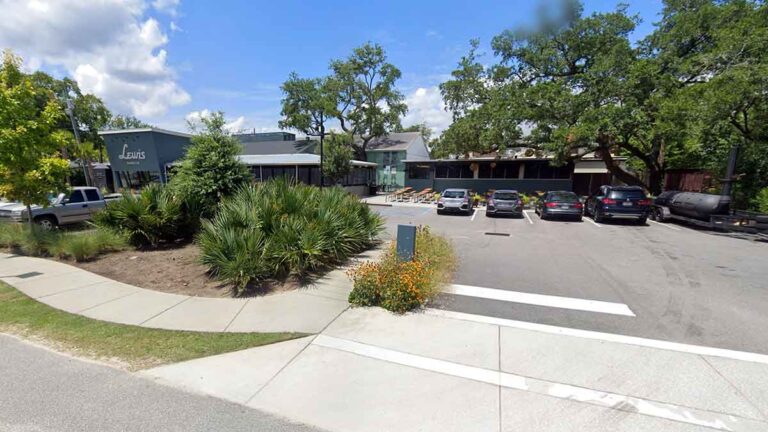
You’ll want to visit Lewis Barbecue because the brisket is about as good as you’re going to find in South Carolina—or just about anywhere else.
Start there. Order some fatty brisket, or mixed if you want slices from both the point and flat. Then add a hot-guts sausage. Spare ribs and turkey are worth making room for, too, and Saturday brings the massive beef short rib if you’re ready to commit.
John Lewis came to Charleston with deep Central Texas barbecue experience and the custom-built pits to match. When he opened on North Nassau Street in 2016, properly cooked Texas brisket was nowhere near as easy to find around South Carolina as it is today. Lewis helped change that.
The brisket still explains the crowds. It should be tender without falling apart, with a dark bark, well-rendered fat, and enough smoke to announce itself without overwhelming the beef. You don’t need to know anything about Lewis’s résumé to understand why people line up once you start eating.
We’re talking specifically about the original Charleston restaurant here. Lewis has expanded, but this is the South Carolina location that started the story.
However, you might not choose Lewis Barbecue if you’ve come to South Carolina specifically looking for barbecue traditions that developed here—whole hog, hash and rice, mustard sauce, or vinegar-pepper pork. Lewis is Texas barbecue. It also happens to be some of the best barbecue in South Carolina.
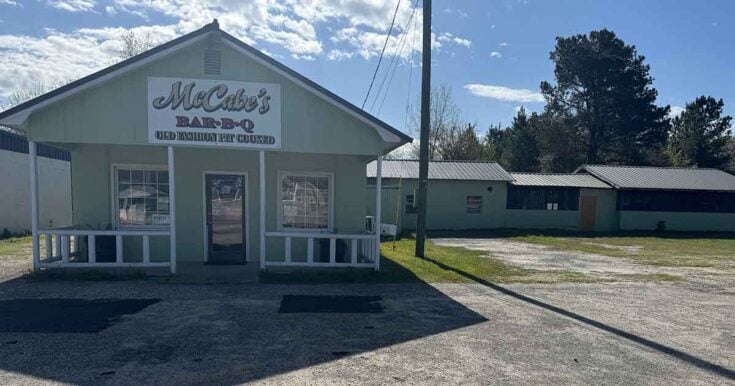
You’ll want to visit McCabe’s Bar-B-Q because it gives you one of those increasingly rare combinations: excellent old-school South Carolina barbecue and the old barbecue-buffet experience in the same place.
Make the pork your first stop. McCabe’s cooks whole hogs, along with shoulders and hams, over wood embers in the pit room behind the restaurant. The meat is pulled and dressed with a lightly sweet vinegar-pepper sauce, and it’s good enough that McCabe’s would be worth visiting even if the buffet ended there.
Thankfully, it doesn’t.
Get some hash and rice. Try the perloo. Add whatever vegetables look good that day, along with fried chicken, greens, cabbage, peas, sweet potatoes, or hush puppies. The buffet isn’t enormous by South Carolina standards, but that’s part of its appeal. It still feels like barbecue is the reason everybody showed up.
This is also one of those places where seeing the pit room and the wood helps explain what winds up on the plate. There isn’t much mystery about how the pork gets to the buffet.
Plan ahead. McCabe’s keeps limited hours, and it remains the kind of place where showing up at the wrong time can leave you staring at a locked door.
However, you might not choose McCabe’s if you want brisket by the pound, a sprawling craft-beer list, or a place to linger all afternoon. If you want South Carolina barbecue that still feels very much like South Carolina, that’s another matter.

You’ll want to visit Palmira Barbecue because Hector Garate is making barbecue that feels both deeply personal and completely at home in South Carolina.
Make room for the pork. Palmira cooks whole hog over wood, using locally raised heritage pork when available, and the meat is good enough that everything else on the tray can be treated as an addition rather than a distraction. Then order widely: pork ribs, house-made sausage, beef cheeks or barbacoa when available, and whatever else is coming off the pits that day.
The sides deserve some room, too. Puerto Rican beans might sit next to collards, mustard slaw, or hash and rice. That combination tells you more about Palmira than calling it “fusion” ever could.
Garate was born in Puerto Rico, where whole-animal cooking was already part of his life, and he later absorbed the barbecue traditions of South Carolina and Texas. At Palmira, those influences don’t seem to be fighting for attention. His Carolina pork still tastes like barbecue from here; other parts of the meal tell you something about the person cooking it.
That creativity is interesting, but it wouldn’t matter if the barbecue weren’t excellent. It is.
However, you might not choose Palmira if what you want is barbecue exactly the way your grandparents might have eaten it. Palmira asks you to be a little more adventurous—and rewards you for it.
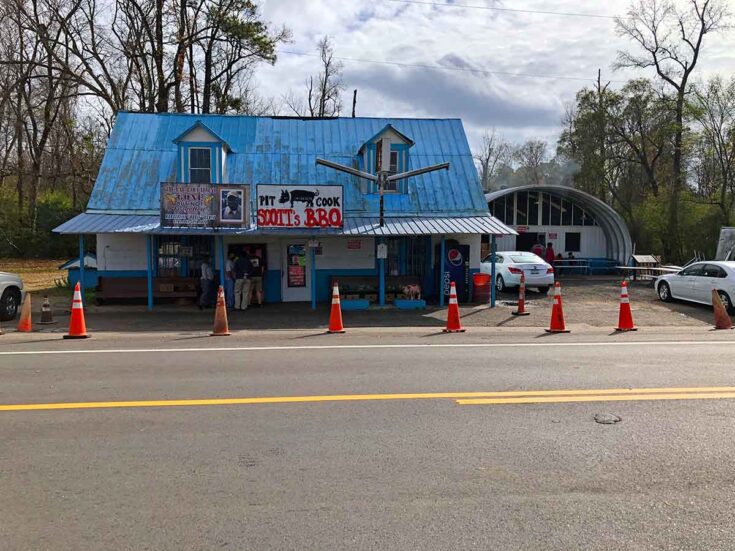
You’ll want to visit Scott’s Bar-B-Que because few places give you a clearer taste of traditional Pee Dee whole-hog barbecue—and the pork still earns the trip on its own.
Order the whole hog. The meat is pulled into long strands from different parts of the animal, so one bite may be leaner and another richer. That mix is part of the appeal of whole-hog barbecue. The Scott family’s peppery vinegar sauce cuts through the pork without burying it.
Get some skins if they’re available. They bring another layer of smoke, salt, fat, and crunch to the plate. The chicken has plenty of loyal fans, too, but the whole hog is why you came.
The process remains wonderfully labor-intensive. Hardwood is burned down to glowing coals, and those embers are shoveled beneath hogs cooking in the pit house. That direct connection among wood, pit, hog, and sauce is about as Pee Dee as barbecue gets.
Scott’s began in 1972 when Roosevelt “Rosie” and Ella Scott opened their country store outside Hemingway. Their son Rodney learned to cook there before going on to build his own restaurant company, but the Hemingway restaurant remains its own thing and continues as a Scott family operation.
There isn’t much polish, and there doesn’t need to be. Pull off the highway, find a place to park, order at the counter, and concentrate on the pork.
However, you might not choose Scott’s if sides, comfort, atmosphere, and a long menu matter nearly as much to you as the barbecue. Scott’s has always been primarily about what comes out of that pit house.
More South Carolina BBQ Worth Seeking Out
Seven places may rise to the top, but they hardly exhaust the really good barbecue in South Carolina.
We’d gladly send you to any of the restaurants below. Some are good enough that reasonable folks could argue they belong with the seven above. Others may do one or two things exceptionally well without quite having the same across-the-board case. A few are carrying forward older South Carolina traditions while others are helping create whatever comes next.
Age, fame, or proximity to a city aren’t enough on their own. The barbecue itself has to be worth seeking out.
They’re listed alphabetically, not ranked.
Bobby’s BBQ — Fountain Inn
Bobby’s BBQ is one of the better places to see how thoroughly Central Texas barbecue has taken root in the Upstate.
Tay Nelson built Bobby’s around brisket, but don’t stop there. Turkey is one of the sleepers on the menu, and pulled pork, ribs, and house-made sausage make it easy to put together a tray for a group. Nelson seasons the meats with the blends he developed in memory of his father and brother, then lets wood and smoke do the rest.
Bobby’s feels different from the older pork-and-hash joints scattered around this part of the state, and that’s fine. South Carolina barbecue has never stood still. If brisket is high on your list and Greenville is somewhere in your plans, Bobby’s is worth the short drive south to Fountain Inn.
Carolina Bar-B-Que — New Ellenton
The family history alone would make Carolina Bar-B-Que worth knowing. Fortunately, the food doesn’t need the help.
Shoulders are cooked over wood, then served unsauced so you can decide what to do with the two mustard sauces on the table. One is the sweet, reddish “rust gravy” associated with the Dukes branch of South Carolina barbecue; the other brings a little more heat.
Don’t leave without trying the hash and rice.
The connections between Carolina Bar-B-Que, the Baltzegars, and the Dukes story are fascinating, but the restaurant has an identity of its own. Add the modest old-school buffet and you get a place that feels unmistakably South Carolinian without having to advertise the fact.
Circle M BBQ — Liberty
Whole-hog barbecue is much easier to find in the eastern half of South Carolina than it is in the Upstate. That alone makes Circle M BBQ unusual. The fact that the pork is worth the trip is what matters.
The hogs are cooked over hickory coals, then pulled by hand and served with a vinegar-based sauce. Make that your first order, but Circle M has grown beyond the menu Marion Martin built when he opened the restaurant in 1992. Brisket, ribs, sausage, and other smoked meats give you plenty of reasons to order around.
Joey Link and his family took over in 2020 and have managed the tricky job of adding new life without walking away from what made the place matter. If you want traditional whole hog in a part of South Carolina where that style is increasingly hard to find, make the detour.
Doko Smoke Barbeque — Blythewood
Doko Smoke Barbeque grew out of competition barbecue, and you can see that in a menu built around pulled pork, brisket, ribs, and chicken rather than one old regional specialty.
That breadth is part of its appeal. You can order a couple of meats, grab the usual lineup of Southern sides, and come away with a very good plate without needing to know anything about barbecue history first.
But there is a nice local touch hiding among those sides: Doko makes a mustard-and-vinegar hash from an old family recipe. Get some with the pork.
Doko isn’t flashy, and it doesn’t need to be. Tony Crout has been cooking around the Blythewood and Ridgeway area for years, and Doko has become one of those dependable Midlands places we’re comfortable sending folks when they want good barbecue without a lot of fuss.
Freeman’s Bar-B-Que — Beech Island
There are easier ways to cook barbecue than the way they do it at Freeman’s Bar-B-Que.
The Freeman family has spent decades cooking whole hog with coals made from hardwood, relying on the kind of pit knowledge that comes from doing the same work over and over again. Pork is the obvious order, but don’t miss the ribs or the hash, which combines pork and beef.
The history here is worth knowing, but what makes Freeman’s special is that the old cooking method isn’t just a story hanging on the wall. It’s still part of how lunch gets made.
Beech Island sits down near the Georgia line, so Freeman’s won’t fall naturally into most Charleston or Greenville itineraries. If you find yourself around Aiken or Augusta, though, this is exactly the sort of place you don’t want to drive past.
Hite’s Bar-B-Que — West Columbia
You can smell the argument for Hite’s Bar-B-Que before you start eating.
Oak and hickory burn behind the restaurant, the coals get shoveled beneath whole hogs and hams, and the same fire helps cook the hash in cast-iron kettles. The menu stays refreshingly short: pork, ham, ribs, chicken, skins, hash and rice, and slaw.
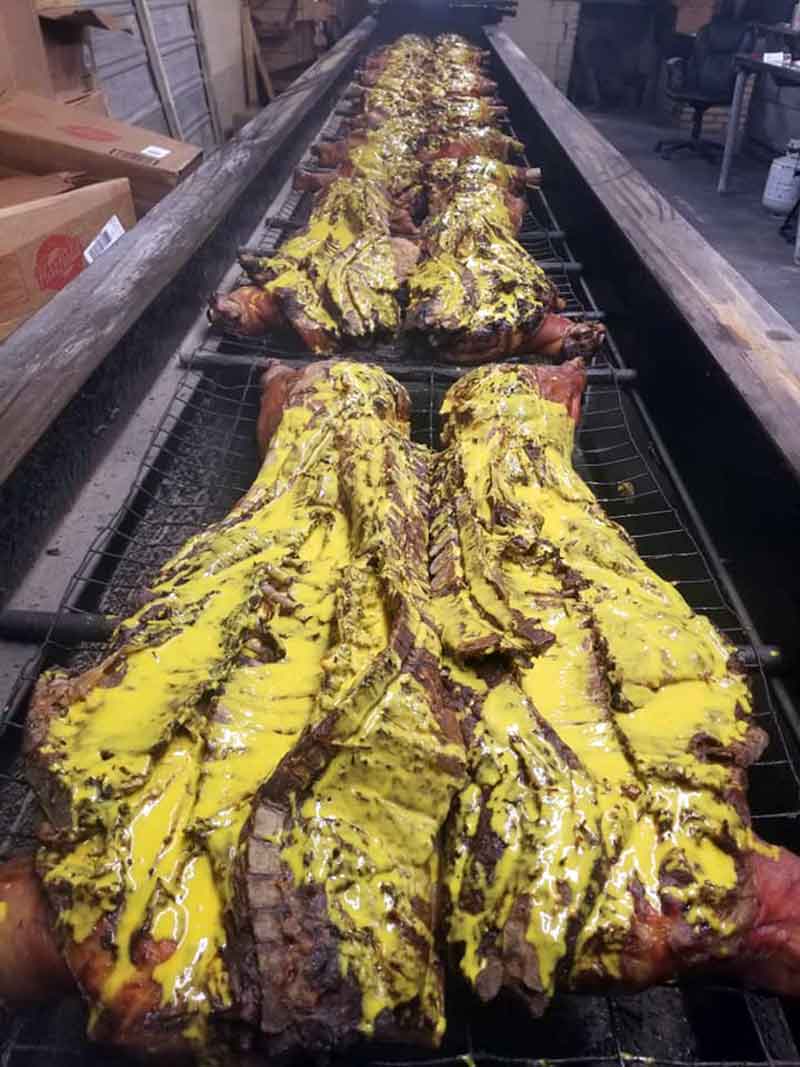
Get the pork, but make sure ribs and hash find their way into the order, too. Hite’s mustard sauce is also worth paying attention to. It’s more mustard-forward than the sweeter style many visitors associate with the Bessinger family. If that particular style interests you, we have Harry Hite’s mustard sauce recipe along with the family story behind it.
Hite’s has been around since 1957, but age alone isn’t the attraction. Few places in the Midlands still connect wood, coals, whole hog, hash, skins, and mustard sauce this directly.
Just remember that it’s takeout, not a sit-down barbecue outing.
Home Team BBQ — Downtown Charleston
Home Team BBQ can be loud, busy, and much more like a bar than the old barbecue joints people sometimes picture when they think of South Carolina.
Order the wings anyway.
They’ve become a signature for good reason, but the barbecue underneath the party atmosphere deserves more attention than it sometimes gets. Pork, ribs, chicken, turkey, and other meats are cooked over wood, and the sides range from hash and rice to smoked gouda mac and cheese and stone-ground grits.
Chef Aaron Siegel opened the first Home Team in 2006, and the company has since become an important part of Charleston’s modern barbecue scene. A number of cooks have passed through its pits and kitchens on their way to doing other interesting things.
The family tree can wait. Get a tray, get the wings, add some smoked meat, and judge it from there.
Melvin’s BBQ — Mount Pleasant
If you want to understand South Carolina mustard barbecue and still eat very good barbecue while you’re doing it, Melvin’s BBQ in Mount Pleasant is a fine place to start.
Pulled pork gets the family’s sweet mustard sauce, but I’d add ribs before filling the rest of the tray with sides. Hash and rice belong there, too, especially if this is your first encounter with the Bessinger branch of South Carolina barbecue.
The family history runs back through Melvin Bessinger to his father, Big Joe, and the mustard-sauce tradition that spread through several independently operated Bessinger-family restaurants. What makes present-day Melvin’s especially interesting is that David Bessinger returned the cooking to all-wood pits rather than simply trading on that history.
There are more famous family names in South Carolina barbecue. Few give you as good a combination of the old story and barbecue we’d still recommend on its own.
Patriots’ Smokehouse — Clarks Hill
You could spend years eating barbecue around South Carolina and still never stumble across Patriots’ Smokehouse unless somebody told you where to look.
So, here you go.
Ron and Stephanie Crowder’s place sits in Clarks Hill, not far from the Savannah River, and the menu is built around meats cooked slowly over a blend of hardwoods. Pork, ribs, and brisket are the places to concentrate. Homemade sides round things out without turning Patriots’ into something more complicated than it needs to be.
It doesn’t have Lewis’s national profile or Hite’s historical weight. It just quietly turns out barbecue good enough that people who care about this stuff should know the name.
If you’re headed toward the lake, Augusta, or the western edge of the state, put it on the route.
Roy’s Grille — Irmo
Roy’s Grille doesn’t look like a traditional barbecue joint at first glance.
The menu is broad. Chef Chris Williams makes burgers, sandwiches, and plenty of other food that has nothing to do with the smoker. But locals kept telling us to stop worrying about the label and eat the barbecue.
They had a point.
Brisket is where I’d begin, then work outward from there. Williams also cures and smokes his own bacon, makes his own sauces, and works smoked pork into dishes like his smokehouse rice. Even the sides tend to get more attention than they do at the average barbecue joint.
Roy’s isn’t an old-school Midlands barbecue house, and it isn’t trying to be. It’s a chef-owned restaurant where barbecue happens to be one of the things the kitchen does particularly well.
Shuler’s Barbecue — Latta
Shuler’s Barbecue gives you a big country buffet, but don’t make the mistake of thinking the buffet is doing all the work.
Pork, ribs, and chicken are cooked over wood coals using methods Norton Hughes carried forward from his family. Try those before the sheer size of the spread distracts you. Then go back for the vegetables, sides, and whatever else looks like something somebody’s grandmother might have put on the table.
The setting is part of the fun. Shuler’s sits well off the interstate near Latta, and eating there feels more like making a destination of lunch than grabbing something on the way through.
There’s plenty of history behind the family sauce and the Hughes operation, but the barbecue itself holds up. The buffet simply makes it easier to stay longer than you meant to.
Slabs BBQ — Lake City
Lake City is firmly in old Pee Dee barbecue country, which makes Slabs BBQ an interesting outlier.
This is wood-fired, Texas-influenced barbecue, with brisket right at the center. No gas or electric heat does the cooking. Pork and ribs are there, too, but if you’ve driven to Slabs for the first time and skip the brisket, I think you’ve missed the point.
The restaurant opened in 2020 after its owners spent a couple of years refining recipes, and it has built a strong following without the benefit of being in Charleston, Greenville, or another obvious dining destination.
South Carolina’s newer brisket culture isn’t limited to the bigger cities. You can eat whole hog and liver hash around this part of the Pee Dee, then drive into Lake City and find someone tending a wood fire with Texas on his mind.
The Smokin’ Pig — Pendleton
The Smokin’ Pig in Pendleton has one of the strongest track records of any barbecue joint in the Upstate.
There isn’t much mystery about why people like it. Brisket, pork, and ribs have been reliably good for years, portions are generous, and the sides have developed followings of their own. Jalapeño cheese grits are one of those things people start recommending before you’ve finished asking what to order.
I’d go with brisket and ribs, then add pork if you’re sharing. Save room for cobbler if you can.
Smokin’ Pig doesn’t need an old family barbecue lineage or some rare regional cooking style to justify the drive. What it has is a long record of sending a lot of people home happy. That consistency matters, especially in a business where a great visit and an ordinary one can sometimes be separated by a single cook.
Swig & Swine — West Ashley
Swig & Swine may have grown into a recognizable South Carolina barbecue brand, but the original West Ashley restaurant is still where I’d send someone for the clearest version of the idea.
The menu really does cover most of the barnyard: pork, brisket, ribs, turkey, chicken, and sausage, all cooked with wood. If it’s your first visit, don’t overthink it. Get several meats and share. Brisket and ribs make a good starting pair, and the pork keeps the tray connected to where you are.
Chef Anthony DiBernardo built Swig & Swine around barbecue that could support a full-service restaurant rather than a weekend-only pit stop. That means a bar, plenty of sides, and a place where you can settle in rather than eat quickly and head back to the highway.
Its growth shouldn’t count against it. Scaling barbecue is hard. Swig & Swine has managed to get bigger without making the smoke irrelevant.
What Makes South Carolina Barbecue Different?
By this point, you’ve probably noticed that “South Carolina barbecue” can mean a lot of different things.
Whole hog is an important part of the story, especially as you head east into the Pee Dee, where places like Scott’s and McCabe’s still cook hogs over wood. But whole hog isn’t a requirement for good South Carolina barbecue, and neither is cooking over an old concrete-block pit. Hite’s still burns wood down to coals. Melvin’s returned to all-wood cooking after years of using gas-assisted pits. Other good restaurants use modern wood-burning or commercial smokers. The method matters, but what ultimately matters is what comes out of the pit.
Sauce is where South Carolina really starts showing its personality. Historically, all four of the major American barbecue-sauce families have had a home here: vinegar and pepper, mustard, light tomato, and heavier tomato-based sauces. Mustard is the one most closely identified with South Carolina, but even calling something “mustard sauce” doesn’t tell you much.
The sweeter sauces associated with the Bessinger family taste very different from the more mustard-forward sauce at Hite’s, while Orangeburg’s Dukes tradition has another character altogether.
If you want to see how those Orangeburg traditions fit together, our guide to why Orangeburg matters to South Carolina barbecue follows the Dukes, Bessinger, Sweatman, and Antley connections through mustard sauce, Orangeburg Sweet, hash and rice, and the old barbecue-buffet tradition.
If you want to try those traditions at home, start with our South Carolina mustard barbecue sauce recipe or the Eastern SC vinegar-pepper sauce. We dig much deeper into the history, people, sauces, hash, whole hog, and other traditions in Going Whole Hog.
Then there’s hash, which may be even more confusing to someone visiting from out of state.
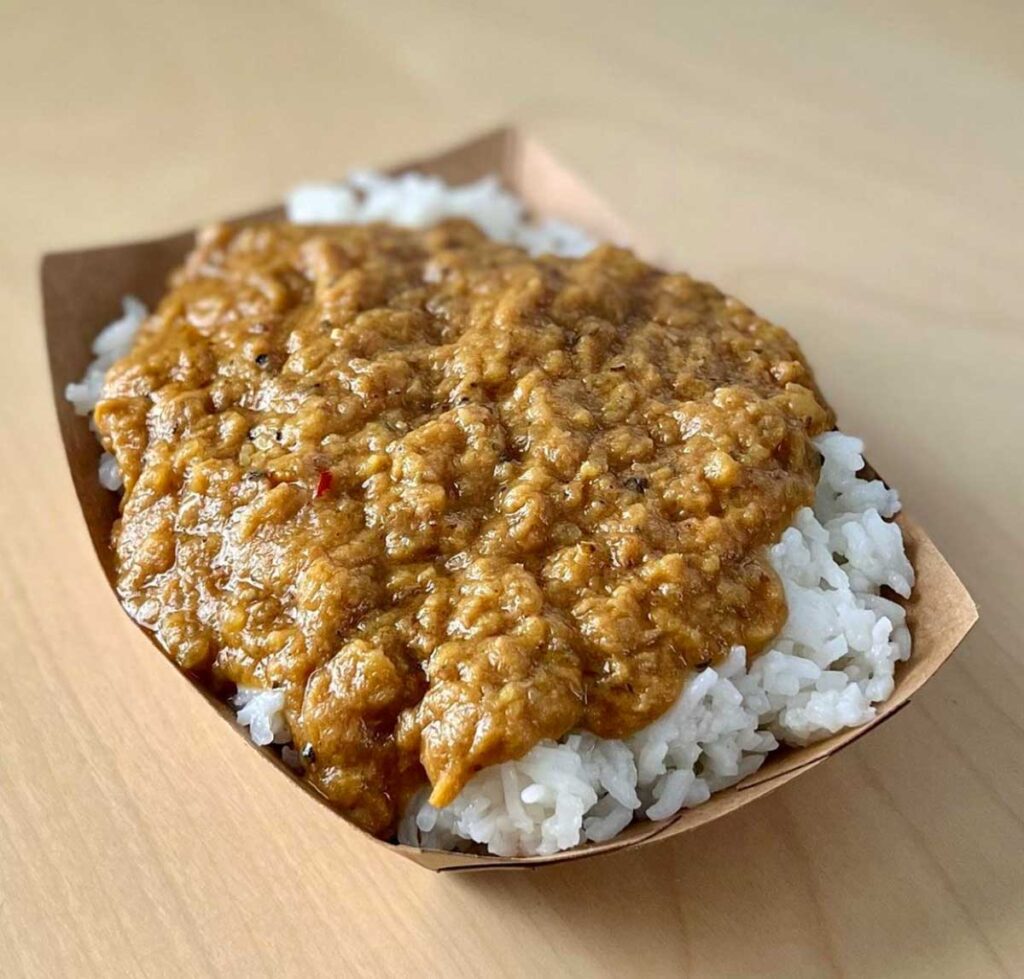 Lexington-style hash — City Limits Barbeque
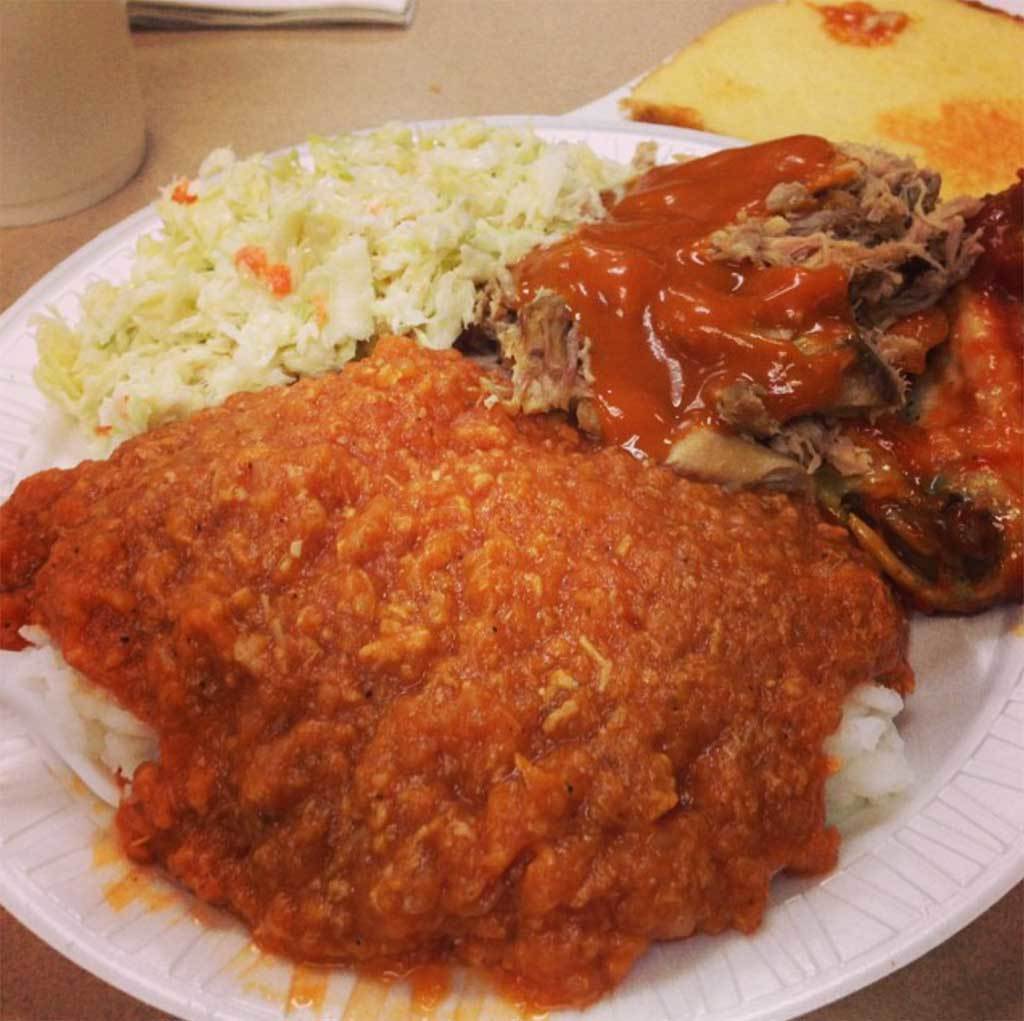 Red hash — Dukes Bar-B-Que
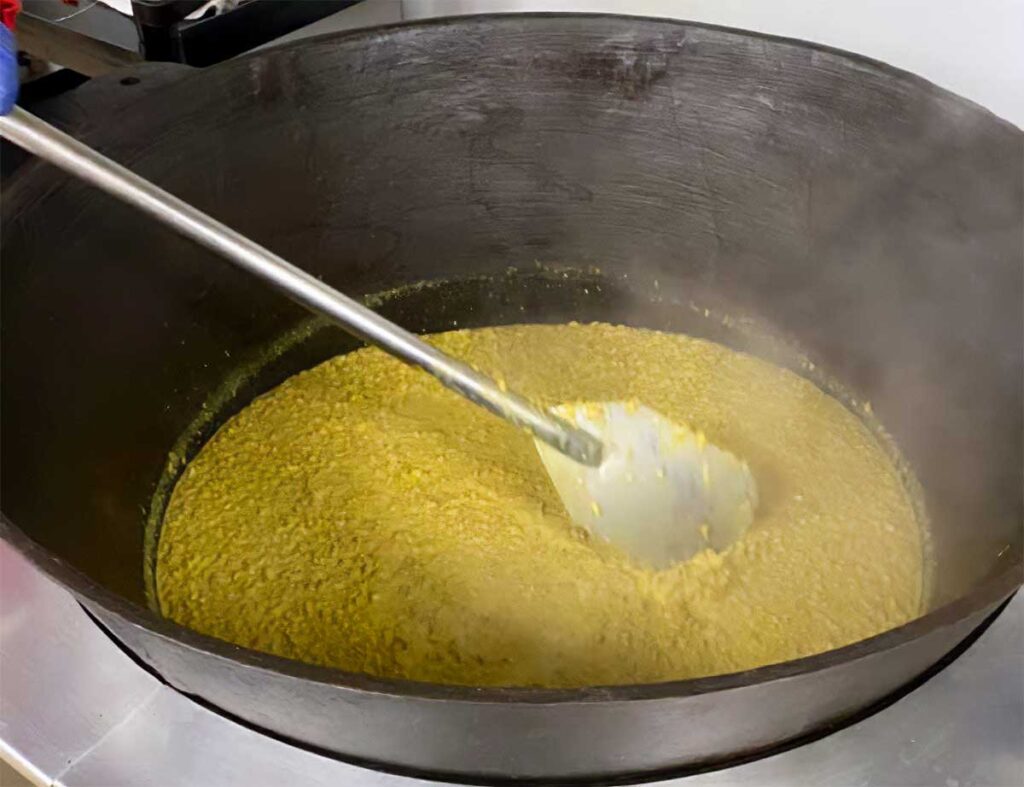 Yellow hash — KennyBo’s Bar-B-Que
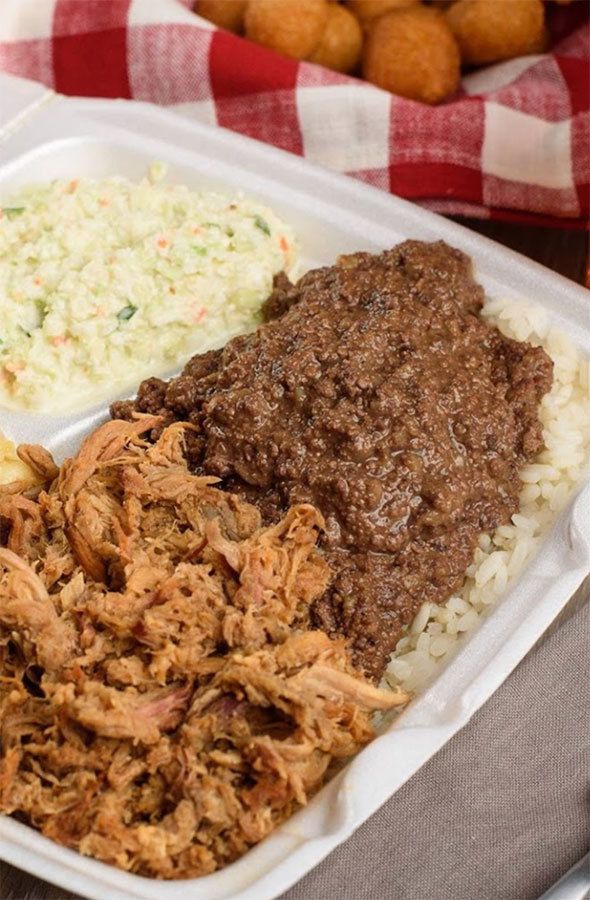 Liver hash — Rogers Bar-B-Que
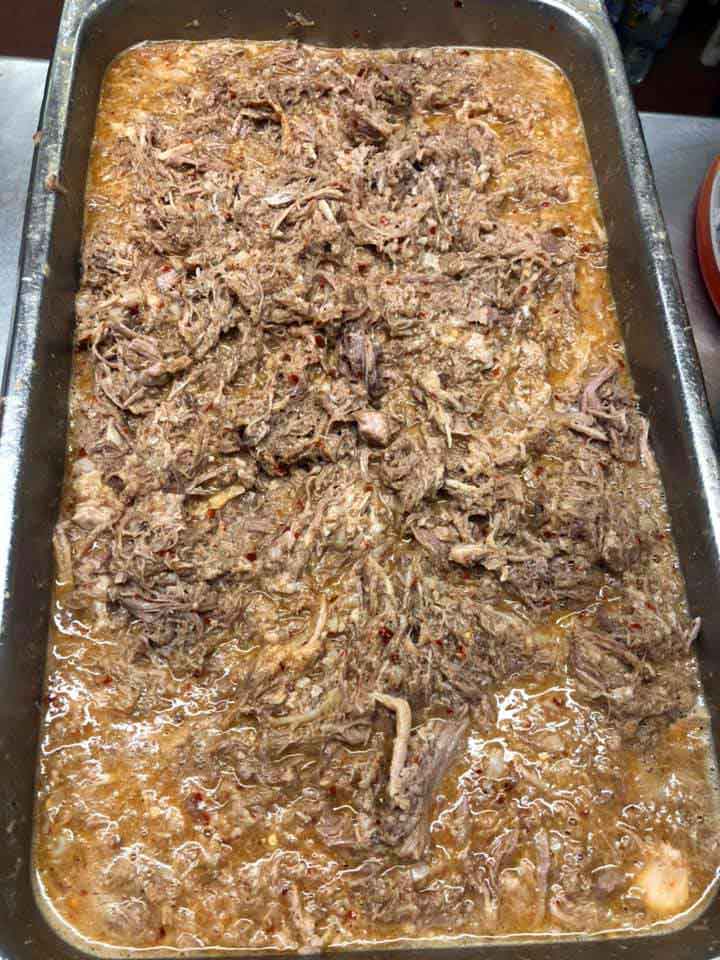 Hash — Cooper’s Country Store, Salters
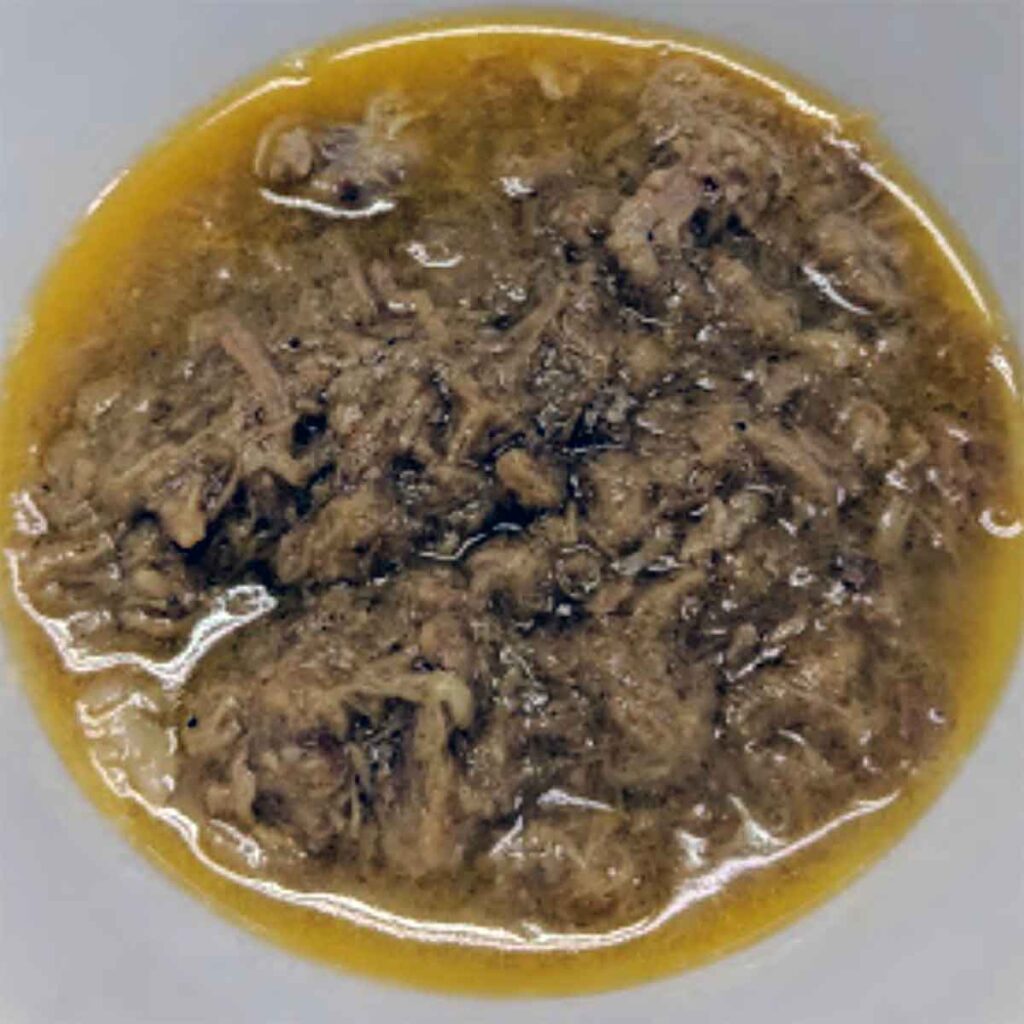 Pork hash — Wise’s Bar-B-Q House
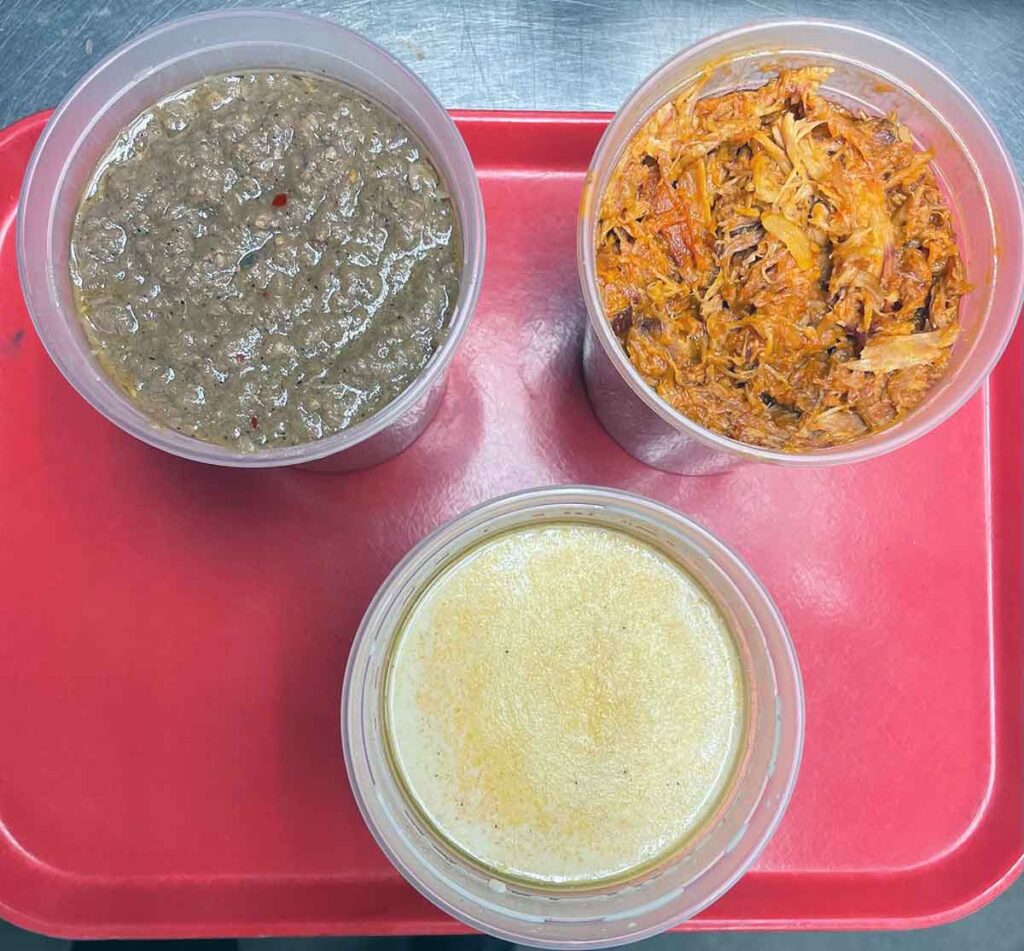 Upstate beef hash (top left) — Midway BBQ. Photo courtesy of Midway BBQ.
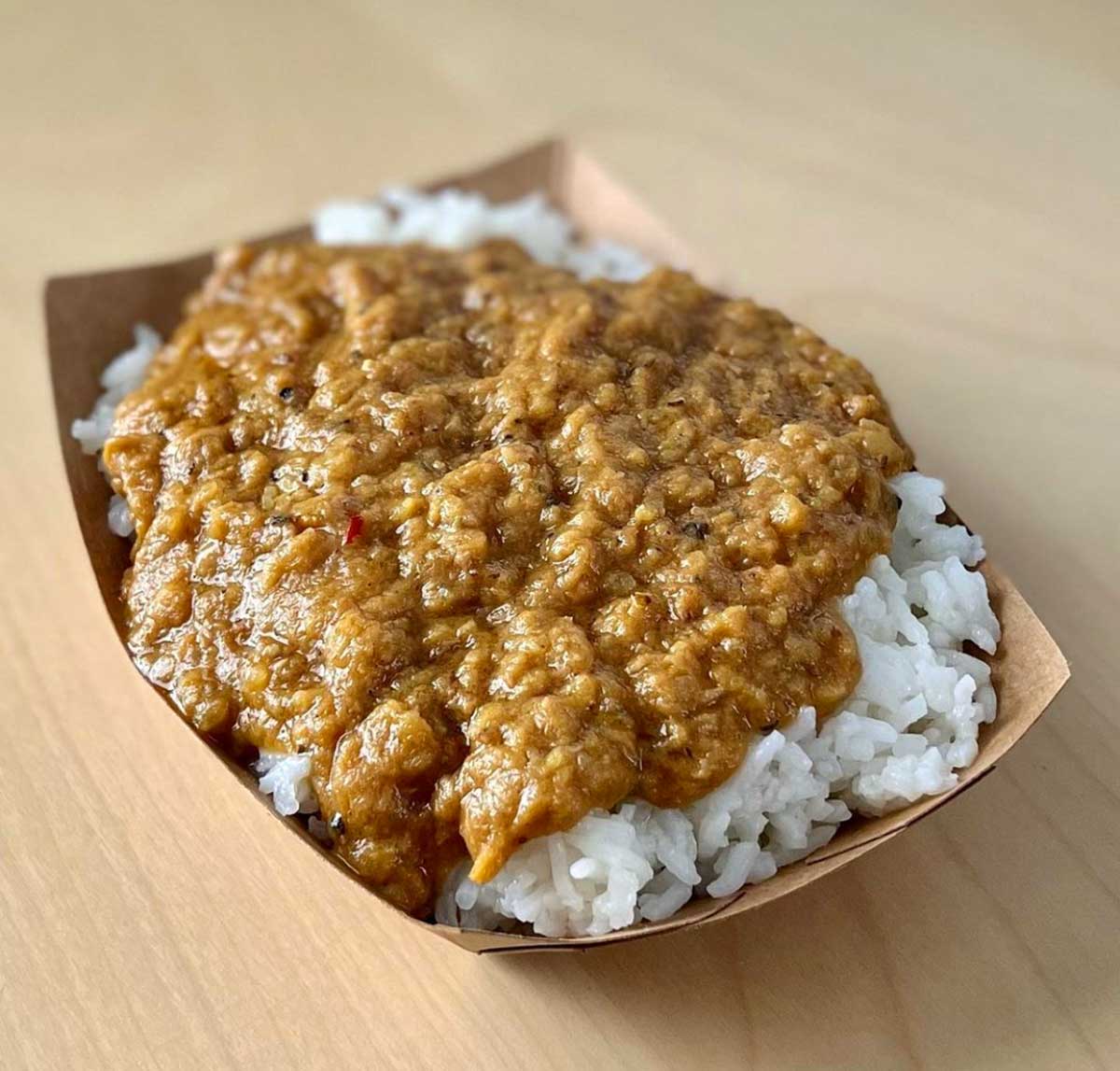
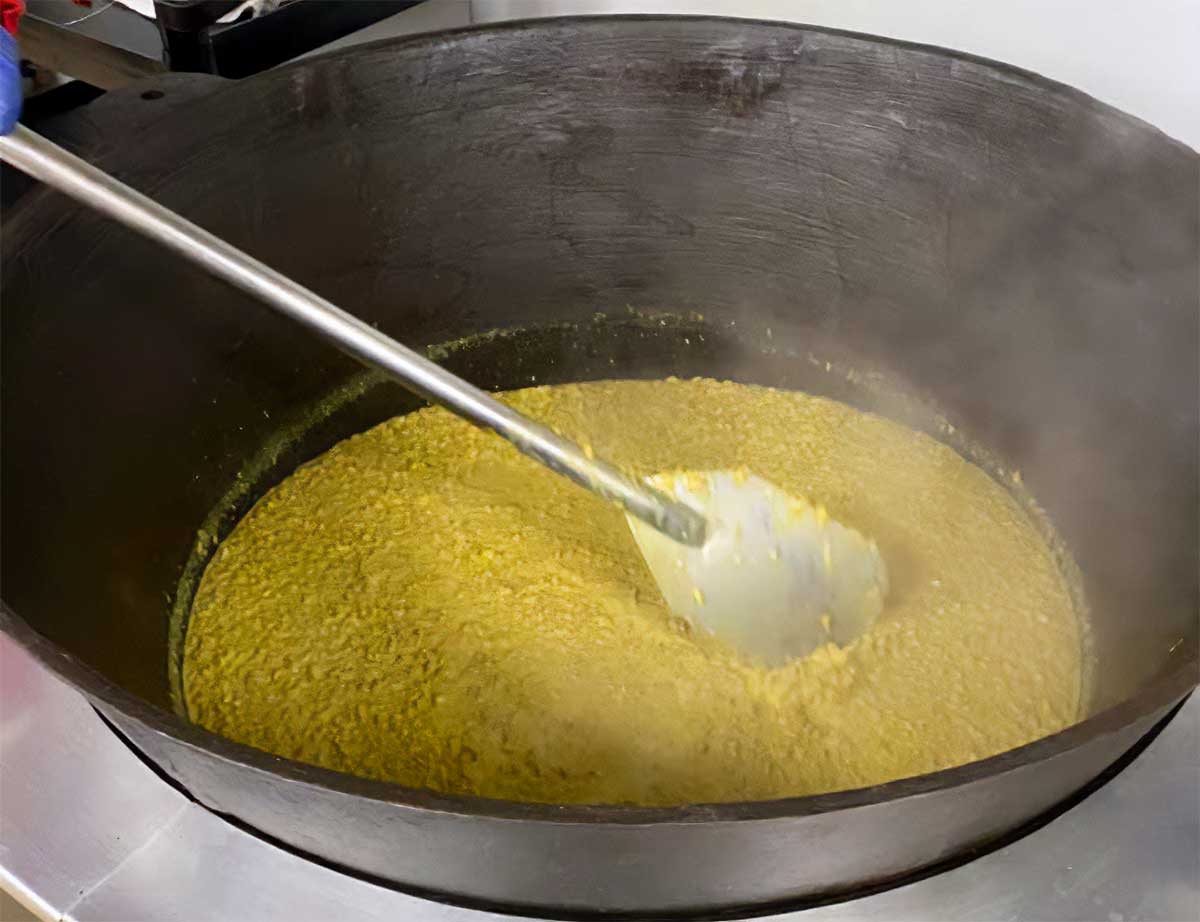

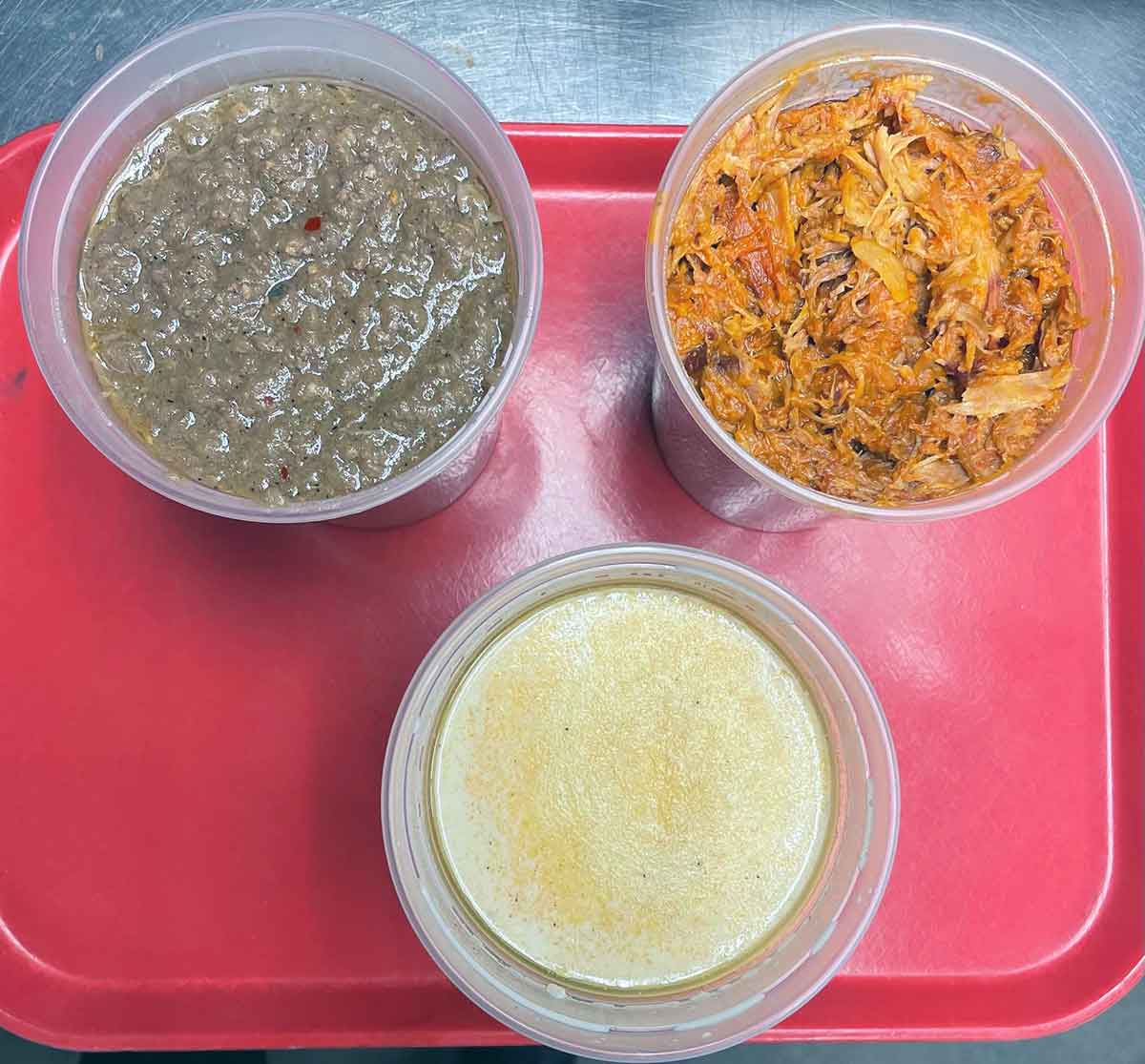
At its simplest, think of it as a meat gravy, usually ladled over white rice. After that, things get complicated. In the Midlands you’ll often find pork hash with mustard in the mix. Around the Pee Dee, liver sometimes plays a noticeable role. Head into the Upstate and you can find beef hash loaded with onions. Sumter even has its own red-hash tradition.
If you want to go down that rabbit hole—and we think you should—our guide to South Carolina barbecue hash covers the history, regional differences, old hash houses, recipes, and places that still serve it.
The buffet matters, too. Not because putting barbecue on a buffet somehow makes the barbecue better. Sometimes it most definitely does not.
But for generations, a South Carolina barbecue outing often meant much more than a plate of pork. You went through a line for hash and rice, fried chicken, vegetables, perloo or chicken bog, macaroni and cheese, sweet potatoes, slaw, banana pudding, and whatever else the restaurant happened to put out that day. McCabe’s and Shuler’s still give you very good barbecue along with that tradition. At places like Shealy’s and Brown’s, the larger spread is a big part of the reason folks have kept coming back.
And that gets at something worth remembering as barbecue changes. Some of South Carolina’s best pitmasters today are cooking brisket, making sausage, borrowing ideas from Texas, bringing Puerto Rican flavors to the pit, or serving barbecue in restaurants that look nothing like the country joints their grandparents knew.
None of that erases what came before. The old places are still here, and plenty of the newer cooks are paying close attention to them.
But there are also a few restaurants where the old ways, a local specialty, or the place itself can be reason enough to make the trip. Maybe the pork isn’t better than everything you’ve already read about above. That’s not really the point.
These are places that can show you something about South Carolina barbecue you might otherwise miss.
South Carolina BBQ Traditions Worth Experiencing
Some barbecue places are worth visiting for more than the pork or ribs alone.
That doesn’t mean the food gets a free pass. We’re still sending you there to eat. But at the places below, part of the reason to go is what you’ll find wrapped around the barbecue: a family tradition that helped shape the way a whole region eats, a kind of hash you won’t find 50 miles away, a working country store, a farm that raises the hogs it sells, or one of those enormous barbecue buffets that has been part of South Carolina life for generations.
If you’re trying to understand South Carolina barbecue rather than simply eat your way through the very best joints, these places fill in some important blanks.
They’re listed alphabetically, not ranked.
Brown’s Bar-B-Q — Kingstree
At Brown’s Bar-B-Q, barbecue is only part of what comes down the buffet line, and that’s exactly the point.
The pork gets what the family calls barbecue gravy, a thin vinegar-and-pepper sauce that gets mopped onto the meat while it cooks. Then look around before filling the rest of your plate. Chicken bog, catfish stew, fried chicken, fatback, sweet potatoes, vegetables, and plenty more turn lunch into something much closer to an eastern South Carolina country meal than a modern barbecue platter.
There’s a real farm connection here, too. Thomas Brown grows vegetables specifically for the restaurant, so some of what you see on that long buffet started in the family’s own fields.
The pork isn’t the only reason to come. Brown’s gives you a taste of the big eastern South Carolina barbecue buffet, where barbecue shares the stage with whatever else the kitchen and the farm have to offer.
Cooper’s Country Store — Salters
Cooper’s Country Store really is a country store.
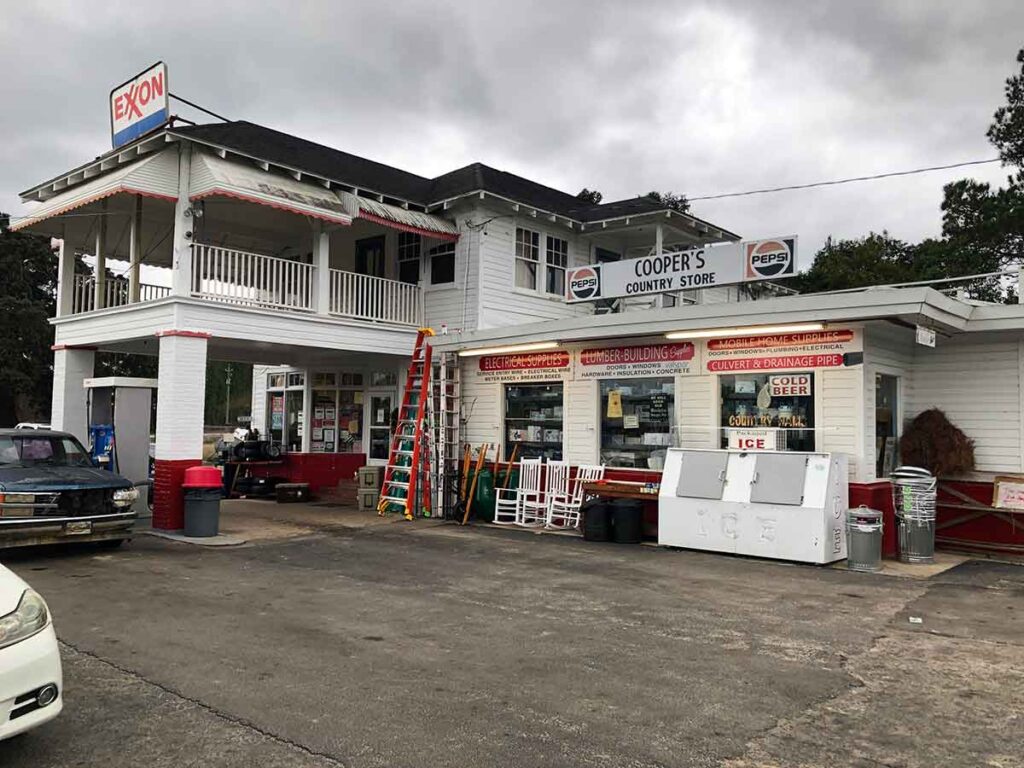
That distinction matters. Plenty of restaurants can hang old signs on the walls and make a room look rustic. Cooper’s has been sitting along Highway 521 since 1937, selling the sorts of things a country store actually sells. You can pick up groceries, hardware, or a country ham and then walk to the back for barbecue.
And the barbecue belongs there. Whole hogs are traditionally cooked over wood embers, pulled, and served in the vinegar-pepper style you’d expect in this part of the state. Get some hash while you’re at it. Cooper’s has also added a hot lunch buffet in recent years, but the meat counter and the store around it remain the real attraction.
The setting isn’t a prop. You’re eating barbecue inside a piece of the rural world that helped produce food like this in the first place.
If your route takes you anywhere near Salters, take the detour.
Dukes Bar-B-Que — Chestnut Street, Orangeburg
Walk into Dukes Bar-B-Que on Chestnut Street and you may wonder where the rest of the buffet went.
That’s part of the charm.
Pork. Hash and rice. Slaw. Pickles. Bread. Sauce. There may be a few extras around the edges, but the basic idea is almost comically simple. Grab a Styrofoam plate, sit at one of the long tables, and eat.
The restaurant is operated by descendants of the Dukes family, and the Ott branch has been serving barbecue in Orangeburg from this location since the 1970s. The family’s old sauce tradition remains central to the experience, including the thick, reddish-orange style often called rust gravy in the Orangeburg branch of the Dukes family tree.
There are other Dukes restaurants around South Carolina, and they aren’t a conventional chain. Each has its own history and quirks. Chestnut is the one we’d choose if you want to get a feel for what the old Dukes tradition is about.
Bring cash, and don’t expect fancy. That would rather defeat the purpose.
Midway BBQ — Buffalo
Go to Midway BBQ for the hash.
The pork is cooked over hickory and oak coals in an old pit, and it’s worth eating. But if you’ve never had Upstate beef hash, this is your chance to discover that the word hash can mean something completely different depending on where you are in South Carolina.
Midway’s version comes from the old Union County hash-house tradition, where beef rather than pork formed the base. It’s thick, rich, and heavy with onion, and it bears very little resemblance to the mustardy pork hashes you’ll find farther south or Ward’s red hash over in Sumter.
The restaurant is also a meat market, which somehow makes the whole thing feel even more appropriate. Walk past the butcher cases, smell the hickory smoke, and order the food that has kept this place part of the local landscape for generations.
You could spend a week eating barbecue around South Carolina and never encounter another bowl quite like it. That’s reason enough to go.
Rizer’s Pork & Produce — Lodge
Rizer’s Pork & Produce makes the farm-to-table connection unusually literal.
The Rizer family has been raising hogs and growing vegetables since 1952. In 2000, the family opened the store and restaurant in Lodge, where they could sell the pork and produce they were already raising.
That means you can come for the country buffet, eat barbecue, hash, ribs, fried chicken, beans and peas, and then leave with fresh pork or vegetables from the same family operation. They’ll sell you everything from shoulders and ribs to sausage and other cuts, and whole hogs can be ordered raw or barbecued.
There are flashier ways to experience South Carolina barbecue. There may not be many that connect the hog, the farm, the market, and the lunch plate so directly.
Rizer’s is out of the way, which is part of the deal. Go hungry and enjoy the drive.
Shealy’s Bar-B-Que — Batesburg-Leesville
If you want to see what happened when the South Carolina barbecue buffet became an institution, go to Shealy’s Bar-B-Que.
Victor and Sara Shealy started by cooking whole hogs on weekends in the 1950s before opening the restaurant in 1969. What grew from that little operation is now a sprawling buffet where barbecue and hash share space with fried chicken, vegetables, macaroni and cheese, sweet potatoes, desserts, and enough other food that first-timers have a tendency to lose all sense of proportion.
That abundance is the point.
Generations of South Carolinians have grown up with the idea that “going for barbecue” can mean sitting down to a spread like this, and Shealy’s may be the grandest surviving example.
Get the pork and hash. Absolutely get the fried chicken. Then make a second trip through the line and admit you were never going to show restraint anyway.
Sweatman’s Bar-B-Que — Holly Hill
There was a time when Sweatman’s Bar-B-Que would have been one of the easiest recommendations on this entire page.
For decades, Sweatman’s was one of the places people pointed to when they wanted to show somebody traditional South Carolina whole-hog barbecue: hogs cooked low and slow, mustard sauce, hash and rice, skins, and an old farmhouse outside Holly Hill that felt like exactly the place where you ought to eat it.
The restaurant has changed. The old open concrete-block whole-hog pits are no longer the way the pork is cooked; Southern Pride smokers eventually replaced that system. The buffet disappeared as well. And in 2026, the Patel family took over the restaurant, marking another major turn in a story that began when the Sweatman family opened here in 1977.
So why go now?
Because old barbecue places don’t live inside snow globes. They change ownership. They change equipment. Sometimes they get better, sometimes worse, and sometimes they simply do what they have to do to keep the doors open.
Order the pork, hash and rice, ribs, and skins if they have them. Then understand that you’re visiting one of South Carolina barbecue’s great names in the middle of its next chapter, not stepping backward into the version somebody wrote about 25 years ago.
Ward’s Bar-B-Que — Sumter
At Ward’s Bar-B-Que on Alice Drive, order the hash and rice before worrying too much about anything else.
Ward’s makes red hash, and if all the hash you’ve eaten elsewhere has been yellowish, mustardy, or beef-based, one look at the plate will tell you this is something different.
This is a pork hash with a red color and flavor profile that belongs to the Sumter area. Put it over rice, add some of Ward’s vinegar-based pork, and you’ve got one of those plates that explains regional South Carolina food better than another thousand words could.
Ward’s has several locations around Sumter and now one in Manning. Of the Sumter locations, Alice Drive is the one we’d choose for this stop, but the larger story is the local tradition rather than one particular dining room.
If you’ve already eaten Midway’s beef hash—or mustard hash somewhere around the Midlands—even better. Try Ward’s next and you’ll understand why asking for “South Carolina hash” is a little like asking for “South Carolina barbecue sauce.”
You’re going to have to be more specific.
Explore More South Carolina BBQ
Ready to narrow things down by destination? Explore our guides to barbecue in Aiken, Charleston, Columbia, Florence, Greenville, Hilton Head, Myrtle Beach, and Spartanburg.
Or, if you’d rather see all the barbecue spots around the state, browse the complete SC BBQ Trail map.
So, Who Makes the Best BBQ in South Carolina?
We still don’t have one answer.
After all these years eating barbecue around South Carolina, we’re not sure we ever will—and we don’t think that’s a problem.
Put a plate from Scott’s in front of somebody who loves vinegar-pepper whole hog and that person may have found exactly what they came looking for. Somebody else may rather have fatty brisket from Lewis, mustard and hash from Hite’s, a little bit of everything from McCabe’s buffet, or something they’ve never tasted before at Palmira.
That’s the fun of eating barbecue here. There are old traditions worth protecting, newer ones taking shape, and plenty of arguments waiting to happen over which place does what best.
Start with what sounds good. Take the detour. Order the hash even if you’re not quite sure what it is. If you see skins on the menu, get some. And if you find a barbecue joint we need to revisit, let us know.
We’re always willing to eat the evidence.
About the author
James Roller has documented South Carolina barbecue for Destination BBQ since 2012 and authored the SC BBQ cookbook Going Whole Hog. These guides draw on years of visiting and documenting barbecue restaurants across the state, along with current restaurant information, historical research, and published sources.
Corrections and editorial standards
- Restaurant details change. Spotted something wrong or outdated? Send a correction here: Corrections & Updates
- How we handle sources, fact-checking, and updates: Editorial Standards
- Media or general notes: Email the publisher

I was born and raised in South Carolina. For anyone to not mention Shealy’s BBQ in Batesburg-Leesville Hites in West Columbia, Prices in Gilbert or Piggy Park in Cayce. Well, as we say, “You ain’t from round here”
And to include (Now closed) Restaurants? If they were so good, then why did they close?
This article was written in 2014 and despite the fact that it currently says it was updated in 2020, I’m not so sure. Definitely, something I need to update at least annually. Apologies and thanks for the comment. I’ll get it updated.
John, Thanks for writing! I have ask: Is McCabe’s still open? I have heard conflicting stories over the years and know that there was an illness or death that significantly impacted the restaurant. McCabe’s is one of SC’s best, without question. Last time I rode by, I had heard that they were shut down for good, but the restaurant sat there unopened but no sign of permanent closure. What do you know?
I much more agree with your own assessment of good barbeque than “the masses”. Honestly, there is no remotely decent que west of I-95 – certainly not in Gaffney! In full disclosure, my office is less than a Seth Beer long homerun shot from McCabes and my wife is in the McCabe family. Can you guess my pick for the best barbeque restaurant in the country?