Brining Math Explained: Percent, Grams, and Equilibrium
A practical guide to wet, dry, and equilibrium brine math with gram-based examples, salt brand conversions, and time-by-thickness tips.
Brining math is simple once you define percent by weight and stick to grams. This explainer covers the core formulas for wet brines, dry brines, and equilibrium brines, with quick examples. It’s a handy companion to our Brining Methods guide and the Brining Calculator.
Quick-Start: The Formulas
- Wet brine: % salt of water weight (e.g., 5% = 50 g/L water).
- Dry brine: % salt of meat weight (e.g., 2% of meat in grams).
- Equilibrium (EQ) brine: set a final target salt % across meat + water. Exact: salt_g = target% × (meat_g + water_g) ÷ (1 − target%).
Use grams for accuracy. Keep brine cold (≤ 40°F/4°C; see USDA FSIS guidance).
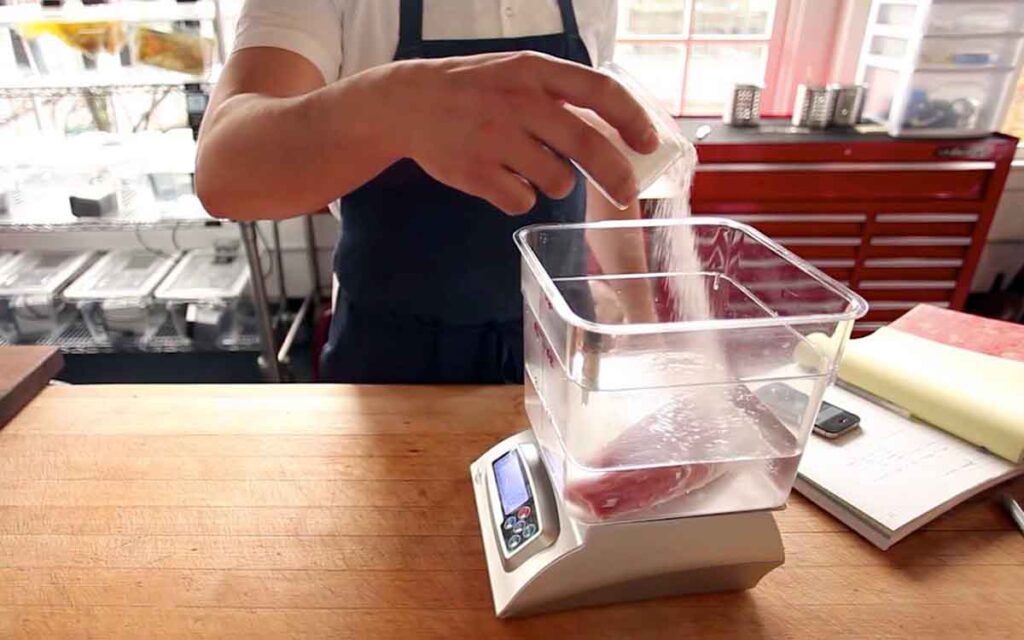
What “percent by weight” means in brining
In brining, percent always means percentage by weight. That’s why recipes use grams or ounces rather than cups.
A 5% wet brine means 5 g of salt per 100 g of water (50 g/L), and a 2% dry brine means 2 g of salt per 100 g of meat.
Using weight makes brine formulas consistent no matter the salt type. For context, most common wet brines range from about 5% to 10% salt by weight. Weigh water if possible (1 mL of water ≈ 1 g) and definitely weigh salt for accuracy.
Wet brine formula (with example)
Formula: salt_weight = target% × water_weight.
In other words, for a 5% brine use about 50 g of salt per 1 liter (1,000 g) of water. This yields a moderately salty soak that’s suitable for many meats.
Worked example (wet brine): Suppose you need 2 liters of a 5% brine. Water weighs ~2,000 g, so required salt = 0.05 × 2,000 = 100 g of salt. Dissolve the salt completely in the water, chill the brine, then submerge your meat fully in this solution. (Always brine under refrigeration at or below 40°F/4°C for food safety.)
Dry brine formula (with example)
Formula: salt_weight = target% × meat_weight.
A common target is around 2% of the meat’s weight in salt. This method simply salts the meat directly (no added water).
Worked example (dry brine): You have 1,200 g of pork chops. Salt needed = 0.02 × 1,200 = 24 g of salt. Sprinkle this 24 g evenly over the chops. Then let the meat rest in the fridge (often 8–24 hours) so the salt can penetrate. For poultry with skin, dry-brining uncovered toward the end helps the skin dry out for better crispness.
Equilibrium brine (exact vs. approximate)
Equilibrium (EQ) brining aims for a specific final salt concentration throughout the meat and the brine. In an EQ brine, you calculate salt based on the total mass of meat + water, so that when diffusion is complete, the meat cannot exceed the chosen salt percentage (it “self-equilibrates”).
Two ways to express the formula:
- Approximate: salt_weight ≈ target% × (meat_weight + water_weight). (This is a simple estimate that slightly under-targets, since it ignores the small weight of the salt itself.)
- Exact: salt_weight = target% × (meat_weight + water_weight) ÷ (1 − target%). This mass-balance formula accounts for the salt’s weight in the system. The EQ Brining Calculator uses this exact formula.
Worked example (EQ brine): Meat is 1,000 g and water is 500 g. You want a final 1.2% salt content.
Using the simple method: 0.012 × (1,500) = 18.0 g salt.
Using the exact formula: 0.012 × 1,500 ÷ (1 − 0.012) ≈ 18.2 g salt.
In practice, 18 g vs 18.2 g is negligible precision for kitchen use. Mix the 18 g of salt into enough water to cover the meat (500 g in this case), and brine as usual. The meat and brine will slowly equalize to about 1.2% salt throughout.
Why use EQ brining? It’s more forgiving on timing. Because the salt level can’t overshoot your target, an extra few hours (or even a day) in the brine won’t ruin the food. This makes EQ brining great when you’re unsure of exact timing. Also, you can use a sealed bag to reduce how much water is needed—just enough to surround the meat—speeding up diffusion and saving fridge space.
Time vs. thickness (diffusion basics)
Weight determines how much salt you add; thickness determines how long you need to brine.
Salt penetrates meat slowly, mainly by diffusion, so a thick roast requires more time than thin cutlets, even if they weigh the same. For example, in one experiment a 3-inch thick pork loin soaked in brine for 1 hour only had salt penetrate about 2 millimeters deep. Thinner pieces (or pieces injected with brine) will reach equilibrium salinity much faster than a whole brisket or turkey breast.
As a rule of thumb, use longer brine times for thicker cuts and very lean meats, and shorter times for thin or pre-salted (“enhanced”) meats. Weight is a poor guide – a 5-pound butterflied chicken might fully brine overnight, whereas a 5-pound whole ham could take several days.
When in doubt, consult the calculator for a brining time estimate based on thickness, and plan for a little extra time to ensure the center gets seasoned. Lab tests show shallow penetration after short soaks; e.g., ~2 mm at 1 hour in pork loin, per Dr. Blonder at AmazingRibs.
Diamond Crystal vs. Morton: why grams matter
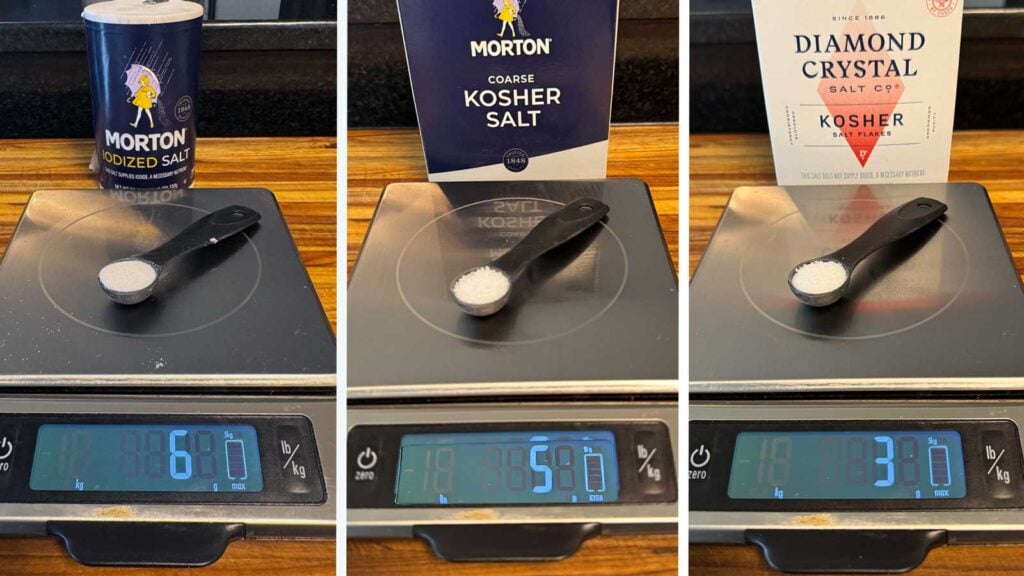
Not all “salt” is equal when measuring by volume. Different brands and crystal shapes pack differently, which can dramatically change how much salt you’re actually adding if you use teaspoons or cups.
For instance, one cup of Morton kosher salt weighs around 225–250 grams, while one cup of Diamond Crystal kosher salt weighs only about 140 grams, per Serious Eats. That’s nearly double the salt in the Morton cup! Similarly, a teaspoon of Morton kosher is ~5 g, versus ~3 g for Diamond Crystal.
This is why brining guides standardize on measuring salt by weight. Grams never lie – 20 g of salt is 20 g of salt, regardless of the brand. If you must measure by volume, be aware of your salt’s density and use salt conversion charts to get close. But whenever possible, weigh your salt for reliable, repeatable brine salinity.
Edge cases and food-safety tips
- “Enhanced” or pre-salted meats: If the package label says something like “contains up to X% solution” or mentions “self-basting” or “kosher” meat, the product has already been salt-treated. Such meat is essentially pre-brined. You’ll want to reduce or skip additional brining to avoid over-salting. In many cases, you might dry-brine very lightly or just not brine at all when dealing with enhanced meats. (For example, Meathead Goldwyn advises not brining enhanced or kosher meats because they’re already infused with salt.) For poultry, salting or brining is only one part of the safety story; our safe turkey internal temperature guide explains how to finish the job with proper cooking temperatures and rest times.
- Keep it cold: Always brine in the refrigerator or an ice-chilled environment at 40°F (4°C) or below. This temperature safety guard applies to wet, dry, and EQ brining alike. Harmful bacteria can multiply if the brine temperature rises above 40°F. For wet brines, start with a chilled solution and keep the container in the fridge. For dry brines, refrigerate the meat while it rests.
- Discard the used brine: A used brine is basically raw meat juice in salt water. To be safe, do not reuse brine. Once you’re done brining, throw it out. The same goes for any marinade or injection that has come into contact with raw meat: discard it to be safe.
- Injection brining hygiene: If you’re injecting brine into meat (a common competition technique), practice good sanitation. Use clean, food-safe equipment and sterilize the needle or syringe before and after use. Never save leftover injection solution that has touched raw meat (it should be treated like used brine). Injected meats still need to be kept cold while they absorb the brine.
Testing notes: examples validated in grams with Diamond Crystal and Morton; EQ results spot-checked against ChefSteps guidance.
Corrections and editorial standards
- Spotted something wrong or outdated? Send a correction here: Corrections & Updates
- How we handle sources, testing, and updates: Editorial Standards
- Media or general notes: Email the publisher
Sources
- USDA FSIS — Refrigeration & Food Safety — primary authority for ≤ 40°F (4°C) storage.
- USDA FSIS — Can you reuse marinade? — “boil before reuse” guidance applies to brines/marinades.
- Serious Eats — Kosher salt weight differences — Diamond Crystal vs Morton grams per cup; why weight beats volume.
- AmazingRibs (Meathead/Blonder) — Salting & Wet Brining — diffusion data, guidance on enhanced/kosher meats.
- ChefSteps — Equilibrium Brining — context on EQ targets and mass-balance approach.
We cite authoritative references and note when testing is based on first-hand experience.
About the author
James Roller documents South Carolina barbecue for Destination BBQ and authored the SC BBQ cookbook Going Whole Hog. This guide explains brining math in plain terms, using gram-based examples for wet brines, dry brines, and equilibrium brines, along with salt-brand conversions, timing guidance, and food-safety references.