How to Choose a Brisket for Smoking: Cut, Grade, Shape, and Size
Choose a brisket with the right cut, grade, shape, and smoker fit before you plan portions, timing, trimming, or the cook
Long before you light a fire, you may be standing in front of a cooler or butcher counter with several heavy, awkwardly shaped packages and one real question: which one goes in the cart? No package guarantees a perfect cook, and technique still matters. The goal is simpler than that: avoid the obvious problems and pick the best brisket in front of you.
Start with the decisions that matter most: the cut, whether it fits your smoker, and the shape of the flat. Then use grade, visible marbling, existing trim, and package condition to choose between briskets that otherwise look close. The Prime shield, the biggest fat cap, and how much the package bends should not overrule the basics.
Meat-Case Check: What to Look For
- Choose the cut: Decide whether you want a whole packer, flat, or point.
- Confirm smoker fit: Compare the brisket’s actual length and width with your usable grate space.
- Favor a full flat: Look for a full, reasonably even flat rather than a severe taper.
- Check the grade: Prime generally offers more marbling potential; Choice can still be an excellent buy.
- Compare visible marbling: Look for fat flecks within the lean, not simply the largest exterior fat cap.
- Check existing trim: Avoid severe gouges, scalped areas, and wispy edges when better options are available.
- Read the label: Confirm the cut, grade, weight, and date wording.
- Inspect the package: Choose a sound package without tears or leaks.
Already have your brisket? Use the Brisket Calculator to turn the cut and package weight into a cooking plan.
Whole Packer, Flat, or Point: Which Should You Buy?
Start with the cut because it tells you what is actually in the package. A whole packer contains the flat and point together; a separated flat or point gives you one major muscle. The USDA IMPS brisket cut definitions identify the deckle-off whole brisket as Item 120, the flat as 120A, and the point as 120B.
For a closer look at the flat, point, deckle, and brisket cut terms, see the brisket glossary and guide.
Use the table to match the package to your space and what you want to serve.
| Cut | What is in the package | Buying advantages | Tradeoffs | Best fit | What to verify |
|---|---|---|---|---|---|
| Whole packer | Flat and point attached | Gives you flat and point meat in one package | Larger and harder to fit or handle | Cooks who want both muscles and have the grate space | The label says whole brisket or whole packer and the point is attached |
| Flat | Separated flat muscle only | Smaller, easier to fit, and suited to sliced flat meat | Leaner; some retail flats are thin or closely trimmed | Smaller smokers or situations where a good flat is the best option | A full flat without severe tapering or scalping |
| Point | Separated point muscle only | Richer point meat without buying the flat | Less common and does not provide flat slices | Point-focused meals when a separated point is available | The butcher confirms it is the separated point |
When a whole packer is the better choice
For most backyard cooks with room for it, a whole packer is usually the better place to start. You get the leaner flat and fattier point in one package, so you have both sliced flat and richer point meat.
When a flat makes sense
A flat can make sense when a packer will not fit, you want the flat by itself, or the best package available is a flat. Because it is leaner, favor one that looks full from end to end instead of thin and sharply tapered.
If the store only has flats
A flat is not a failed shopping trip. Look for the fullest, most even flat available, and avoid severe tapering, scalped areas, or damaged packaging when you have a choice. Treat grade and visible marbling as supporting clues. If every flat is thin, closely trimmed, or damaged, ask whether the store can order a whole packer.
When buying a point makes sense
A point-only purchase works when you specifically want the richer point meat and can find it sold separately. It does not include the flat, so ask the butcher to confirm what is in the package.
Choose a Brisket That Fits Your Smoker
A brisket can look like the best package in the case and still be wrong for your cooker. Measure the usable grate, not the lid, and make sure the brisket can sit where it belongs without hanging over direct heat.
What size brisket should you buy?
“What size brisket should I buy?” is really two questions. One is whether it fits your smoker. The other is how much you need for your group. Compare the brisket’s actual length and width with your usable grate space, not just the weight on the label. Briskets at similar weights can have very different proportions.
Also make sure you can carry, refrigerate, and safely handle the package. Bigger is not automatically better.
Smoker fit is one question. Feeding your group is another. Use how much brisket to buy for guest-count and purchase-weight math, then use the Brisket Calculator to build the plan after you choose the brisket.
Look for a Full, Reasonably Even Flat
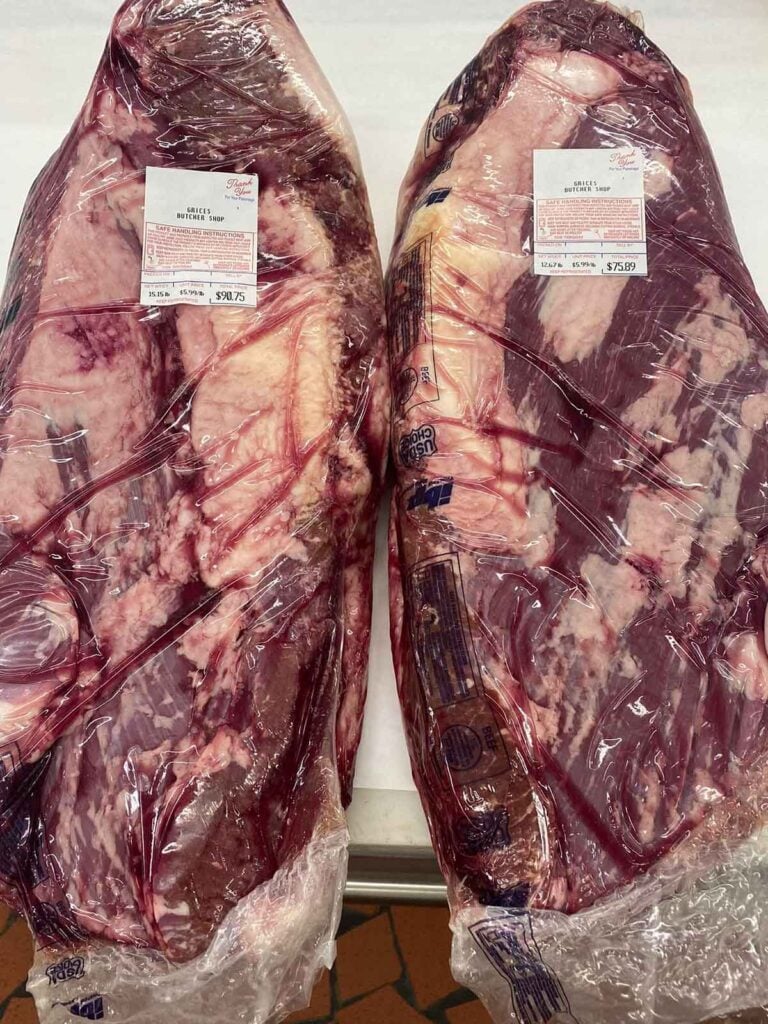
The shape of the flat is one of the easiest things to compare. Find the thinner, flatter end on each package. A flat that stays reasonably full is generally easier to manage than one that fades into a wispy edge.
You do not need a ruler or perfect symmetry. Retail briskets vary, and you are comparing what is actually in front of you. When two packages are otherwise close, favor the one with the fuller, more consistent flat.
Once you know the cut, weight, and shape, the brisket smoking time chart can help with rough timing ranges.
What you can see through the package
- The overall length, width, and general shape
- How sharply the flat tapers
- Exterior fat and closely trimmed or scalped areas
- Deep processor gouges, ragged flaps, and very thin edges
- The cut name, grade, weight, inspection mark, and date wording
- Some visible marbling where lean surfaces are exposed
- Whether the package is tight, torn, or leaking
What you cannot know from the package
- The tenderness of the finished brisket
- How marbling is distributed through every part of the flat
- The exact trimmed or cooked yield
- The exact cooking time
- Whether a Prime brisket will outperform every Choice brisket
- Whether a package that bends more will finish more tender
Prime vs. Choice vs. Select Brisket
USDA grade tells you something about marbling, but it does not settle the choice. Under the USDA carcass beef grade standards, Prime has a higher minimum marbling requirement than Choice, and Choice has a higher minimum than Select.
The grade is assigned from the carcass, including marbling measured at the ribeye. Your brisket is not graded on its own. A well-shaped Choice brisket may still be the smarter buy than a Prime brisket with a badly tapered flat or damaged package.
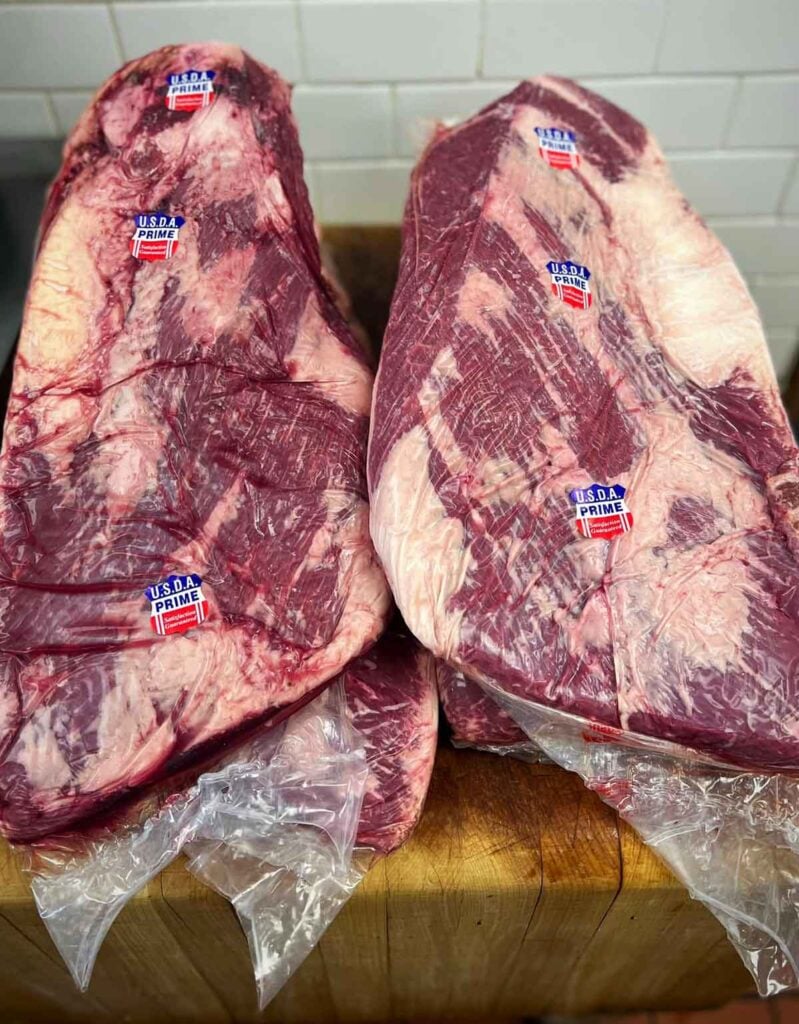
The marbling terms come from USDA. The buying advice is ours.
| USDA grade | Official minimum marbling | What it suggests | What it cannot guarantee | Buying advice |
|---|---|---|---|---|
| Prime | Minimum slightly abundant for the younger maturity group | More marbling potential | Good shape, sound packaging, or a better result every time | Consider when shape and price also make sense |
| Choice | Minimum small for the younger maturity group | Moderate marbling potential and value | That every Choice brisket is the same or worse than Prime | A strong everyday choice when well shaped |
| Select | Minimum slight | Less marbling potential | Failure or an unusable brisket | Usable, but generally less forgiving |
Inspection and grading are not the same
The inspection mark and grade shield answer different questions. Federal inspection addresses wholesomeness. USDA quality grading is a voluntary, fee-for-service program. Ungraded does not mean poor quality, but it also does not prove Prime or Choice quality.
Is Prime worth it?
Prime offers more marbling potential. It may be worth paying for when the shape, fit, and budget also work. It does not fix a paper-thin flat or damaged package.
If the Choice brisket has the better shape, it may also be the better buy. Select is leaner by the grade standard, but it is not a waste. Favor the best-shaped piece available.
Wagyu labels and branded programs use other criteria. Check the seller’s documented standards rather than assuming every premium label means the same thing.
Check Marbling, Fat Cap, and Existing Trim
Marbling and exterior fat are not the same thing. Marbling sits within the lean; the fat cap sits outside. A thick cap does not replace marbling or automatically make a better buy.
Where lean is visible, compare the white flecks within it. That is a useful sign, not a complete view of marbling through the flat.
You cannot undo deep gouges, scalped areas, ragged flaps, or a flat shaved to a thin edge. Choose a cleaner package when one is available.
Inspect the Label and Package
Read the cut name before the grade shield. A package marked only “brisket” may be a whole packer, flat, or another brisket cut. Terms such as first cut and second cut can vary. When the label is unclear, ask.
Next check the grade, weight, inspection legend, and date wording. Weight helps with fit now and planning later. Follow the package’s date language rather than inventing a home wet-aging schedule.
Purple beef in a vacuum package can be normal
Vacuum-packed beef can look burgundy or purplish rather than bright red. USDA’s meat-color guidance explains that oxygen changes meat pigments. Color alone does not prove freshness or spoilage.
Do not open a store package to test the color. Ask the meat department when something looks unusual.
Package integrity matters more than a perfect color
Pass on tears, leaks, or an obviously broken seal. You do not need to guess what caused it. Choose another brisket or ask store staff to check it.
The table below shows what matters most and what should not decide the purchase.
| Signal | How much it matters | Look for | What it tells you | What it cannot tell you |
|---|---|---|---|---|
| Correct cut | High | Whole packer, flat, or point that matches what you want to buy | What muscles are included in the package | How tender or juicy the finished brisket will be |
| Smoker fit | High | Length and width that fit the usable grate | Whether the brisket can sit where it belongs in your cooker | How many people it will feed |
| Flat shape | High | A full, reasonably even flat without a severe taper | Whether the thin end has an obvious disadvantage | The exact cooking time or final tenderness |
| Package integrity | High | A sound, tight package without tears or leaks | Whether the package appears intact | Whether color alone proves freshness or spoilage |
| USDA grade | Medium | Prime, Choice, or Select shield when present | The marbling level tied to the USDA grade | Individual shape or condition |
| Visible marbling | Medium | White flecks within exposed lean | A limited view of marbling | Marbling throughout the entire flat |
| Existing trim | Medium | No severe gouges, scalped areas, or wispy edges | Whether the brisket has been gouged or trimmed too closely | How you should trim the brisket later |
| Bend or flex | Low | At most, compare otherwise similar packages | Little on its own | Tenderness or cold-chain history |
| Perfect symmetry | Low | A generally workable shape | Little beyond appearance | A better finished brisket |
| Exact weight to the pound | Low | A package that fits and works for your later plan | A planning input | Fit, shape, or exact cook time |
Fresh vs. Frozen Brisket
Frozen brisket is not automatically a lesser purchase. Look for sound packaging and allow time for safe thawing. USDA’s beef handling guidance says continuously frozen beef remains safe indefinitely, though quality can decline.
That does not prove fresh and frozen always taste identical. It means “frozen” should not end the comparison before you check cut, shape, grade, and package condition.
Do not turn the purchase into a home wet-aging project. USDA does not recommend aging beef in a home refrigerator because commercial aging depends on controlled conditions.
Where and How to Buy a Brisket
Where you shop matters less than whether you can get the cut you want, clear answers, and a sound package. Selection varies from one store, butcher, or online seller to the next, so use the table to compare what each may offer, not as a ranking.
| Buying channel | Typical selection pattern | Can inspect the exact package? | Can request a specific cut? | Main advantage | Watch for |
|---|---|---|---|---|---|
| Grocery store | May offer separated flats, whole packers, or both; selection varies | Often | Ask the meat counter | Convenience and direct package inspection | Do not assume “brisket” means whole packer |
| Warehouse club | May offer several vacuum-packed briskets to compare; selection varies | Often | May be limited | Side-by-side package comparison | Inventory and counter help vary by location and day |
| Independent butcher | May offer displayed cuts, custom trim levels, or special orders | Often, though some items may be ordered | Often | Conversation and special-order help | Be specific; butcher-shop beef is not automatically better |
| Online seller | May offer specified cuts, grades, or branded programs | Often no, unless exact-item photos are provided | Within the seller’s listed options | Access to specialty specifications | Check specifications, shipping terms, and replacement policies |
What to ask the butcher
Ask the butcher for the brisket you want. Start with plain language. The IMPS code is a useful backup when the person behind the counter knows the formal cut specifications, but not every retail employee will know those numbers.
What to Ask the Butcher
- “I’m looking for a whole packer brisket with the flat and point still attached.”
- “What USDA grade is it?”
- “Has it already been closely trimmed?”
- “Can you show me one with a full, reasonably even flat?”
- “Can you order one in a size range that fits my smoker?”
- If the cut is unclear: “Is this the whole IMPS 120 brisket, the 120A flat, or the 120B point?”
What Not to Overvalue at the Meat Case
Once you have the right cut, fit, shape, and sound package, do not let smaller clues overrule the basics.
The raw bend test
We did not find reliable evidence that a brisket that bends more in the package will finish more tender. The bag, meat temperature, fat firmness, brisket size, and how you support the package can all change the bend. At most, use it to break a tie after you compare the cut, fit, shape, grade, existing trim, and package condition.
The biggest fat cap
A large exterior cap is not marbling. Compare the exposed lean and overall shape before choosing the one with the thickest cap.
Perfect symmetry and exact weight
Briskets are naturally irregular. You need a workable flat, not a geometric showpiece. A slightly lighter or heavier package may be better if it fits and has a fuller shape.
Grade as a guarantee
Prime does not guarantee the better brisket. Choice is not second-rate, and Select is not an automatic failure. Check the grade, then judge the shape and condition of the package in front of you.
After You Buy, Plan the Cook
Once the brisket is in your cart, the question changes from what to buy to how much food and time you need. These guides handle the next steps:
- How Much Brisket Per Person handles guest counts, portions, and purchase-weight math.
- How Long to Smoke a Brisket gives rough smoker-time ranges and temperature comparisons.
- Brisket Calculator builds a custom start-to-serve plan.
- Brisket Glossary/Guide covers what brisket is, flat and point anatomy, IMPS terminology, deckle clarification, and broader brisket context.
Brisket Buying FAQs
A pre-trimmed brisket can be a good buy. Look at what is actually left in the package rather than treating “pre-trimmed” as a plus or minus by itself. Favor a full, reasonably even flat, and pass on severe gouges, scalped areas, ragged flaps, or very thin edges when you have a better option.
Sometimes, but the label alone does not tell you whether the extra cost is worthwhile. Wagyu and other branded beef programs can use different standards, so check what the seller or program actually promises. Then judge the brisket in front of you for cut, smoker fit, flat shape, condition, and price just as you would any other brisket.
Not necessarily. Some liquid, often called purge, can collect inside an intact vacuum package as beef releases moisture during storage. The liquid alone does not tell you that the brisket is spoiled. Pay more attention to the package itself: pass on tears, leaks, or an obviously broken seal, and ask store staff if anything looks unusual.
Read the full product name and ingredient statement so you know what has been added. Some raw beef products contain added solutions introduced through processes such as injecting, marinating, or tumbling. That does not automatically make the brisket a bad choice, but it means you are not buying plain beef alone. Decide whether that matches what you want before putting it in the cart.
Yes. Two smaller briskets can be a good option when one larger brisket will not fit your smoker, refrigerator, or available handling space. Check the cut, actual dimensions, flat shape, and package condition of each brisket separately rather than choosing only by their combined weight.
Sources, method, and accuracy note
The cut and grade information in this guide comes from USDA. Texas A&M Meat Science provides added brisket-cut context, while USDA FSIS covers inspection and grading, package condition and color, freezing, storage, home-aging guidance, meat juices, and products containing added solutions. These buying recommendations are informed by research and barbecue experience, not controlled side-by-side testing of briskets selected by each individual trait.
- USDA AMS: Institutional Meat Purchase Specifications, Fresh Beef Series : official definitions for the deckle-off whole brisket, flat, point, and two-piece brisket
- USDA AMS: Carcass Beef Grades and Standards : Prime, Choice, and Select quality-grade and marbling requirements
- Texas A&M Meat Science: Beef Brisket, Deckle-Off : brisket anatomy, packer-trim terminology, packaging, and flat-versus-point context
- USDA FSIS: Beef From Farm to Table : inspection versus grading, freezing, storage, thawing, and home-aging guidance
- USDA FSIS: Keep Food Safe! Food Safety Basics : shopper guidance for avoiding torn or leaking meat packages
- USDA FSIS: The Color of Meat and Poultry : vacuum-packaged beef color and the limits of using color alone to judge freshness or spoilage
- USDA FSIS: Water in Meat & Poultry : naturally occurring meat juices, often called weep or purge, and labeling of raw meat products containing added solutions
Shape, smoker fit, and first-brisket recommendations are Destination BBQ buying judgment, not USDA grading rules or guarantees of the finished result.
Corrections and editorial standards
- Spotted something wrong or outdated? Send a correction here: Corrections & Updates
- How we handle sources, testing, and updates: Editorial Standards
- Media or general notes: Email the publisher
About the author
James Roller documents South Carolina barbecue for Destination BBQ and authored the SC BBQ cookbook Going Whole Hog. He writes BBQ guides for backyard cooks who want clear answers without making barbecue harder than it needs to be.