Pastrami Brine: Salt, Cure #1, and Time
See how to build a pastrami brine around your brisket so the salt, Cure #1, water, and cure time all line up
Pastrami brine usually gets confusing when the recipe almost fits your brisket, but not quite.
Your brisket may be thicker than the one in the recipe. Your container may need more water to keep the meat covered. The directions may say “pink salt,” but the pink salt in your pantry is Himalayan. Then you start comparing cure times and see five days in one place, ten in another.
That is not a small difference when Cure #1 is involved.
For pastrami, the brine needs to match the beef you are actually curing. Salt matters. Cure #1 has to be the right product and the right amount. Extra water changes the brine. Cure time depends on thickness and shape, not just the weight on the package.
This guide walks through how salt, Cure #1, water, and cold time work in a pastrami brine.
Quick answer
Start here before you get into the details.
Quick answer
- Pastrami brine seasons and cures the beef before smoking. Salt seasons the meat, Cure #1 supplies the nitrite, and time lets the cure reach the center.
- Cure #1 must be weighed. Do not spoon it by feel, use heaping measures, or add extra “just to be safe.”
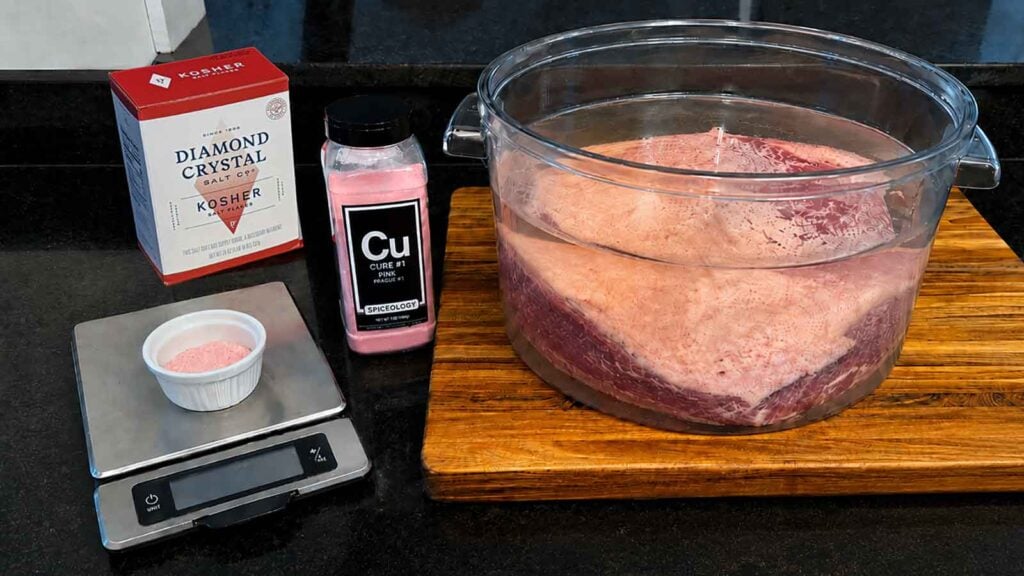
- Cure #1 is not Himalayan pink salt. It is also not Cure #2. Make sure the package says Cure #1, Prague Powder #1, Insta Cure #1, or pink curing salt #1.
- The meat must stay cold. Keep the brine refrigerated at or below 40°F the whole time.
- Water amount and thickness matter. Use the trimmed beef weight, the actual water needed to cover it, and the thickest part of the cut.
Those measurements matter. A recipe can work beautifully for the brisket and container it was written for. Your brisket may not be that brisket.
What a pastrami brine actually does
A brisket pastrami brine is not just salty water with pickling spice in it. It is a cold wet cure that changes the beef before it ever goes on the smoker.
The salt seasons the meat and helps manage moisture. Cure #1 supplies sodium nitrite, which gives pastrami its cured color and flavor and does an important food-safety job in cured meats. The water carries those dissolved ingredients around the beef. Sugar helps round out the salt. Spices give pastrami its familiar flavor, mostly near the surface.
The smoke comes later. So does the peppery rub, the bark, the slicing, and the sandwich. If you are curing brisket for corned beef instead, the salt, Cure #1, water, and time questions are related, but the seasoning and finish are different. Use our corned beef brine guide for that cook.
The brine’s job comes first: get the salt and cure into the beef safely and evenly enough that the center is cured before you cook it.
That sounds simple, but the details matter.
What each pastrami brine ingredient does
Each ingredient has a job. The trouble starts when one ingredient gets treated like it can stand in for another.
Use this table to keep the ingredients straight.
| Ingredient | What it does | What it does not do | Why it matters |
|---|---|---|---|
| Salt | Seasons the beef and helps manage moisture as part of the brine. | It does not replace Cure #1, cold storage, or cooking. | Salt matters, but regular salt alone does not make cured pastrami. |
| Cure #1 | Supplies sodium nitrite for cured color, cured flavor, and the safety work regular salt cannot do. | It does not replace all the regular salt, and it should never be guessed. | This is the ingredient that needs the most care because too little or too much can create a real problem. |
| Water | Carries the dissolved salt, Cure #1, sugar, and spices around the beef. | It is not neutral. Add more water, and you change the brine. | If you add water to cover the meat, the brine changes unless the amounts are recalculated. |
| Sugar | Rounds out the salt and softens some of its harshness. | It does not cure the meat. | Sugar is mostly about balance, not safety. |
| Spices | Add pastrami flavor, especially near the surface of the beef. | They do not decide whether the cure is safe. | Coriander, black pepper, mustard seed, bay, garlic, and pickling spice are flavor choices, not curing safeguards. |
The exact amounts depend on your trimmed beef weight, the water needed to cover it, and the way you are brining it. That is why a fixed recipe can fall apart when the container changes.
Cure #1 is not regular salt
This is the section to take your time with. Cure #1 is useful, but it is not something to eyeball.
Oregon State University Extension describes Prague Powder #1, also sold as Cure #1 or Insta Cure #1, as a curing salt blend with 6.25% sodium nitrite and 93.75% salt. It is dyed pink so it is not mistaken for table salt.
That is the Cure #1 this guide means: the standard 6.25% sodium nitrite curing salt sold as Cure #1, Prague Powder #1, Insta Cure #1, or pink curing salt #1. If your package lists a different nitrite percentage, names a different curing salt, or does not clearly match one of those labels, stop and identify it before using it.
That pink dye is helpful, but it also creates one of the biggest points of confusion in home curing. “These pink salts are not the same as Himalayan pink salt,” warns OSU Extension.
Cure #1 vs Himalayan pink salt
These sound close enough to fool people. They are not close.
Cure #1, Prague Powder #1, Insta Cure #1, and pink curing salt #1 are different names for the kind of pink curing salt for pastrami that contains sodium nitrite. Himalayan pink salt is just mineral salt. It does not contain the nitrite that Cure #1 provides.
That means Himalayan pink salt cannot stand in for Cure #1, Prague Powder #1, or any other properly labeled curing salt in a pastrami brine.
This is not a flavor swap. It changes the cure.
Cure #1 vs Cure #2
Cure #2 is also the wrong product for this job.
Cure #2 contains nitrate along with nitrite and is meant for long dry-cured meats that are not cooked before eating, such as salami or prosciutto. That is a different kind of curing project. Smoked pastrami from brisket uses a short-term refrigerated cure and then gets cooked.
For this job, use Cure #1.
Why weighing Cure #1 matters
In a Cure #1 pastrami brine, the curing salt is not something to add by feel. More does not mean safer.
Nitrite-containing curing salts help inhibit Clostridium botulinum growth and toxin production, but nitrite salts also have toxicity concerns when used incorrectly. That is why Extension sources tell home cooks to stick with tested curing salt amounts and methods.
For pastrami, the safe habit is simple: do not guess how much Cure #1 to use based on a spoon measure or how large the brisket looks. Weigh the Cure #1 in grams and base the amount on the beef and water you are actually using. Do not use heaping spoonfuls. Do not add a little extra.
Cure #1 safety note
- Use Cure #1, Prague Powder #1, Insta Cure #1, or pink curing salt #1.
- Do not use Himalayan pink salt.
- Do not use Cure #2 for cooked smoked pastrami.
- Weigh Cure #1 in grams. A 0.01-gram digital scale makes these small amounts easier to measure accurately.
- Do not spoon it by feel.
- Do not add extra Cure #1 as a safety buffer.
- Do not adjust the amount because the brisket “looks big.”
That is the safer way to handle Cure #1: not more, not less, just the measured amount. If you want a deeper look at the curing salt itself, our guide to how to use Cure #1 safely explains the names, labels, and safety limits in more detail.
Why water weight matters in a pastrami brine
The amount of water in a pastrami brine is not just about filling the container. The water changes the brine.
If a recipe calls for a set amount of water, salt, sugar, and Cure #1, that recipe assumes the water amount stays the same. If your brisket needs more water to stay covered and you pour in another quart, you have changed the brine. The salt and Cure #1 are now spread through more water than the recipe planned for.
That is why weighed brines and equilibrium brining are useful. They start with what you actually have, not what the recipe writer happened to use.
Here is the difference in plain English.
| Method | What it is | What changes when the brisket or water changes | Main benefit | Main risk |
|---|---|---|---|---|
| Fixed recipe wet brine | A set amount of water, salt, sugar, Cure #1, and spices. | If you add more water or use a much different brisket, the recipe no longer matches the cook in front of you. | Simple to follow when your meat and container match the recipe. | Easy to dilute or get wrong when you need more water to cover the meat. |
| Weighed wet brine | A wet brine where salt and Cure #1 are weighed instead of measured by spoons or cups. | The measuring is more accurate, but the brine still has to match your beef and water. | Much better than guessing by volume, especially with salt and Cure #1. | Weighing helps, but it does not fix a recipe that no longer fits your container. |
| Equilibrium wet brine | A brine calculated from the total weight of the meat and the water. | The water is part of the calculation, so using more or less water changes the amount you need. | More forgiving because the target level is set across the meat and the brine together. | It still needs accurate weights and enough refrigerated time to work. |
In an equilibrium wet brine, the meat and the water are counted together. The salt and Cure #1 are based on that combined weight, not just the water. Our guide to how brining math works walks through the broader math if you want the deeper explanation.
For pastrami, keep it simple: weigh the trimmed beef, measure the water needed to cover it in your container, choose the brining method, and measure the thickest part of the cut. Once you know those numbers, you have what you need to calculate the brine.
How long to cure pastrami
Pastrami cure times can look all over the place, but that does not mean the recipes are wrong. They may be working with different cuts, thicknesses, or methods.
You will see respected pastrami recipes call for different cure times. Hey Grill Hey uses a shorter range. Meat Church uses a longer process for a large brisket. Tori Avey gives another range. Those differences are not automatically a problem. They are a clue.
The right question is not “which day count is always right?”
The better question is “how far does the cure have to travel, and under what conditions?”
When you are curing brisket for pastrami, the thickest part of the meat matters more than the number on the package.
A thin trimmed flat and a thick point do not cure the same way. A separated flat, a separated point, and a whole packer behave differently. A cold refrigerator matters. Enough brine contact matters. Injection or splitting a thick piece can change how fast the cure reaches the middle.
Thickness matters most because the cure moves from the outside in. Weight tells you how much beef you have. Thickness helps tell you how long the cure needs. That is why curing guides pay attention to thickness, refrigerator temperature, brine contact, and injection. The cure has to move through the meat, not just sit around it.
Use this table to see what changes the time.
| Factor | Why it matters | What to do before you brine |
|---|---|---|
| Thickness | The cure has to reach the center of the meat. The thicker the beef, the farther it has to travel. | Measure the thickest part of the trimmed beef. |
| Shape | A flat slab and a thicker rounded piece expose the meat to the brine differently. | Match the shape to the cut you are actually curing. |
| Whole packer vs separated muscles | A whole packer has a flat and point attached. The thickest point can lag behind the thinner flat. | Consider separating thick pieces when that gives you a more even cure. |
| Water amount | In a fixed brine, extra water dilutes the brine. In an equilibrium brine, water is part of the calculation. | Measure the water needed to keep the beef covered. |
| Refrigerator temperature | Cure time assumes the meat is held cold. Warming the cure is not a shortcut. | Keep the brine at or below 40°F. |
| Injection or splitting | Injection can move brine toward the center faster, and splitting can make thick pieces more manageable. | Use these only when they fit the cut and your process, then calculate the brine for what you are actually doing. |
No single day count can fit every brisket because thickness, shape, brine method, water amount, refrigerator temperature, and injection or separation can all change the cure. Treat recipe ranges as a starting point. Our guide to how long to brine meat explains the broader timing issue.
Common pastrami brine mistakes
Most pastrami brine problems start before the meat ever reaches the smoker. The fix is usually not complicated, but it does require measuring and staying cold.
Here are the mistakes worth avoiding.
| Mistake | Why it matters | What to do instead |
|---|---|---|
| Guessing Cure #1 | Cure #1 has to be used in the right amount. Guessing can leave you too low or too high. | Weigh Cure #1 in grams and calculate the amount from your beef and water. |
| Using Himalayan pink salt | Himalayan pink salt does not contain sodium nitrite and cannot cure pastrami. | Use Cure #1, Prague Powder #1, Insta Cure #1, or pink curing salt #1. |
| Using Cure #2 | Cure #2 is for a different kind of long dry cure, not cooked smoked pastrami. | Use Cure #1 for refrigerated brisket pastrami that will be cooked after curing. |
| Adding water without recalculating | Extra water changes the brine strength and can throw off salt and Cure #1 amounts. | Measure the water needed to cover the meat, then calculate the brine for that amount. |
| Curing too warm | A pastrami cure needs cold refrigerator time. Warm curing is not a safe shortcut. | Keep the brine and meat at or below 40°F. |
| Rushing a thick brisket | The cure has to reach the center. A thick point takes longer than a thin flat. | Measure thickness and consider separating or injecting thick cuts when needed. |
| Letting meat float above the brine | Meat that sits above the liquid is not getting the same brine contact. | Use a food-safe weight, bag, or smaller container to keep the beef submerged. |
| Treating cured pastrami as shelf-stable | Homemade smoked pastrami still needs normal cooked-meat storage. | Cook it after curing, refrigerate leftovers, and reheat leftovers safely. |
That is the main idea: measure carefully, keep the meat cold, and give the cure enough time. Do not try to be safer by adding more Cure #1.
Homemade pastrami brine safety checklist
Before the beef goes into the brine, slow down long enough to make sure the setup is right.
FDA refrigerator guidance says home refrigerators should be kept at 40°F or below and recommends using an appliance thermometer. That matters here because pastrami curing takes days, not minutes.
USDA brining guidance also backs up the basics that matter here: use a food-grade container or brining bag, cool any heated brine before it touches the meat, keep the meat covered by brine, and hold it in the refrigerator during the brine.
Use this checklist before you start.
Safety checklist before you brine
- Confirm you have Cure #1, Prague Powder #1, Insta Cure #1, or pink curing salt #1.
- Do not use Himalayan pink salt.
- Do not use Cure #2.
- Weigh Cure #1 in grams.
- Weigh the beef after trimming.
- Measure the water needed to cover it.
- Keep the brine at or below 40°F.
- Use a food-safe, nonreactive container.
- If you heat part of the brine to dissolve salt, sugar, or spices, cool it completely before it touches the beef.
- Keep the beef fully submerged.
- Discard used brine.
- Cook the pastrami after curing.
- Refrigerate leftovers.
For cooked beef and leftovers, FoodSafety.gov’s temperature chart lists 145°F with a 3-minute rest as the safe minimum for beef roasts and 165°F for reheated leftovers.
Pastrami usually cooks well past 145°F because brisket needs time and heat to become tender, but the safety numbers still matter. Use a food thermometer for those checks; color, smoke ring, and texture do not prove that beef or leftovers have reached a safe temperature.
Calculate pastrami brine amounts before you cure
Once you understand what the ingredients are doing, the next step is not to copy a random number. It is to measure what you have.
Before you do your calculations, gather these:
- Trimmed beef weight, not just the package weight before trimming
- Water needed to cover the meat in the container you are actually using
- Confirmed Cure #1 label, making sure you have the standard product described above
- Brining method, because a fixed wet brine and an equilibrium wet brine do not use the water the same way
- Thickest part of the meat, because thickness affects time
- Shape of the cut, because a flat piece and a thicker rounded piece do not cure the same way
The calculator uses the water amount you enter to return the exact salt grams, exact Cure #1 amount, and a cure-time estimate based on the thickness, shape, and method you choose.
It also assumes you are curing a whole piece of beef in the refrigerator with standard 6.25% Cure #1. It is not for Cure #2, Himalayan pink salt, proprietary curing blends, room-temperature curing, shelf-stable meat, or any curing salt label that does not clearly match Cure #1, Prague Powder #1, Insta Cure #1, or pink curing salt #1.
That is the safer way to handle it when the cut, container, water amount, or thickness changes. Use the Brining Calculator to calculate your pastrami brine before the meat goes into the refrigerator.
Pastrami brine questions before you cure
These are the questions that usually come up once you move from reading a pastrami recipe to curing the brisket in front of you.
Do not just top off the container and keep the same salt and Cure #1 amounts. Extra water changes the brine. Measure how much water it takes to keep the beef covered, then calculate the brine for that meat and water together, especially if you are using an equilibrium wet brine.
There is not one day count that fits every brisket. A thin trimmed flat can cure differently from a thick point or whole packer. Thickness, shape, brine method, water amount, refrigerator temperature, and injection all matter. Treat recipe ranges as a starting point, then calculate the timing for the cut in front of you.
You can smoke brisket with pastrami spices, but it will not be cured pastrami in the usual sense. Cure #1 supplies sodium nitrite, which helps create pastrami’s cured color and flavor and helps do the safety work regular salt cannot do. If you skip Cure #1, use a process written for uncured meat instead.
No. For this wet brine approach, calculate salt and Cure #1 from the trimmed beef weight and water weight. Sugar and spices are there for flavor and balance, so measure them separately. Do not change the Cure #1 amount because you changed the sugar or pickling spice.
Many pastrami recipes call for rinsing after the cure, and some use a short soak to reduce surface salt. Whether you need that depends on the brine strength and the recipe you follow after curing. Rinsing may help saltiness, but it cannot fix an unsafe Cure #1 amount.
No. Once the brine has held raw beef, discard it. Do not save it for another brisket, and do not treat boiling as a way to make the same brine safe for another cure. That brine was mixed for one piece of raw beef, one water amount, and one Cure #1 amount.
Corrections and editorial standards
- Spotted something wrong or outdated? Send a correction here: Corrections & Updates
- How we handle sources, testing, and updates: Editorial Standards
- Media or general notes: Email the publisher
Sources
Reviewed May 19, 2026. This guide is based on practical home-cooking experience, authoritative food-safety and Extension sources, and the way Destination BBQ’s Brining Calculator handles meat weight, water amount, Cure #1, and cure time. It has not been validated through controlled laboratory testing.
- Oregon State University Extension: Making cured bacon at home: supports Cure #1 composition, the Himalayan pink salt distinction, Cure #2 distinction, refrigerator curing, and basic curing-salt handling.
- University of Wisconsin Extension: What’s the deal with Nitrates and Nitrites used in meat products?: supports the discussion of nitrite use, safety, and controlled use in meat products.
- USDA: Brining Safely Will Bring Tender, Flavorful Meat to the Thanksgiving Table: supports cold brining guidance, food-safe containers, cooling heated brine before use, keeping meat covered, and refrigerating during the brine.
- U.S. Food and Drug Administration: Refrigerator Thermometers: source for keeping home refrigerators at 40°F or below and using an appliance thermometer.
- FoodSafety.gov: Cook to a Safe Minimum Internal Temperature and USDA FSIS: Leftovers and Food Safety: sources for beef cooking temperatures, reheating leftovers to 165°F, and refrigerating leftovers promptly.
- Oklahoma State University Extension: Meat Curing: supports the explanation of water as a carrier, thickness-based curing logic, and injection moving cure toward the center.
- Destination BBQ: Brining Math Explained and Destination BBQ: Brining Calculator: support the meat-plus-water explanation, equilibrium brining handoff, and exact salt, Cure #1, water, and cure-time guidance.
About the author
James Roller documents South Carolina barbecue for Destination BBQ and authored the SC BBQ cookbook Going Whole Hog. His BBQ guides focus on practical questions: how food-safety principles apply to what you are actually cooking, how to read a recipe critically, and how to use the right tools without making the process harder than it needs to be.