Equilibrium Brining Explained
Understand how equilibrium brining sets a target salt level, when meat and water both count, and why timing still matters
Equilibrium brining sounds like it ought to be harder than it is. What you really want to know is simple: how do you salt meat so it lands where you want, instead of soaking it in a strong brine and hoping you pull it at the right time?
Equilibrium brining starts with the salt level you want in the finished meat, then weighs what the salt needs to season. For a wet equilibrium brine, that means the meat and water together. For a dry equilibrium brine, it means the meat.
You may have also seen the claim that with equilibrium brining, you can’t overbrine. That is close enough to sound helpful and loose enough to get you in trouble. Equilibrium brining is more forgiving on salt level, but timing, thickness, texture, and food safety still matter.
Use equilibrium brining when you want more control. Once the method makes sense, the math is straightforward: weigh what matters, choose your salt percentage, and calculate the exact grams.
Here is the basic idea before the details.
Quick Answer
- Equilibrium brining starts with the salt level you want in the finished meat instead of relying on a strong brine and exact timing.
- For a wet equilibrium brine, weigh the meat and the water together. Salt is based on the combined weight.
- A practical starting range is 1.2% to 1.8%, with 1.5% as a good place to begin for many flavor brines.
- It is more forgiving on salt level, not faster. Thick meat still needs time for salt to move inward.
- Food safety still matters. Keep meat and brine at 40°F or below, and do not brine turkey longer than two days.
- If Cure #1 or Prague Powder #1 is involved, use the calculator’s Cure #1 mode or a tested curing process. Do not treat cured meats like ordinary flavor brines.
- For exact grams, use the Brining Calculator.
What equilibrium brining actually means
Here is the part people usually miss: equilibrium brining is not about making a super salty brine. It is about choosing how salty you want the meat and brine to end up when the brine has done its work.
In a regular strong wet brine, the brine starts out much saltier than the meat. Salt moves from the saltier place toward the less salty place, so it starts moving into the meat. As long as that gap is large, the process keeps going. Leave the meat in too long, and it can get too salty.
In a wet equilibrium brine, you decide the final salt percentage first, then add enough salt for the meat and water together to settle at that level. In a dry equilibrium brine, the same idea applies, but the salt is based on the meat weight only.
As salt moves into the meat, the brine becomes less salty. The meat becomes saltier. Over time, the two get closer to the same salt level. When they settle at the target you set, the meat is much less likely to keep getting saltier past that point.
That is what “equilibrium” means in a wet brine. The meat and brine are working toward the same salt level.
For the full formula behind that, our brining math page handles the details. You do not need to do that math by hand to understand the method.
How equilibrium brining is different from a regular wet brine
A regular wet brine and a wet equilibrium brine both use salt water. The difference is how the salt is measured and how much the timing can punish you.
A regular wet brine is usually based on the water weight alone. Many traditional wet brines are much stronger than the final salt level you want in the meat. That is why they can work faster, but it is also why timing matters so much. A strong brine gives you less room for error.
A wet equilibrium brine is gentler because the salt is measured against the meat and water together. It usually takes longer, but you have more control over how salty the meat gets.
Use the table as a quick way to see the difference. The big thing to notice is not just the salt percentage. It is what that percentage is based on.
| Method | What you measure | How salty it usually is | Timing risk | Best for | What to watch |
|---|---|---|---|---|---|
| Regular wet brine | Salt based on water weight | Often around 5% to 7% of the water in many traditional wet brines, though recipes vary | More time-sensitive. Left too long, it can oversalt. | Quick poultry parts, pork chops, and lean cuts when you are following a tested recipe | Keep cold, watch the clock, and chill any heated brine before adding meat |
| Wet equilibrium brine | Salt based on combined meat and water weight | 1.2% to 1.8% of the combined meat and water weight, with 1.5% as a good place to begin for many flavor brines | More forgiving on salt level, but salt still takes time to move through thick meat | Turkey, chicken, pork, and larger cuts when you have time to plan | Thickness drives timing, and food-safety limits still apply |
| Dry brine by weight | Salt based on meat weight only | Often around 1.5% to 2% of meat weight | Forgiving on salt if weighed correctly | Poultry skin, steaks, chops, brisket bark, and pork shoulder | Spread evenly, refrigerate, and check whether the meat is already salted |
For a broader explanation of wet, dry, equilibrium, and injection brining, see our brining methods page or see a comparison of the primary methods in Wet vs Dry vs Equilibrium Brine.
Why meat and water both count
This is where equilibrium brining feels strange at first.
In a wet equilibrium brine, the water is not just a place to dissolve the salt. It is part of the system. The salt spreads through everything in contact with it: the water, the surface of the meat, and gradually the inside of the meat as the salt works its way inward.
That means the amount of water matters.
Think about it this way.
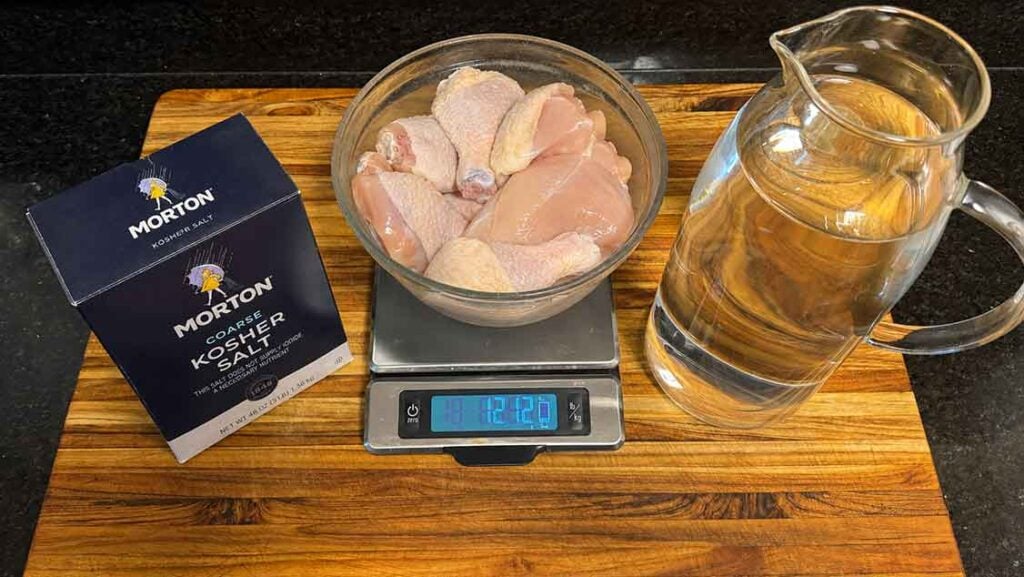
If you have 1,000 grams of meat and 1,000 grams of water, you have 2,000 grams total. At 1.5%, that takes 30 grams of salt.
If you use the same 1,000 grams of meat but need 2,000 grams of water to cover it in a larger container, now you have 3,000 grams total. At 1.5%, that takes 45 grams of salt.
Same meat. Different amount of water. Different amount of salt.
That is why a tight brining bag can change the amount you need. Less water around the meat means less total weight in the brine. A big stockpot with extra water means more total weight.
You do not need to guess that number. Once you know your meat weight, water weight, and target percentage, the exact salt amount follows from the same calculation.
More forgiving on salt, but not faster
This is where the “you can’t overbrine” claim needs a little straightening out.
The helpful part is true. Because an equilibrium brine is working toward a lower, specific salt level, it gives you more room if the timing shifts. A strong traditional wet brine can punish you if the meat sits too long. An equilibrium brine is less likely to leave you with something unpleasantly salty.
But that does not mean you can stop paying attention.
The method does not make salt move faster. It does not change what happens inside a thick piece of meat. It does not remove food-safety limits that have nothing to do with salt level.
The other limit is texture. Even at a reasonable salt percentage, meat that sits too long can still start to suffer. And for turkey in particular, USDA’s brining guidance says to keep the turkey and brine refrigerated at 40°F or below and not brine longer than two days.
Equilibrium brining gives you more room on salt. But you still have to think about time, thickness, texture, and food safety.
Weight tells you how much salt, and thickness tells you how long
These are two different questions, and they have different answers.
The weight of what you’re seasoning tells you how much salt to use. For a wet equilibrium brine, that means the meat and water together. For a dry equilibrium brine, it means the meat. A 10-pound turkey and a 5-pound pork shoulder need different amounts of salt to reach the same final percentage because one weighs more.
How long the meat needs to sit in the brine is a question of thickness.
A 5-pound flat cut and a 5-pound round roast may need the same total amount of salt to reach the same target percentage. They will not brine at the same speed. The round roast is thicker, so the salt has farther to travel.
That is why timing charts can get you in trouble if they only look at pounds. The biggest piece, or the thickest part of the piece, is what matters most. For a deeper look at timing by cut, thickness, and method, see How Long to Brine Meat.
AmazingRibs discusses a Greg Blonder test where salt from a strong brine moved only about 2 millimeters into a 3-inch pork loin after one hour. That was a traditional strong brine, not an equilibrium brine, but the practical lesson carries over: salt moves slowly through meat.
This is also why planning earlier is usually better than trying to force the brine to work faster. Keep the meat cold, give it enough refrigerated time, and plan around the thickest part instead of trying to rush a thick cut.
What salt percentage should you use for an equilibrium brine?
The right salt percentage for an equilibrium brine depends on what you are measuring. For wet equilibrium flavor brines, a practical starting range is 1.2% to 1.8% of the combined meat and water weight. If you are unsure, 1.5% is a good place to begin for many flavor-brining situations. That range is a flavor target, not a curing formula or a food-safety shortcut.
That does not mean every other number you see online is wrong. It often means the source is measuring something different.
Some people calculate salt as a percentage of water only. Some calculate it as a percentage of meat only. Some are talking about dry brining. Some are talking about flavor brining, while others have crossed into curing. Those numbers do not all mean the same thing.
For a wet equilibrium brine, remember what the percentage is based on: meat plus water combined.
Be extra careful with meat that is already enhanced. Many turkeys, pork loins, and other supermarket cuts are injected with a salt solution before you buy them. If the label says the meat is enhanced, self-basting, pre-brined, or contains an added solution, it is not starting from zero. In that case, aim lower, be cautious with added salt, or choose a different method.
For pastrami, corned beef, and ham, the salt percentage is a different conversation. Once Cure #1 is involved, you are not just measuring regular salt anymore.
Is equilibrium brining safe?
Equilibrium brining is more forgiving on salt level. That is a real advantage.
It is not preservation. It does not make raw meat safe on the counter. It is not a way around safe cooking temperatures.
A milder brine is still raw meat sitting in liquid. The same basic food-safety rules apply. Keep the meat cold. Keep the brine cold. Cool any heated brine before adding raw meat. Discard used brine. Cook poultry to 165°F, according to FoodSafety.gov’s safe minimum internal temperature chart.
Use this checklist before you start.
Before You Start
- Weigh the meat.
- Weigh the water if you are using a wet equilibrium brine.
- Use a food-safe container: food-grade plastic, stainless steel, glass, or a brining bag.
- Make sure the meat is fully surrounded by brine.
- Keep the meat and brine at 40°F or below the entire time.
- Cool any heated brine to refrigerator temperature before adding raw meat.
- Do not brine at room temperature.
- Do not brine turkey for more than two days.
- Discard the brine after use.
- Cook poultry to 165°F.
- For pastrami, corned beef, or ham, use a tested process or the calculator’s Cure #1 mode.
Equilibrium brining controls salt better. It does not replace refrigeration, sanitation, or safe cooking temperatures.
USDA’s turkey brining guidance is especially clear here: keep the turkey and brine refrigerated at 40°F or below, cool heated brine before adding the turkey, and do not brine turkey longer than two days.
That last part matters. “Equilibrium” does not override the two-day turkey limit.
Where Cure #1 changes the rules
Cure #1 is not regular salt.
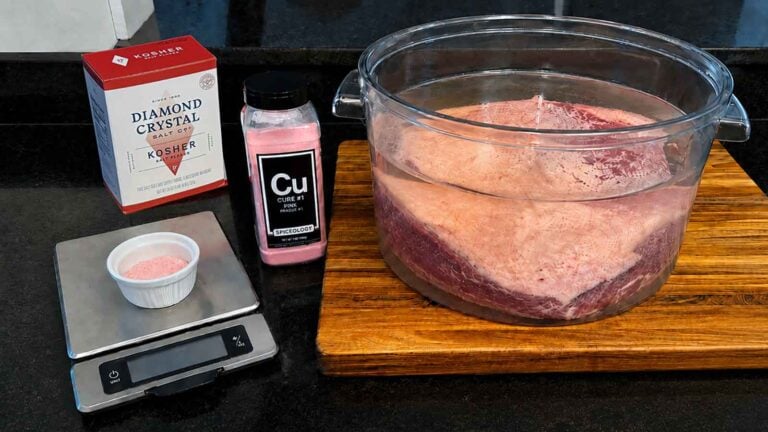
That is the first thing to get clear. Cure #1, also called Prague Powder #1 or pink curing salt, contains sodium nitrite. It is used in cured-meat processes, not as a casual add-in for ordinary flavor brining. If Cure #1 or Prague Powder #1 is new to you, start with Cure #1 safety before you mix a curing brine.
The problem is not that Cure #1 is mysterious. The problem is that it has to be measured carefully and used within a tested process. MSU Extension’s guidance on legal limits in cured meat products is a good reminder that nitrite is regulated for a reason.
That is why pastrami, corned beef, and ham should not be treated like ordinary chicken or pork chops in a flavor brine. They need a tested process or a calculator that handles Cure #1 by weight.
If you are working with Cure #1, use the Brining Calculator mode that handles Cure #1 by weight and nitrite PPM. Do not eyeball it. Do not swap it for kosher salt. Do not add it because a regular brine sounds close enough.
Close enough is not the goal with Cure #1.
For cured meats, use the guide written for what you are making instead of adapting a general flavor brine: pastrami brine, smoked corned beef brine, or ham brine. Each one needs its own salt, Cure #1, water, and timing decisions.
When equilibrium brining is not the right choice
A good method still has limits. Equilibrium brining is useful, but it is not the answer every time.
If dinner is in a few hours, a wet equilibrium brine may be too slow. You may be better off with a tested regular wet brine for a short soak, a dry brine by weight, or seasoning the meat and cooking it.
If you want crisp poultry skin, dry brining may be the better choice. Wet brining adds moisture to the surface, and that can work against browning unless you dry the skin well before cooking.
If that sounds like the direction you need, Dry Brine by Weight explains how to salt the meat directly without adding water to the calculation.
If the meat is already enhanced or pre-salted, be careful. The label matters. You are not starting with unsalted meat anymore.
If you are following a tested cured-meat recipe, follow the recipe. Do not replace its salt, Cure #1, water, or timing with a general flavor-brining approach.
The safest answer is not always the fanciest one. Sometimes the better choice is the one that fits the cook in front of you.
Should you use equilibrium brining?
Use this as a quick gut check before you start.
Should You Use Equilibrium Brining?
- Are you flavor-brining chicken, turkey, pork, or another fresh cut for home cooking? Equilibrium brining may fit.
- Are you making pastrami, corned beef, ham, bacon, sausage, or anything with Cure #1? Use a tested process or a calculator that handles Cure #1 by weight.
- Do you want a more forgiving salt level in case your timing shifts? That is one of equilibrium brining’s strengths.
- Are you willing to weigh both the meat and the water? That is what makes a wet equilibrium brine work.
- Do you need dinner in the next few hours? This method may be too slow.
- Is the cut thick? Plan earlier rather than cutting it close.
How to calculate the exact grams of salt
Once the idea makes sense, the next step is simple: weigh what you have.
For a wet equilibrium brine, bring three things to the calculator:
- the meat weight
- the water weight
- the target salt percentage
If you are not sure where to start, 1.5% is a reasonable starting point within the 1.2% to 1.8% range for wet equilibrium flavor brines.
The Brining Calculator handles the exact salt amount in grams. It also gives guidance for the brining method you chose, so you are not trying to build your brine from this article alone.
If you want to see the full equation and why the meat-plus-water calculation works, Brining Math Explained walks through the calculation step by step.
This page explains the idea. The calculator gives you the exact amount to use.
Equilibrium brining questions before you start
Yes. Equilibrium brining can be wet or dry. In a wet equilibrium brine, the salt percentage is based on the meat and water together. In a dry equilibrium brine, it is based on the meat only. Either way, you choose the final salt level first, then weigh what the salt needs to season.
For a wet equilibrium brine, yes. The amount of water changes the total weight, so it changes how much salt you need. A tight brining bag usually takes less water than a large stockpot. Weigh only the water you actually need to cover the meat.
Yes, but keep the salt calculation separate. For a wet equilibrium brine, weigh the meat and the liquid used to cover it. Small amounts of sugar, herbs, garlic, peppercorns, and spices are flavor additions. They do not replace the salt percentage. If you heat the brine to dissolve sugar or wake up spices, chill it completely before adding raw meat.
Check the label before you brine. Enhanced, self-basting, kosher, or pre-brined meat already has salt in it, so a normal equilibrium-brine percentage may make it too salty. If salt has already been added, start lower, be cautious with added salt, or skip the brine.
Yes, but turkey still needs strict food-safety handling. Keep the turkey and brine refrigerated at 40°F or below, cool any heated brine before adding the bird, and do not brine turkey longer than two days. Equilibrium brining gives you more control over salt, not a longer turkey brining window.
Usually, no. If you used a reasonable salt percentage, rinsing is not needed and can wash away surface flavor. Pat the meat dry instead. For poultry skin or bark-forming cuts, letting the surface dry uncovered in the refrigerator can help before cooking.
No. Equilibrium brining can be used for flavor brines, but curing is different when Cure #1, Prague Powder #1, or sodium nitrite is involved. Pastrami, corned beef, and ham need a tested curing process or a calculator mode built for Cure #1. Do not treat curing salt like regular salt.
Corrections and editorial standards
- Spotted something wrong or outdated? Send a correction here: Corrections & Updates
- How we handle sources, testing, and updates: Editorial Standards
- Media or general notes: Email the publisher
Sources
- USDA, Brining Safely Will Bring Tender, Flavorful Meat to the Thanksgiving Table: cold brining guidance, food-safe containers, cooling heated brine before use, the two-day turkey brining limit, and turkey cooking safety
- FoodSafety.gov, Cook to a Safe Minimum Internal Temperature: safe minimum internal temperatures, including poultry at 165°F
- AmazingRibs, Salting and Wet Brining: practical brining science, traditional wet-brine strength, and salt-penetration context
- eCFR, 9 CFR § 424.22: federal nitrite-use rules for meat processing, useful background for why Cure #1 must be measured carefully and handled separately from ordinary salt
- Michigan State University Extension, Additives Have Legal Limits in Cured Meat Products: nitrite limits and why Cure #1 belongs in tested curing processes, not casual flavor brines
This guide combines Destination BBQ’s home barbecue brining experience with USDA/FoodSafety.gov safety guidance, brining-science references, and curing sources. It is not a lab-validated curing protocol or a substitute for tested Cure #1 recipes.
About the author
James Roller documents South Carolina barbecue for Destination BBQ and authored the SC BBQ cookbook Going Whole Hog. This guide combines practical home-barbecue brining experience with published food-safety and curing references to explain when equilibrium brining fits, how salt percentage works, and where Cure #1 requires a tested process.