How to Use Cure #1 Safely
Use Cure #1 safely by reading the label, weighing in grams, choosing the right method, and knowing when shortcuts can get you in trouble
Somewhere between buying a bag of pink curing salt and weighing it on a gram scale, you can hit the same wall a lot of home cooks run into. Your recipe says Cure #1. The bag says Prague Powder #1. One recipe tells you to measure Cure #1 by the teaspoon, and the next one tells you to measure it by weight.
That usually happens because those recipes are not always using the same curing method. Wet brines, dry cures, wet equilibrium brines, and bacon do not all use the same calculation.
So do not start by looking for a shortcut. Start by making sure you have the right product, the right method, and cold storage in place before you measure anything. Cure #1 belongs in cured meats like pastrami, corned beef, cook-before-eating ham, bacon-style pork belly or loin, and some cured turkey projects. It does not belong in regular BBQ brines for fresh meat.
Start here.
Quick answer
- Cure #1 is a measured curing ingredient, not a seasoning salt. It is commonly sold as Prague Powder #1, Insta Cure #1, Curing Salt #1, or pink curing salt #1.
- Standard Cure #1 is commonly 6.25% sodium nitrite and 93.75% salt. Read the label and confirm the nitrite percentage before you use it.
- It is not Himalayan pink salt, Cure #2, Morton Tender Quick, kosher salt, table salt, celery powder, or saltpeter. Those are not substitutes.
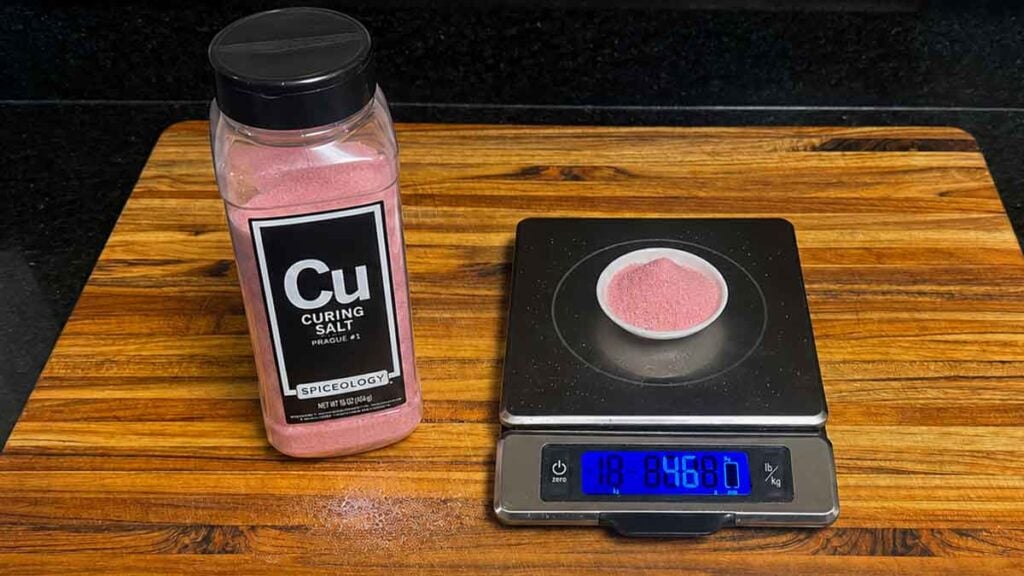
- Weigh Cure #1 in grams on a scale that reads at least to tenths of a gram. Spoon measures are not reliable enough for a curing ingredient.
- For the exact amount, use the Brining Calculator after you confirm the product and method.
Before we get into the details, keep one boundary in mind: this page is a safety guide for using Cure #1, not a complete curing process for every meat. If you are making shelf-stable dry-cured meat, fermented sausage, country ham, or a very thick ham-style project, use a tested process written for that exact product.
What Cure #1 actually is
Cure #1 is a curing salt used for short, refrigerated cured meats that will be cooked before eating. It is not something you eyeball into a brine the way you might toss kosher salt into a pot.
A standard version is commonly 6.25% sodium nitrite and 93.75% salt. Oregon State University Extension identifies Prague Powder #1 under names like Curing Salt #1 and Insta Cure #1 and gives that same 6.25% sodium nitrite formulation. Iowa State University Extension also lists names readers may see, including InstaCure #1, DQ Cure #1, and Modern Cure #1.
You may see it labeled as:
- Cure #1
- Prague Powder #1
- Insta Cure #1
- Pink curing salt #1
- Curing Salt #1
You may also see the spacing vary on labels, including Insta Cure #1 or InstaCure #1.
The pink color is intentional. It helps keep curing salt from being mistaken for table salt or sugar. But that color is also where people get tripped up.
Pink curing salt #1 is not the same thing as Himalayan pink salt. One contains nitrite and cures meat. The other is a mineral seasoning salt and does not cure meat.
Know that before you measure anything.
One more note, because the wording can get confusing: federal rules regulate sodium nitrite and nitrate by food category and parts-per-million limits, not by consumer names like Cure #1 or Prague Powder #1. The label matters more than the marketing name. If the label is unclear, do not use it.
Read the label, not just the color
The bag, jar, or packet needs to tell you what you have. Do not rely on the product being pink. Do not rely on something being sold near barbecue rubs. Read the label.
For sodium nitrite curing preparations sold for household use, federal rules require the label to identify the additive, state its concentration, give directions for use, and warn to keep it out of reach of children.
Before you measure anything, match the label to the table.
| Label says | Same as Cure #1? | Use for these cooked cured projects? | What to do |
|---|---|---|---|
| Prague Powder #1 | Usually yes | Yes | Confirm 6.25% sodium nitrite and weigh it in grams. |
| Insta Cure #1 | Usually yes | Yes | Confirm the label and use it only for cured meats. |
| Pink curing salt #1 | Usually yes | Yes | Confirm it is curing salt #1, not Himalayan pink salt. |
| Curing Salt #1 | Usually yes | Yes | Confirm the nitrite percentage before you calculate. |
| Prague Powder #2 or Cure #2 | No | No | Use only in tested long dry-cure processes not covered here. |
| Morton Tender Quick | No | No | Follow Morton’s directions only. Do not substitute it into Cure #1 recipes. |
| Himalayan pink salt | No | No | Use it as seasoning salt only. It does not cure meat. |
| Kosher salt or table salt | No | No for curing | Use plain salt for flavor brines, not as a Cure #1 substitute. |
| Celery powder | No | No | Do not treat it as a home Cure #1 substitute. |
If the label is missing, unclear, refilled, or homemade, stop there. Cure #1 is not the place to guess.
What Cure #1 does in cured meat
Cure #1 does give cured meat that familiar pink color and cured flavor, but that is not the main reason to use it.
The nitrite in Cure #1 helps inhibit Clostridium botulinum, the bacterium responsible for botulism. OSU Extension describes nitrite-containing curing salts as an important safety measure in cured meats, and University of Wisconsin Extension explains how nitrite helps control C. botulinum in cured meat.
Nitrite also helps with cured color, cured flavor, and rancidity control. Those matter for the finished product, but they do not turn Cure #1 into a seasoning.
That is why you weigh it. Too little may not do the job. Too much can be unsafe.
Cured color does not prove the meat is safe
This is worth separating because it is easy to blur together. Curing and cooking are two different steps.
During the cure, you need the right product, the right amount, the right method, cold storage, and enough time. When you cook the meat, you still need to bring it to the proper internal temperature. After cooking, you still need to cool, store, and reheat leftovers safely.
Cured color does not prove safety. Cured flavor does not prove safety. A pastrami can look beautifully pink and still need to be cooked properly.
FoodSafety.gov’s safe minimum internal temperature chart lists 145°F with a 3-minute rest for beef and pork roasts, 165°F for poultry, and 165°F for leftovers. Bacon-style projects need the extra caution covered below.
Use a thermometer. Do not use color as the final answer.
Cure #1 vs Cure #2, Tender Quick, and Himalayan pink salt
This is where many mistakes start. The names sound similar, the salts can look similar, and online recipes do not always explain which method they are using.
Keep these products straight.
Cure #1 is not Cure #2
Cure #2, also called Prague Powder #2, contains sodium nitrite plus sodium nitrate. The nitrate acts as a slower time-release curing agent for products that cure over a long period, such as salami or prosciutto.
That is a different kind of curing.
For cooked, refrigerated projects like pastrami, corned beef, cook-before-eating ham, and bacon-style pork belly, Cure #2 is the wrong product. It does not make a short cooked cure safer. It brings in nitrate you do not need for this kind of project.
Bacon makes this even more important. OSU Extension says nitrate-containing curing blends are not recommended for bacon because high-heat cooking can increase nitrosamine concern. That warning is easy to skim past. Don’t.
Cure #1 is not Himalayan pink salt
Himalayan pink salt is a mineral seasoning salt. It does not supply nitrite.
If you used Himalayan pink salt in a project that called for Cure #1, the meat was not cured. Even if it was kept cold, do not treat it as pastrami, bacon, corned beef, or cured ham.
Do not serve it as cured meat.
Cure #1 is not Morton Tender Quick
Morton Tender Quick is its own proprietary curing mix. Morton says it contains salt, sugar, sodium nitrate, and sodium nitrite, and it comes with its own directions.
That does not make it a drop-in replacement for Cure #1. If a recipe or calculator calls for Cure #1, do not swap in Tender Quick and hope the numbers still work.
Cure #1 is not kosher salt or table salt
Kosher salt and table salt are useful for regular brines and dry brines. They season meat. They help meat hold moisture. They can make barbecue taste better.
They do not do what the nitrite in Cure #1 does.
If you are just brining chicken, pork chops, ribs, or turkey for flavor before cooking fresh meat, use plain salt. If you are intentionally making cured meat, use the correct curing salt and calculate it by weight.
Cure #1 is not celery powder or saltpeter
Some commercial products use celery-based curing systems and may be labeled in ways that confuse people. That is not covered here and not something to treat as a home substitute.
Saltpeter, or potassium nitrate, is an older curing ingredient. It is not Cure #1. Leave it out unless you are following a tested process that specifically calls for it.
Use the simple rule here: if the product is not clearly Cure #1, Prague Powder #1, Insta Cure #1, Curing Salt #1, or pink curing salt #1 with the correct nitrite percentage, do not use it for these cooked cured projects.
Do not substitute
- Do not use Himalayan pink salt in place of Cure #1.
- Do not use Cure #2 in place of Cure #1 for short cooked projects.
- Do not use Morton Tender Quick in Cure #1 formulas.
- Do not use kosher salt or table salt as a curing salt substitute.
- Do not add extra Cure #1 as a safety buffer.
If you cannot verify the product or the amount, stop and start over with facts you can check.
When to use Cure #1 for pastrami, corned beef, ham, and bacon
Cure #1 belongs when you are intentionally making a cured meat, not when you are simply seasoning fresh meat before it goes on the smoker.
That sounds obvious until you are standing there with a brisket, a pork belly, or a turkey breast and three different recipes open on your phone.
Use this as the practical split.
| Project | Cure #1 belongs? | What to know before you start | What to do next |
|---|---|---|---|
| Pastrami | Yes | This is a cooked, cured beef project. Cure in the refrigerator, then cook the meat to the right finished temperature and tenderness. | Use a measured Cure #1 formula written for pastrami, then cure it cold before cooking. |
| Corned beef | Yes | Use a chilled brine and a non-reactive container such as glass, food-safe plastic, or stainless steel. | Use a measured Cure #1 brine written for corned beef. If you are making pastrami instead, use a pastrami-specific process. |
| Cook-before-eating ham | Yes, with caution | Large, thick, or bone-in cuts may not cure evenly with passive soaking alone. Some ham-style projects need injection or a tested process. | For smaller cuts, use a measured Cure #1 formula. For very thick cuts, follow a tested ham process. |
| Bacon-style pork belly or loin | Yes, with extra care | Bacon has specific nitrite limits and should not be treated like pastrami or corned beef. | Use PPM mode and the bacon-specific settings. |
| Smoked or cured turkey breast | Only if making cured turkey | Cure #1 belongs only if you are making a cured, deli-style turkey product. It does not belong in a simple flavor brine. | Use a curing formula only for cured turkey. For fresh turkey, use a regular brine without Cure #1. |
| Regular BBQ brine | No | Fresh chicken, pork chops, ribs, and turkey brines use plain salt, sugar, and flavorings. Cure #1 is not needed. | Use standard wet or dry brine settings without curing salt. |
For project-specific help, use the narrower guides for pastrami brine, corned beef brine, and ham brine.
When Cure #1 does not belong
Cure #1 is not a flavor shortcut and it is not a default ingredient for every brine.
If you are seasoning meat before grilling, smoking, or roasting, and the meat will be cooked as fresh meat and eaten the same day, plain salt is what you want. Cure #1 does not belong.
This is also where the line needs to be clear. Shelf-stable dry-cured meats, salami, prosciutto, country ham, fermented sausage, and other products that cure for weeks or months without cooking require a tested process written for that exact product. Cure #2 projects are not covered here, nor is commercial production.
The distinction that matters is simple: Cure #1 belongs when you are intentionally making a cooked cured meat that stays refrigerated during the cure. Regular BBQ brines for fresh meat do not need it.
Wet cure, dry cure, and equilibrium cure are not the same calculation
This is where a lot of online Cure #1 advice falls apart. A number from one method may not fit another method at all.
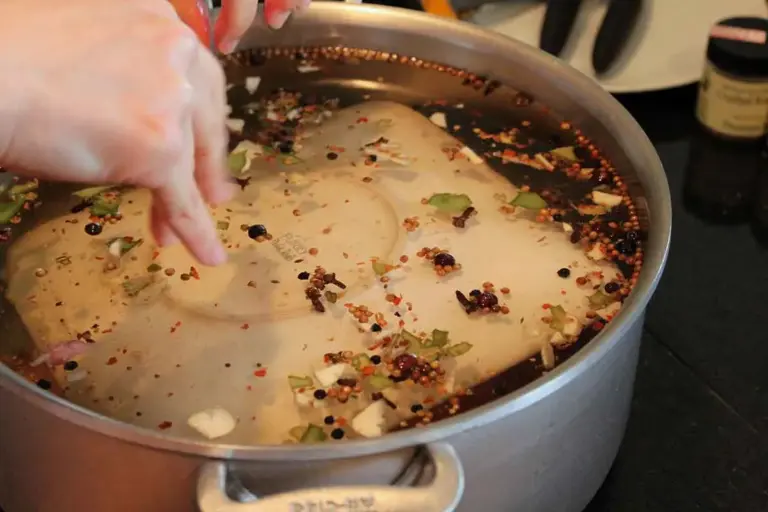
In a wet cure, the Cure #1 is dissolved in water along with salt and other ingredients, and the meat soaks in that liquid. The exact amount depends on the cure method, how much meat you have, how much water you use, and the nitrite level you are trying to hit. A per-gallon rule, a meat-only rule, and an equilibrium calculation are not the same thing.
In a dry cure, the curing salt and seasoning are rubbed directly onto the surface of the meat with no added water. The calculation is based on the weight of the meat alone.
In a wet equilibrium cure, the Cure #1 and salt are based on the meat plus the water. Over time, the meat and brine move toward the same salt and cure level. Add water and the math changes.
If you take a Cure #1 amount from one method and apply it to a different one, you can end up either under-curing the meat or using more nitrite than you should. That is why you choose the curing method before you measure the Cure #1.
If you are actually choosing a regular brine for fresh meat, our guide to choosing a brining method can help. For the regular-brining version of meat-plus-water math, see our guide to equilibrium brining.
| Method | What gets weighed | Where people go wrong | What to do |
|---|---|---|---|
| Wet cure | The meat and liquid both matter, but wet-cure recipes do not all count them the same way. | People copy per-gallon rules or meat-only rules without matching the method. | Use a formula written for the wet-cure method you are actually using. |
| Dry cure | The meat weight, with no added water. | People add water-based logic where it does not belong. | Use the dry cure setting, or use PPM mode when you need to check nitrite limits. |
| Wet equilibrium cure | The meat plus the water, because both are part of the final balance. | People forget that extra water changes the total weight and concentration. | Enter the meat and water weights before the Cure #1 amount is calculated. |
| PPM calculation | The ingoing nitrite amount for the method and product. | People treat PPM like a seasoning percentage. | Use PPM mode when nitrite limits need to be checked, especially for bacon. |
If you already know you are working by meat weight only for a regular salt dry brine, the guide to dry brining by weight may be the better next step. Dry brining with kosher salt is not the same thing as curing with Cure #1.
How much Cure #1 to use: why grams beat teaspoons
Cure #1 is concentrated enough that small differences matter. A level teaspoon, a heaping teaspoon, and a packed teaspoon can all weigh differently.
For Cure #1, use a scale that reads at least to tenths of a gram. A scale that only shows whole grams may not give you enough precision for small batches, where the difference between 2 grams and 3 grams matters.
With a seasoning salt, a little more or less is usually a flavor question. With Cure #1, it is a safety question.
Older recipes sometimes call for Cure #1 by the teaspoon. Those recipes may have been written for one method, one batch size, and one product. The trouble starts when that teaspoon amount gets copied into a different method, scaled for a larger batch, or used with a different curing salt.
The safer habit is to weigh Cure #1 in grams on a kitchen scale. Grams are precise, repeatable, and not affected by how full the spoon looks. The Brining Calculator gives you the exact amount after you enter the weights your method requires and choose the right cure mode.
Percent mode vs PPM mode for Cure #1
The simple answer is this: use PPM mode for bacon and bacon-style pork belly. For pastrami, corned beef, and smaller cook-before-eating ham-style projects, percent mode can be the simpler place to start when the method matches the calculator. Use PPM mode whenever you need to check ingoing nitrite more directly.
Percent mode and PPM mode are not two names for the same thing.
Percent mode works by weight percentage. In a wet equilibrium setup, that means the weight of the meat and water together. In a dry cure, there is no water to include. This mode is useful when you want a consistent weight-based cure, but it is not the same thing as checking a federal parts-per-million limit.
PPM mode tracks ingoing sodium nitrite in parts per million. That matters because federal curing rules are written around nitrite limits, not teaspoon rules. The Brining Calculator uses PPM mode when you need that nitrite check instead of a simpler percentage.
Those federal limits are written for regulated meat processing, but they still help explain why bacon needs a tighter nitrite check than a simple “use this much Cure #1 per pound” shortcut.
For many cooked cured projects covered here, percent mode keeps the process understandable. PPM mode is there when you need to check nitrite limits more directly.
Bacon is the place to slow down.
Before you measure Cure #1
- Use percent mode when you want a weight-based cure for the method you are using.
- Use PPM mode when you need to check how much nitrite is going into the meat.
- Use PPM mode for bacon and bacon-style pork belly projects.
- Do not convert a teaspoon amount to grams unless you know what kind of cure the recipe was written for.
- Use the calculator for the exact Cure #1 amount.
Why bacon needs extra care
Do not treat bacon like pastrami, corned beef, or ham. It has its own rules.
Under 9 CFR 424.22, bacon nitrite limits depend on the curing method. Pumped bacon, immersion-cured bacon, and dry-cured bacon are treated differently. The key federal limits are pumped bacon at 120 ppm ingoing sodium nitrite with sodium ascorbate or erythorbate, immersion-cured bacon not exceeding 120 ppm, and dry-cured bacon not exceeding 200 ppm.
That is why bacon should use PPM mode.
Cure #2 is also the wrong direction for bacon. OSU Extension specifically warns that nitrate-containing curing blends are not recommended for bacon because bacon is cooked at high heat, and that can increase nitrosamine concern.
For home-cured bacon, OSU Extension recommends cooking pork belly to a minimum internal temperature of 160°F. That is different from the general FoodSafety.gov safe minimum for pork roasts, which is 145°F with a 3-minute rest.
Do not let bacon borrow rules from pastrami, corned beef, or ham. It needs its own check.
Handling, refrigeration, and storage
Curing is a cold process. Do not cure meat at room temperature.
The meat sits in the cure long enough for time and temperature to matter. Salt and nitrite take time to move through the meat, especially in larger pieces. If the meat sits warm, the cure has not magically protected it.
FDA’s safe food handling guidance says refrigerators should stay at 40°F or below, foods should be marinated in the refrigerator, and meat, poultry, seafood, and other perishables should be refrigerated within 2 hours, or within 1 hour when the temperature is above 90°F.
For Cure #1 projects, use this checklist before you measure anything.
Before you calculate
- Confirm the label says Cure #1, Prague Powder #1, Insta Cure #1, Curing Salt #1, or pink curing salt #1.
- Confirm the label shows 6.25% sodium nitrite.
- Confirm the product does not contain sodium nitrate unless you are intentionally following a Cure #2 process not covered here.
- Weigh the meat in grams.
- Weigh the water in grams for wet and wet equilibrium cures.
- Use a gram scale that reads at least to tenths of a gram for Cure #1.
- Choose the curing method before measuring the Cure #1.
- Use glass, food-safe plastic, or stainless steel. Do not use aluminum or cast iron.
- Label the container with the meat, cure type, and start date.
- Keep the meat at 40°F or below.
- Discard used curing brine.
- Know the cooking temperature for your specific project before you start.
- Stop if you cannot verify the product, the amount, the method, or the refrigeration history.
Used curing brine should be discarded. It has touched raw meat, and the salt and nitrite balance is no longer the same as when you started. FDA says not to reuse marinades that have touched raw foods unless brought to a boil first. With Cure #1 brine, the cleaner home-cook answer is simpler: discard it.
How to handle Cure #1 mistakes safely
This is not a reason to panic. It is a reason to stop guessing.
Some mistakes can be corrected before the meat goes in. Some cannot. The line is whether you can verify the product, the amount, the method, and the refrigeration history.
Use this table as the safer next step.
| Problem | Likely cause | Safer next step |
|---|---|---|
| Recipe gives teaspoons, but your formula gives grams | Volume and weight do not match cleanly, especially with small amounts. | Trust grams, verify the method, and calculate the amount before starting the batch. |
| One recipe uses meat weight, another uses water amount | They are probably using different curing methods. | Do not mix formulas. Pick the method first, then calculate from that method. |
| You bought Cure #2 | Wrong curing salt for these short cooked projects. | Do not substitute it. Save it for a tested Cure #2 process or do not use it. |
| You used Himalayan pink salt | It is seasoning salt, not curing salt. | Do not assume the meat is cured. Do not serve it as cured meat. |
| You added extra water | The cure concentration changed. | Recalculate before adding meat. If meat is already in a brine you cannot verify, stop and restart. |
| You measured Cure #1 by spoon and cannot verify the amount | The dose may be too low or too high. | Do not serve it as cured meat if the amount cannot be confirmed. Start the next batch by weight. |
| The brine sat out too long | The meat spent too much time in the danger zone. | Discard if it was out more than 2 hours, or more than 1 hour above 90°F. |
| You reused curing brine | The brine touched raw meat and the concentration is no longer known. | Discard and start over with a fresh calculated brine. |
| You cannot verify what was added | The product, dose, or timing is unknown. | Do not serve it as cured meat. When you cannot verify the important facts, discard and start fresh. |
Do not try to fix an unknown batch by rinsing it, cooking it longer, adding more Cure #1, or leaving it in the cure for extra time. Those do not fix an unknown product or unknown dose.
When the product, amount, method, or cold-storage history cannot be verified, the safest choice is to discard and start over.
When this guide is not enough
Some cured meats need more than this guide can safely cover.
Large hams and very thick cuts may need injection, pumping, or a tested process so the cure reaches the center evenly. That is especially true for thick or bone-in cuts. Do not assume that soaking any large cut in Cure #1 brine will cure it safely all the way through.
This guide also does not cover shelf-stable dry curing, salami, prosciutto, fermented sausage, dry sausage, country ham, Cure #2 projects, or commercial curing.
If that is what you are making, use a tested source written for that exact process.
Cure #1 FAQs
Use these answers as safety checks before you measure Cure #1, not as a complete curing process by themselves.
Usually, yes. Cure #1 and Prague Powder #1 usually mean the same curing salt: 6.25% sodium nitrite and 93.75% salt. It may also be sold as Insta Cure #1, Curing Salt #1, or pink curing salt #1. Still, read the label first. The name helps, but the nitrite percentage is what matters.
No. Himalayan pink salt is a mineral seasoning salt. Cure #1 is a curing salt that contains sodium nitrite. The two are only similar in color. If a cured meat recipe calls for Cure #1 and you use Himalayan pink salt instead, the meat has not been cured. Do not treat one as a backup for the other.
No, not for the short cooked projects covered here. Cure #2 contains sodium nitrate in addition to sodium nitrite and is meant for long dry-cured products like salami or prosciutto. For pastrami, corned beef, cook-before-eating ham, bacon-style pork belly, and cured turkey breast, use the correct Cure #1 product.
Do not use a universal per-pound shortcut. The amount depends on the curing method, meat weight, water weight when used, and whether the project needs a PPM check. Weigh the meat and water in grams, use a precise gram scale for the Cure #1, then use the Brining Calculator for the exact amount.
Use percent mode when you are making a weight-based cure and the project does not need a direct nitrite-limit check. Use PPM mode when you need to check ingoing nitrite, especially for bacon and bacon-style pork belly. Pick the curing method before entering numbers. Percent mode and PPM mode are not interchangeable labels for the same calculation.
No. Cure #1 is part of the curing step, not a replacement for cooking, chilling, or safe storage. The meat still needs to stay refrigerated during the cure and be cooked to the proper internal temperature for that project. Cured color and cured flavor do not prove the meat is safe.
Corrections and editorial standards
- Spotted something wrong or outdated? Send a correction here: Corrections & Updates
- How we handle sources, testing, and updates: Editorial Standards
- Media or general notes: Email the publisher
Sources
This guide leans on university Extension guidance, federal curing rules, manufacturer information, and current food-safety recommendations. It explains how to identify Cure #1, use it safely, and avoid common measuring and substitution mistakes.
- Oregon State University Extension: Making Cured Bacon at Home: supports Cure #1 composition, Cure #2 warnings, bacon handling, refrigeration, and home-cured bacon cooking guidance
- Iowa State University Extension: DIY Corned Beef: supports alternate Cure #1 names home cooks may see on labels and in recipes
- University of Wisconsin Extension: Nitrates and Nitrites Used in Meat Products: supports the explanation of nitrite’s role in cured meats and Clostridium botulinum control
- 9 CFR 424.21: supports the discussion of federal nitrite and nitrate limits for cured meat and poultry products
- 9 CFR 424.22: supports bacon-specific nitrite limits for pumped, immersion-cured, and dry-cured bacon
- 21 CFR 172.175: supports sodium nitrite rules for home meat-curing preparations, including label concentration and directions for use
- FDA Safe Food Handling: supports refrigerator temperature, raw marinade handling, thermometer use, and safe handling reminders
- FoodSafety.gov Safe Minimum Internal Temperatures: supports cooking and reheating temperatures for meat, poultry, ham, and leftovers
- Morton Tender Quick: supports the explanation that Tender Quick is its own curing mix and should not be substituted into Cure #1 formulas
Source guidance reviewed during the most recent article update. We cite authoritative references and update this guide when source guidance, federal rules, or food-safety recommendations change.
About the author
James Roller documents South Carolina barbecue for Destination BBQ and authored the SC BBQ cookbook Going Whole Hog. His BBQ guides focus on practical planning and food-safety questions, including how to choose the right brine, measure carefully, and keep backyard cooking clear without making it more complicated than it needs to be.