Ham Brine: Salt, Cure #1, and Time
See how ham brine changes fresh pork into cured ham, when Cure #1 belongs, and why thickness matters more than weight
If you bought a ham and you’re wondering whether it needs brine, start with the label before you mix anything.
Fresh ham is raw, uncured pork. A ham from the grocery store may already be cured, smoked, cooked, or ready to eat. You need to be sure which one you have before you start mixing a curing brine.
If you’re turning fresh ham into cured smoked ham, Cure #1 belongs in the brine. If the ham is already cured, it does not. Sort that out first. Exact salt, Cure #1, water, and cure time should come from a tested process or a calculator, not from guesswork.
Ham brine quick answer
Before you mix anything, get these five things straight.
Quick answer
- Fresh ham is raw pork: Unless the label says otherwise, treat fresh ham like an uncured raw pork roast.
- A true cured ham uses salt and Cure #1: Salt seasons and helps the cure work, but Cure #1 supplies sodium nitrite for cured ham color, cured flavor, and the safety work regular salt cannot do.
- Already-cured store ham is different: Do not cure a ham again just because you plan to smoke or glaze it.
- Exact amounts need to be calculated: Do not guess at salt, Cure #1, water, or cure time, and do not measure Cure #1 by casual spoonfuls.
- Keep it cold and cook it after curing: Cure fresh ham under refrigeration, discard used brine, and cook the ham safely after the cure is finished.
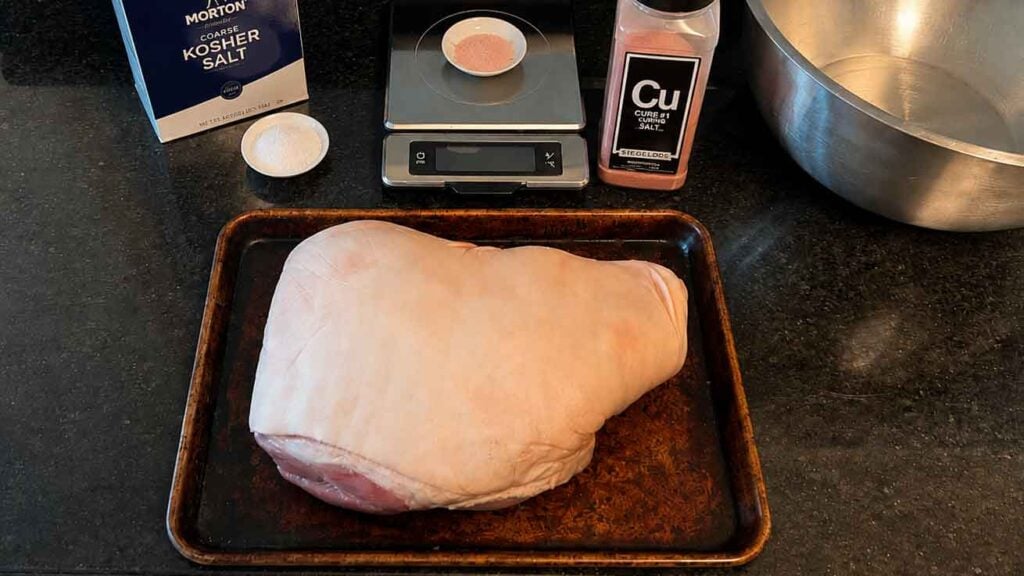
Before we get into the details, keep one thing clear: do not treat ham brine as a spoon-measured recipe. Fixed Cure #1 amounts and one-size-fits-all cure times are not safe shortcuts. You need to know what kind of ham you have, whether Cure #1 belongs, and what to measure before you work out the numbers.
Start with the ham you have
A lot of the confusion starts with the word “ham.” It can mean raw fresh pork, cured but uncooked ham, cured and smoked ham, fully cooked ham, country ham, or a dry-cured product like prosciutto.
Federal labeling rules say “ham” without a species prefix refers to the hind leg of swine. They also say “fresh” should not be used for meat that contains nitrate, nitrite, or salt used for preservation.
In everyday terms, fresh ham means uncured pork. USDA FSIS’s ham safety guidance and FoodSafety.gov’s cold food storage chart both separate fresh uncured ham from cured, cooked, country, canned, and prosciutto-style ham, which is why the label matters before you decide whether a curing brine applies.
On the package, look for words like fresh, cured, smoked, fully cooked, ready-to-eat, cook-before-eating, and sodium nitrite.
Use the table to figure out what kind of ham you have before you decide anything about brine, cure, or smoke.
| Label or type | What it usually means | Cured? | Cooked? | Does this guide apply? | What to do next |
|---|---|---|---|---|---|
| Fresh ham | Raw, uncured pork from the hind leg. | No | No | Yes, when you want to make cured smoked ham. | Keep it cold, weigh it, measure the water and thickness, then work out the exact cure from those measurements. |
| Cured, cook-before-eating ham | A ham that has been cured but still needs cooking before serving. | Yes | No | Usually no | Follow the label and current cooking guidance. Do not cure it again. |
| Cured and smoked ham | A ham that has already gone through a curing and smoking process. | Yes | Check the label | No for curing | Use the label to decide whether you are cooking, reheating, glazing, or smoking for extra flavor. |
| Fully cooked ham | A ready-to-eat ham that may only need reheating, depending on how you plan to serve it. | Yes | Yes | No | Do not cure it. Follow label and reheating guidance. |
| Country ham | A dry-cured, salt-cured ham made by a different process. | Yes | Varies | No | Use the product directions or a tested country ham process. |
When the label is unclear, stop there and figure that out first. A fresh ham and a fully cooked ham may both be called ham, but they do not need the same treatment.
When ham brine becomes a cure
A salt brine and a ham cure sound similar enough to cause trouble. They do not do the same thing.
A basic flavor brine is salt, water, and maybe sugar or aromatics. It can season meat and affect moisture over a short time. That is useful for plenty of cooks, but it does not turn fresh pork into cured ham.
A wet cure goes further. For cured ham, it uses salt plus Cure #1, also called Prague Powder #1, and the meat stays refrigerated while the cure works. Mississippi State University Extension lists salt, sugar, sodium nitrate, and sodium nitrite as curing ingredients for pork and warns that too much nitrate and nitrite can be toxic. That is why guessing is not good enough.
The basic difference is simple: a brine seasons; a cure changes the meat.
If you are still deciding which kind of brining method fits your cook, the broader comparison in wet brine vs dry brine vs equilibrium brine can help. For ham, the important point is whether you are seasoning fresh pork or making a cured ham.
The table below is not a recipe. Use it to keep the choices straight before you work out exact amounts.
| Method | Uses Cure #1? | Main purpose | What must be measured | What has to be calculated | Safety note |
|---|---|---|---|---|---|
| Flavor brine | No | Seasons meat and can help with moisture and texture. | Salt and water should still be measured, but this is not a cured ham process. | How much salt to use and how long to brine, if you are calculating a seasoning brine. | Keep raw pork refrigerated and cook it safely. |
| Wet cure | Yes, when making cured ham from fresh pork. | Turns fresh pork into cured ham with cured color and flavor. | Ham weight, water amount, salt, Cure #1, thickness, and refrigerator temperature. | Salt, Cure #1, water, PPM choice, and cure-time estimate. | Do not add extra water or extra Cure #1 after calculating unless you recalculate. |
| Equilibrium wet cure | Yes, when making cured ham from fresh pork. | Controls the final salt level by treating the meat and measured water together. | Ham weight and water weight both matter because they affect the final cure strength. | Salt and Cure #1 based on the meat and water you actually use. | More controlled does not mean foolproof. The ham still has to be measured, kept cold, cured long enough, and cooked safely. |
What salt does in a ham brine
Salt has a real job, but it is easy to give it more credit than it deserves.
Salt seasons the meat. It also changes how the meat holds water, which is part of why brined meat can eat differently from unbrined meat. In a cure, salt also helps create an environment that works with the curing process.
What salt does not do is replace Cure #1. Kosher salt, table salt, sea salt, and pink Himalayan salt are not the curing salt that makes fresh pork into cured ham.
That is why you should calculate salt by weight and not build a ham cure from rough handfuls or “enough water to cover.” If you add more water after calculating, you change the cure you just calculated.
What Cure #1 does in ham
Cure #1 is not hard to use, but it does require careful measuring.
Cure #1, also called Prague Powder #1, is a curing salt that supplies sodium nitrite for short-term cured meats that will be cooked. In ham, nitrite helps create the cured color and cured flavor people expect. The American Meat Science Association also describes nitrite’s role in controlling oxidation and helping with antimicrobial activity in cured meat systems.
That does not mean more is better. MSU Extension warns that too much nitrate and nitrite can be toxic and says cuts must be weighed so the right amount of cure can be used. That is why Cure #1 should be measured by weight, on a gram scale, not by casual spoonfuls.
Cure #2 is not covered here. It is used for long dry-cured products, not for the short-term refrigerated ham cure we are talking about here.
For the deeper safety explanation, use the guide on how to use Cure #1 safely. For ham, keep the rule simple: use Cure #1 only when it belongs, weigh it accurately, and use a weighed, tested calculation for the exact amount.
Do you need Cure #1 for ham?
The answer depends on what you are trying to make and whether the ham is already cured.
Do you need Cure #1?
- If the ham is already cured or fully cooked: Do not cure it again. Follow the label for cooking, reheating, or serving.
- If it is fresh ham and you want cured smoked ham: Cure #1 belongs in the brine, and the exact amount has to be calculated from your actual ham and method.
- If it is fresh ham and you only want to cook it like a pork roast: Cure #1 is not needed. Season it and cook it safely as fresh pork.
- If you are making country ham, prosciutto, sausage, or shelf-stable cured meat: Use a tested process for that product instead.
This is not a place to guess. When Cure #1 belongs, use the exact amount. When it does not belong, leave it out.
Cure #1 is not pink Himalayan salt
The color is the trap.
Cure #1 is sometimes called pink curing salt. Pink Himalayan salt is also pink. That does not make them the same ingredient.
Pink Himalayan salt is a cooking or finishing salt. It does not supply the sodium nitrite needed for a cured ham. If you use it in place of Cure #1, you have salted the pork, but you have not made the cured ham you think you are making.
When a recipe says “pink salt,” slow down and make sure it means Cure #1 or Prague Powder #1, not pink Himalayan salt. Cure #1 is dyed pink so it is not mistaken for regular salt. That color is a safety cue, not a flavor cue.
Wet cure vs equilibrium wet cure for ham
With wet curing, you usually have two choices, and the difference matters because water is part of the calculation.
In a traditional wet cure, the strength of the brine matters. If you mix a cure and then add more water to cover the ham, you dilute the cure. That changes what reaches the meat.
In an equilibrium wet cure, the meat and measured water are treated together. The idea is to control the final salt level instead of relying only on a strong brine surrounding the meat. The equilibrium brining guide explains that method in more detail.
For ham, do not let the word “equilibrium” make this feel foolproof. More control does not make the cure automatic. You still need correct weights, enough time, cold storage, and safe cooking.
Why ham cure time depends on thickness
Pounds matter for amounts. Thickness matters for time.
That is the easiest way to keep the two ideas separate. The weight of the ham helps determine how much salt and Cure #1 the cure needs. The thickest part of the ham helps determine how long it takes for the cure to reach the center.
A flat piece of pork and a round, bone-in fresh ham can weigh the same and cure very differently. The rounder ham puts the center farther away from the surface. Skin, fat, bone, and shape can all slow things down.
MSU Extension’s dry-cure guidance is not a wet-cure formula, but it does show why thickness matters in curing. A big, thick ham is not cured just because the scale says a certain number of pounds.
This is also why “one day per two pounds” is not a good main rule for ham. It sounds tidy, but it ignores the part that often matters most. For more detail on that larger timing question, see the guide to how long to brine meat.
For a ham cure, plan more refrigerated time than you think you need. Do not try to make up for short timing with extra Cure #1.
When injection matters for a large ham
Whole fresh hams are not small, flat pieces of meat. They can be thick, round, bone-in, skin-on, and uneven.
At some point, passive soaking may not be enough, or it may take longer than you can safely and practically manage. That is when you may need injection, smaller pieces, or a tested large-ham process.
Very thick cuts may cure too slowly or unevenly with passive soaking alone. Treat any large-cut or injection warning seriously. It does not mean you should panic, and it does not mean you should add more Cure #1. It means the cut may need a different approach.
Do not treat this section as an injection tutorial. There are no injection amounts, spacing, or technique here. If your ham is large enough that injection comes up, use a tested large-ham curing method, or cut the ham into smaller pieces and calculate from the pieces you actually cure.
How to cure ham safely in the refrigerator
With a wet ham cure, careful handling matters more than confidence.
A wet ham cure is a raw pork project, so the cold storage is not optional. Keep it in the refrigerator, not on the counter and not in a garage that feels cold at night and warms up during the day. FoodSafety.gov uses 40°F or below for refrigerator storage, and MSU Extension gives 32°F to 40°F as the best temperature range for curing meat.
Use a food-safe, non-reactive container and keep the ham submerged if you are using an immersion cure. When the cure is finished, discard the brine. It has held raw pork for days.
Curing is not cooking. A fresh ham you cure at home still needs to be cooked safely afterward. FoodSafety.gov lists raw ham at 145°F with a 3-minute rest, and it gives separate reheating guidance for precooked ham and leftovers. Follow the label when you are dealing with a store-bought cured or cooked ham.
If you plan to smoke the cured ham after the cure is finished, that is the cooking stage, not a replacement for the cure. Once the curing side is handled correctly, you can use the BBQ Wood Selector to compare hardwoods like apple, cherry, maple, oak, and hickory for ham.
Use the card below as the last check before the ham goes into the cure.
Before you cure ham at home
- Fresh ham is raw pork: Treat it that way from start to finish.
- Keep it at 40°F or below: The ham stays refrigerated the entire time it is curing.
- Weigh Cure #1 on a gram scale: Do not measure it by the spoonful.
- Do not substitute pink Himalayan salt: It is not Cure #1 and does not cure meat.
- Discard used brine: It has been in contact with raw pork.
- Cook after curing: Curing is not cooking. Use current FoodSafety.gov temperature guidance.
What to measure before mixing ham brine
Once you know you are working with fresh, raw ham, slow down and measure the things that actually change the cure.
Weigh the ham. Measure the water needed to cover it if you are using a wet or equilibrium wet cure. Measure the thickest part of the ham, and pay attention to whether it is flat, round, bone-in, boneless, or irregular.
Those details matter for different reasons. Weight helps set the salt and Cure #1 amounts. Water changes the strength of the cure. Thickness affects how long the cure needs to reach the center.
Once those measurements are ready, use the Brining Calculator for the exact salt, Cure #1, water, and cure time. Similar cured whole-muscle projects, like pastrami brine and smoked corned beef brine, follow the same basic caution: weigh carefully, keep it cold, and do not guess at Cure #1.
Before you calculate, check these details.
Before you calculate the cure
- Confirm the ham is fresh/raw and not already cured.
- Weigh the ham.
- Measure the water needed to cover it, if using a wet or equilibrium cure.
- Measure the thickest part.
- Note whether it is bone-in or boneless.
- Note whether it is flat, round, or irregular.
- Make sure the refrigerator is at or below 40°F.
- Use a gram scale for salt and Cure #1.
- Do not add extra water after calculating unless you recalculate.
If you already added water after calculating, do not try to fix it by tossing in a little more Cure #1. Recalculate from the real meat and water amounts.
Common ham brine mistakes
Most ham brine problems start before the ham goes into the refrigerator. The mistake is usually in the label, the measurement, the water, the temperature, or the time.
Use this as a last check before you mix anything.
| Problem | Likely cause | Safer next step |
|---|---|---|
| The ham is already cured | The label shows cured, smoked, fully cooked, ready-to-eat, or similar wording. | Do not cure it again. Follow the label for cooking, reheating, smoking for flavor, or serving. |
| The cure time seems very long | The ham may be thick, round, bone-in, skin-on, or curing at a colder refrigerator temperature. | Do not shorten the cure just because the estimate surprised you. Plan more refrigerated time, or consider smaller pieces or a tested large-ham process. |
| You added more water after calculating | The ham was not fully covered, so extra water went in after the cure was mixed. | Recalculate using the real water amount. Do not guess by adding a little more salt or Cure #1. |
| Cure #1 was measured by spoonfuls | The recipe used volume measures, or the scale was skipped. | Use a gram scale and a tested process or exact calculation. Cure #1 is not a seasoning to eyeball. If the cure is already underway and the amount is uncertain, the safer choice is to stop and start over with weighed ingredients. |
| Pink Himalayan salt was used | Pink curing salt and pink Himalayan salt were confused. | Do not treat the ham as cured. Pink Himalayan salt does not replace Cure #1. |
| The ham is thicker than expected | A whole or bone-in ham has more distance from the surface to the center than a flat piece. | Measure the thickest part again. Use a process that accounts for thickness, and take any injection or large-cut warning seriously. |
| The ham cured above 40°F | The refrigerator ran warm, or the ham was held somewhere that was not reliably cold. | Do not try to rescue a warm raw-pork cure. Use reliable refrigeration before starting another cure. |
| The cure is finished, but the ham is not cooked | Curing was mistaken for cooking. | Cook the ham safely after curing. Use current FoodSafety.gov guidance and check with a thermometer. |
Most of the time, the safer choice is to stop and fix the mistake before you keep going. Recalculate, recheck the label, or change course while you still can.
Ham brine FAQs
These questions come up because ham can mean raw pork, cured pork, cooked ham, or ready-to-eat ham, depending on the label.
Start with the label. Fresh ham is raw, uncured pork, so it needs a curing process if you want to turn it into cured smoked ham. If the label says cured, smoked, fully cooked, ready-to-eat, or cook-before-eating, do not cure it again. Follow the label for cooking, reheating, glazing, or smoking for flavor.
Yes, if you want fresh pork to become cured ham. Salt can season the pork, but it does not supply sodium nitrite or do the same curing work as Cure #1. Use Cure #1 only when it belongs, weigh it on a gram scale, and use a tested calculation for the exact amount.
No. Pink Himalayan salt and Cure #1 are not the same ingredient. Pink Himalayan salt is regular cooking or finishing salt, and it does not supply sodium nitrite. If a recipe says pink curing salt, make sure it means Cure #1 or Prague Powder #1, not pink Himalayan salt.
Fresh ham cure time depends more on thickness and shape than pounds alone. A thick, round, bone-in ham takes longer for the cure to reach the center than a flatter piece of pork. Use a cure-time estimate that accounts for thickness, keep the ham refrigerated, and take any large-cut or injection warning seriously.
Yes. Curing fresh ham changes the meat, but it does not cook it. After the cure is finished, discard the used brine and cook the ham safely with a thermometer. For store-bought cured or cooked ham, follow the label and current food-safety guidance for cooking, reheating, or serving.
Corrections and editorial standards
- Spotted something wrong or outdated? Send a correction here: Corrections & Updates
- How we handle sources, testing, and updates: Editorial Standards
- Media or general notes: Email the publisher
Sources
This guide combines practical barbecue planning with current food-safety guidance, federal labeling rules, university extension guidance, and meat-science references. It is not a lab-tested ham cure formula. Exact salt, Cure #1, water, and cure-time numbers should come from a tested process or a weighed calculation, not fixed spoon measures.
- FoodSafety.gov, Cook to a Safe Minimum Internal Temperature and Cold Food Storage Chart: Supports raw ham cooking temperature, precooked ham reheating guidance, leftovers guidance, refrigerator temperature, ham storage categories, and fresh uncured ham storage guidance.
- USDA FSIS, Hams and Food Safety: Supports the distinction between fresh, cured, cooked, country, canned, and other ham products before deciding whether a curing brine applies.
- 9 CFR § 317.8 via Cornell Legal Information Institute: Supports the ham labeling discussion and the meaning of “fresh” when nitrate, nitrite, or salt preservation is involved.
- Mississippi State University Extension, Curing Pork Products at Home: Supports the curing ingredients discussion, nitrite toxicity caution, weighing guidance, thickness-based cure timing concept, and 32°F to 40°F curing range.
- American Meat Science Association, Sodium Nitrite in Processed Meat and Poultry Meats: Supports nitrite’s role in cured color, cured flavor, oxidation control, and antimicrobial activity.
Food-safety and labeling sources were checked on the published or last-updated date shown above; always follow the current product label and current USDA/FoodSafety.gov guidance.
About the author
James Roller documents South Carolina barbecue for Destination BBQ and authored the SC BBQ cookbook Going Whole Hog. His BBQ guides focus on practical cooking and planning questions, including how to use salt, time, temperature, and food-safety guidance without making backyard barbecue more complicated than it needs to be.