Corned Beef Brine for Brisket: Salt, Cure #1, and Cure Time
Learn how to brine brisket for corned beef or smoked corned beef so the salt, Cure #1, water, and time match the brisket in your fridge
The recipe says one gallon of water. Your brisket does not fit in one gallon of water. So you add more, and now the brine you made no longer matches the recipe. The salt concentration is too low. The Cure #1 concentration is too low. You just diluted a cure you are trusting to do its job over the next week, and nothing on the recipe page told you that was a problem.
Most corned beef brine recipes are built around a specific brisket in a specific pot. When yours does not match (and it usually does not), the recipe’s salt, Cure #1, and timing are based on someone else’s brisket and pot. That matters even more if you are making smoked corned beef, where the smoker will not pull salt away the way simmering water can.
So use the brisket and water in front of you. Weigh the beef, weigh the water, measure the thickest part of the meat, and use the Brining Calculator for the exact salt, Cure #1, and cure time. Do not guess with Cure #1, and do not add extra to speed things up. That is not how curing works.
Quick answer for corned beef brisket brine
Start here before you get into brisket cuts, water weight, timing, or what changes if the cured brisket is headed for the smoker.
Quick answer
- Use this for: Raw brisket you plan to cure at home before cooking or smoking, not store-bought corned beef that has already been cured.
- Best cuts: Use brisket flat, brisket point, or a trimmed whole packer split into pieces when practical.
- Cure #1: Cure #1 / Prague Powder #1 is required for true cured corned beef.
- Temperature: Keep the brine refrigerated the whole time, at or below 40°F.
- Weigh: Weigh the trimmed beef and the water needed to cover it.
- Measure: Measure the thickest part of the brisket, not just the total weight.
- Calculate: Use the beef weight and water weight to calculate the salt and Cure #1, and use thickness to estimate cure time.
- Do not rush it: Do not add extra Cure #1 to speed things up or create a safety buffer.
Why curing brisket for corned beef is different from ordinary brining
An ordinary beef brine seasons meat. A corned beef brine cures it.
That difference matters. Corned beef is beef cured in a salt brine, usually with sugar and pickling spices, and for a true cured result, Cure #1 / Prague Powder #1. Iowa State University Extension describes pink curing salt as a mix of sodium chloride and sodium nitrite that helps inhibit bacterial growth while giving cured meats their reddish color and cured flavor.
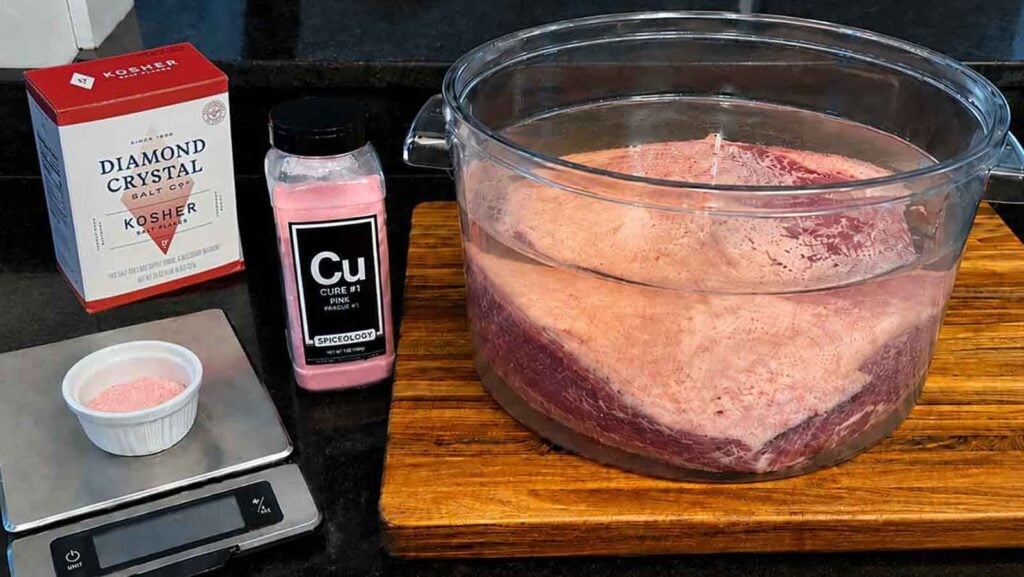
Kosher salt and Cure #1 are not doing the same job. Kosher salt seasons the beef and affects texture. Cure #1 brings sodium nitrite into the cure. That is why a brisket soaked in salty water without Cure #1 is not the same thing as corned beef.
Also, Cure #1 is not just there to keep the meat pink. University of Wisconsin Extension explains that nitrite added to meat products helps inhibit Clostridium botulinum and slows other harmful bacteria. The color and flavor matter, but nitrite is doing more than making the meat look right.
This is also why the cure should be measured by weight. The amounts are small, and small mistakes matter more when you are dealing with Cure #1.
Pickling spices, garlic, bay leaves, peppercorns, brown sugar, and similar ingredients shape the flavor of the finished corned beef, but they are not part of the calculations. For this method, trimmed beef weight and water weight determine the salt and Cure #1 amounts. The thickest part of the brisket helps determine the cure time.
Start with the brisket you are curing
The cut of brisket changes how easy it is to cure evenly. A thin, even flat is easier to manage than a thick, uneven point. A whole packer has both problems in one piece.
Brisket flat
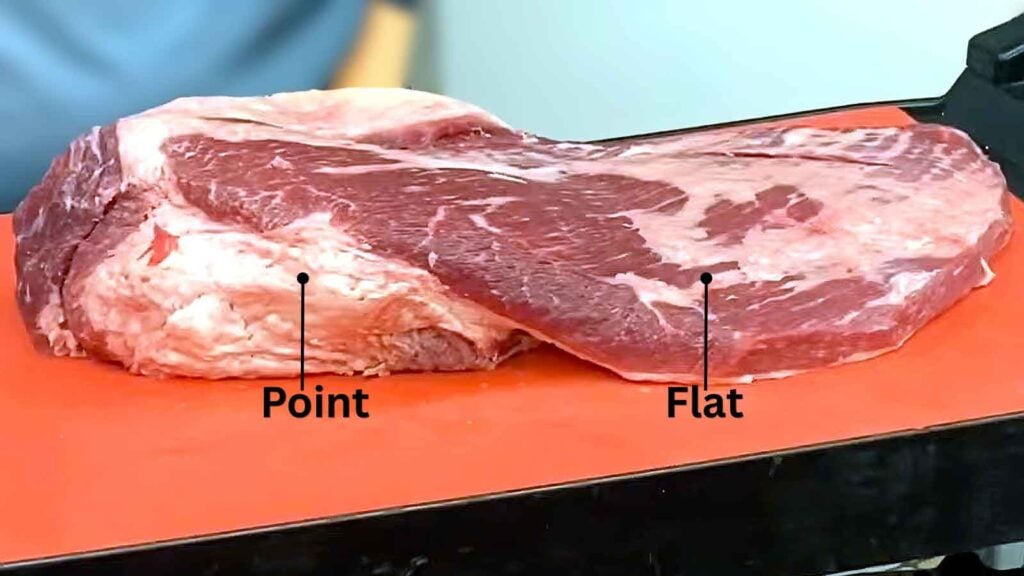
A brisket flat is the easiest place to start. It is usually more even in thickness, so the cure can reach the center more predictably.
That does not mean every flat cures on the same schedule. You still need to measure the thickest part and use that thickness when you estimate the cure time. But compared with a point or a whole packer, the flat gives you fewer surprises.
If you plan to smoke the corned beef after curing, remember that the flat is leaner. Lean meat can make salt seem sharper because there is less fat to soften the bite.
Brisket point
The point is thicker, fattier, and less even. That can make excellent eating, especially on a smoker, but it also makes the cure less forgiving.
The thickest part is what matters. Total weight can fool you here. A point may not weigh much more than a flat, but if it is much thicker in one spot, the cure needs more time to reach the center.
If you separate the point from the flat, treat it as its own piece. That gives the point its own weight and thickness instead of pretending it behaves like the flat.
Whole packer brisket
A whole packer is natural barbecue territory, but it is harder to cure evenly as one piece. The flat and point have different shapes, different thicknesses, and a fat seam between them.
When practical, split the flat and point before curing. That lets you trim between the muscles, measure each piece on its own, and lower the chance that the flat is ready while the thickest part of the point is still not fully cured.
Use this table to match the cut you bought to the way you should cure it.
| Cut | What changes in the brine | Time caution | Before smoking | What to measure |
|---|---|---|---|---|
| Brisket flat | More even shape and thickness, usually the easiest brisket cut to cure evenly. | Recipe timing is most likely to work here, but thick spots still matter. | Leaner meat can taste saltier after smoke, so check the salt level first. | The trimmed flat weight and the thickest part of the flat. |
| Brisket point | Thicker, fattier, and less even than the flat. | Be more careful with the thickest area because the cure has farther to go. | Rich after smoking, but uneven curing can show up as gray patches near the center. | The point weight and maximum thickness if split from the flat. |
| Whole packer | Flat and point differ in thickness, shape, and fat seams. | Do not treat a whole packer like a thin flat. Split it when practical. | Great BBQ cut, but harder to cure evenly before it ever reaches the smoker. | Measure the flat and point separately. If curing whole, measure the thickest area. |
| Store-bought cured corned beef | The curing is already done, so you are not building a brine from scratch. | Do not re-cure it unless you are following a tested method written for that product. | Often very salty before smoking. Rinse well and consider a cold-water soak. | Nothing to measure here for the calculator. The calculator is for raw brisket you plan to cure at home, not corned beef that has already been cured. |
The salts you can and cannot swap
“Pink salt” is where some folks get into trouble. Cure #1 is pink. Himalayan pink salt is pink. They are not the same thing.
Cure #1 is tinted so you do not mistake it for regular salt. The color is a warning aid, not the thing that makes it cure meat.
| Ingredient | What it does | Use it here? | Can it replace Cure #1? | Main warning |
|---|---|---|---|---|
| Cure #1 / Prague Powder #1 | Adds sodium nitrite for cured color and flavor, and helps inhibit harmful bacteria in a way regular salt cannot. | Yes, when you are making true cured corned beef. | It is the curing salt, not a substitute. | Weigh it carefully. Do not rely on spoon measurements when scaling a brine. |
| Kosher salt | Seasons the beef and affects texture. | Yes, as the main salt when the recipe or calculator calls for it. | No. | Different brands measure differently by volume, so weight is safer. |
| Table salt | Seasons the beef, but it is denser by volume than kosher salt. | Only if the recipe or calculator accounts for it. | No. | Do not swap it cup-for-cup with kosher salt. |
| Himalayan pink salt | Works as regular salt, not curing salt. | No, not for curing corned beef. | No. | Its pink color does not mean it contains Cure #1 nitrite. |
| Cure #2 / Prague Powder #2 | Used for dry-cured meats that cure over weeks or months because Cure #2 includes nitrate. | No, not for cooked corned beef. | No. | Do not use Cure #2 in place of Cure #1 for corned beef. |
| Morton Tender Quick | A different curing product with its own formula. | Only in recipes written specifically for it. | No. | It is not a volume swap for Cure #1. |
For a deeper look at the curing salt itself, see our Cure #1 guide. Here, the main point is simple: use Cure #1 when the cure calls for it, weigh it, and do not improvise.
Wet brine vs equilibrium brine for corned beef brisket
Both methods can cure brisket. The big difference is whether you are following a fixed recipe or measuring the brine for your actual beef and water.
Traditional wet brine
A traditional wet brine is the one most recipe pages use. It gives you a set amount of water, salt, sugar, spices, and Cure #1. The brisket sits in that brine for a set window of time.
That can work when your brisket, water amount, salt type, and timing match the recipe closely. The trouble starts when you need more water to cover a bigger brisket or when your brisket is thicker than the one the recipe was written around.
Once you change the water amount, you change the brine. The salt concentration drops, and so does the Cure #1 concentration. At that point, you need to recalculate instead of treating the recipe as-is.
Wet equilibrium brine
A wet equilibrium brine is more controlled because it is based on weight. You weigh the beef, weigh the water, and calculate the salt and Cure #1 for both together.
That is why weighing both parts matters. The brine is built around what you are curing and the water it takes to cover it.
If you want the bigger explanation, see our guide to how equilibrium brining works. For this brisket, the practical point is that the water counts.
Why water weight matters
Water is not just there to cover the brisket. In an equilibrium brine, it is part of what determines how much salt and Cure #1 you need.
More water means more total weight in the brine. Less water means less. That is why measuring water by “enough to cover” is not enough unless you also weigh it or account for it in the math.
Here is a simple way to keep the two methods straight.
Wet brine or equilibrium brine
- Traditional wet brine: Familiar and recipe-driven, but less flexible when brisket size or water amount changes.
- Wet equilibrium brine: Built around the weight of the beef and water together.
- Water matters: Adding more water changes the brine and should be recalculated.
If you are curing a brisket that does not match a recipe exactly, calculate salt and Cure #1 by weight. That is the safer way to handle your brisket and the container you actually have.
How long to brine brisket for corned beef
This is the question everybody wants answered with one number. The honest answer is that one number is not enough.
Time depends on the meat you are curing. The thicker and more uneven the brisket, the less useful a simple recipe window becomes.
Why 5 to 7 days is only a starting point
You will see a lot of corned beef recipes use 5 to 7 days. That can be a reasonable starting point for many brisket flats. Iowa State University Extension gives a window of 5 to 10 days in its home corned beef method.
Those ranges are helpful, but they do not overrule thickness and shape.
A thinner, even flat is the most predictable. A thick point or a whole packer needs more caution. Do not rush the cure just because a recipe says “5 days,” and do not add more Cure #1 to speed things up.
Thickness matters more than total weight
Total weight matters for salt and Cure #1 amounts. Thickness matters for time. That same difference is why the brining math matters: weight sets the amounts, while thickness drives the cure time.
A six-pound flat and a six-pound point do not cure the same way if the point is much thicker in the middle. The cure has to reach the center of the meat, and the thickest part is where that takes longest.
That is why you measure the thickest part of the brisket before using the calculator. Not the average thickness. Not the prettiest side. The thickest part.
Shape matters too
A flat slab is easier to cure evenly than a thick, rounded, uneven piece. A whole packer can have the flat ready before the point has caught up.
That is the reason for splitting the flat and point when you can. You are not doing it to make extra work. You are doing it because the pieces behave differently.
For more general timing help across meats and brines, see our how long to brine meat guide. For this brisket, the thickest part matters most.
What to enter in the Brining Calculator
The calculator can only help if the numbers you enter match the brisket in front of you. This is the part worth slowing down for.
What to enter in the calculator
- Trimmed beef weight: Weigh the brisket after trimming, not before.
- Water weight: Use the amount of water needed to cover the brisket in your container.
- Brine type: Choose the method you are actually using.
- Cure #1 setting: Use Cure #1 / Prague Powder #1 when making true cured corned beef.
- Salt amount: Let the calculator return the exact amount instead of guessing from a recipe.
- Thickest part of the brisket: Measure the thickest area, especially on a point or whole packer.
- Separate pieces: If the flat and point are split, enter them separately when you can.
Before you smoke corned beef
Smoked corned beef starts with the same cured brisket. The difference is what happens after the cure.
When you simmer corned beef in water, some salt moves out into the cooking liquid. When you smoke it, there is no pot of water pulling salt away. That can make salt more noticeable.
Rinse, soak, or taste before smoking
Rinse the cured brisket under cold running water before cooking or smoking. That removes surface salt and any spices clinging to the outside.
If you are not sure about the salt level, fully cook a small thin piece in a skillet and taste it before the brisket goes on the smoker. That little test can save the whole brisket.
If it tastes too salty, soak the brisket in cold water in the refrigerator for an hour or two, changing the water once or twice. Store-bought cured corned beef may need longer because it often starts out saltier. Homemade corned beef from a measured brine may only need a good rinse.
That is the bigger point: do not assume smoking will reduce salt the way simmering does.
Dry the brisket before smoking
After rinsing or soaking, pat the brisket dry. A dripping wet surface does not help you in the smoker.
By this point, the goal is simple: get the brisket cured safely and check the salt before the cook begins. If you need help choosing smoke wood once the brisket is ready, our BBQ Wood Selector can help with that next choice.
Corned beef, smoked corned beef, or pastrami?
Corned beef is the cured brisket. Smoked corned beef is cured brisket finished on the smoker.
Pastrami-style brisket starts with cured beef too, but it adds a pastrami rub and its own finishing method. That is a different process. Use our pastrami brine guide for that cook.
If you are making smoked corned beef, do not change the brine just because you plan to smoke it. Get the cure right first, then check the salt before the brisket goes on.
Before you smoke corned beef
- Rinse: Rinse the cured brisket under cold running water.
- Taste first: Taste a small cooked piece if you are unsure about salt level.
- Soak if needed: Use a cold-water soak if the meat tastes too salty or is store-bought and pre-cured.
- Dry the surface: Pat the surface dry before it goes on the smoker.
- Expect more salt: Do not assume smoking will reduce salt the way simmering does.
Common mistakes when curing brisket for corned beef
Most corned beef brine problems come from the same few places: guessing with Cure #1, changing the water, treating a thick point like a flat, or rushing the cure.
Use this table before you start, or come back to it if something went wrong.
| Mistake | Why it causes trouble | Safer fix | Next time |
|---|---|---|---|
| Measuring Cure #1 casually by spoon | Cure #1 amounts are small and need to match the beef, water, and method. | Do not guess. Weigh Cure #1 carefully. | Use the calculator and a scale. |
| Adding extra water without recalculating | Extra water dilutes the brine, lowering the salt and Cure #1 concentration. | Recalculate before continuing if the water amount changed significantly. | Weigh the water needed to cover the brisket before mixing the brine. |
| Confusing Cure #1 with Himalayan pink salt | Himalayan pink salt does not contain the sodium nitrite that makes Cure #1 a curing salt. | Do not treat the beef as properly cured corned beef. | Confirm the label says Cure #1, Prague Powder #1, Insta Cure #1, or an equivalent curing salt. |
| Using Cure #2 | Cure #2 is meant for dry-cured meats that cure for weeks or months, not this cooked brisket process. | Do not use it as a substitute for Cure #1. | Use Cure #1 only when making true cured corned beef. |
| Curing a thick point like a thin flat | The point is thicker and less even, so the cure may not reach the center on the same schedule. | Do not assume the center is properly cured if the handling or timing is questionable. | Split thick pieces when you can and measure the thickest part. |
| Rushing because a recipe says 5 days | Recipe timing is not a guarantee for every brisket shape. | Give thick or uneven brisket the time the method calls for. | Use the calculator’s time estimate and do not add more Cure #1 to speed things up. |
| Smoking without checking salt level | Smoking does not pull salt away like simmering in water. | Rinse, taste a small cooked piece if practical, and soak if too salty. | Check salt before the brisket goes on the smoker. |
| Letting the brine get too warm | The beef sits in the brine for days, so refrigerator temperature matters the whole time. | Discard if time and temperature safety are uncertain. | Keep the brine at or below 40°F from start to finish. |
| Reusing brine | Used brine has been in contact with raw meat. | Discard it after the cure. | Mix a fresh brine for any new cure. |
If the brisket is thick enough that you are thinking about injecting the cure, stop and use a tested method written for that. This guide is for letting the brisket sit in a cold brine in the fridge, not for injecting cure into the meat. The simpler fix is usually to split the brisket and calculate each piece on its own.
Be careful with a gray center. It can mean the cure did not reach the middle of the brisket. The answer is not to add extra Cure #1 next time. The better choice is to split thicker pieces, measure the thickest part, keep the brine cold, and give the cure enough time.
Corned beef brine safety and leftovers
This is still raw beef sitting in a curing brine for several days. Good technique matters, but food safety comes first.
Keep the brine refrigerated the whole time, at or below 40°F. Do not cure brisket at room temperature. A refrigerator thermometer is worth using here because the brisket may sit in the brine for several days.
If the container will not fit in the refrigerator, use a smaller container or split the brisket before you start. Use a food-safe, non-reactive container such as food-grade plastic, stainless steel, or glass. Avoid bare aluminum and cast iron. Keep the brisket covered and submerged.
After curing, discard the brine. Do not reuse it.
FoodSafety.gov lists 145°F with a 3-minute rest as the safe minimum for beef roasts, but brisket is usually cooked much longer for tenderness. Leftovers should be refrigerated within 2 hours, used within 3 to 4 days or frozen, and reheated to 165°F.
Safety note
- Temperature: Keep the brine refrigerated the whole time, at or below 40°F.
- Cure #1: Use Cure #1 / Prague Powder #1 only when you are making true cured corned beef.
- Do not swap salts: Do not confuse Cure #1 with kosher salt, table salt, Himalayan pink salt, or Cure #2.
- Measure carefully: Weigh Cure #1 carefully. Do not add extra as a safety buffer.
- Container: Use a clean, food-safe, non-reactive container such as food-grade plastic, stainless steel, or glass.
- Avoid reactive metal: Do not use bare aluminum or cast iron for curing brines.
- Keep it submerged: Keep the brisket covered and submerged while curing. If it wants to float, weigh it down with a clean, food-safe weight and turn or reposition it during the cure.
- Used brine: Discard used brine after the cure. Do not reuse it.
- Leftovers: Refrigerate leftovers within 2 hours.
- Storage: Use leftovers within 3 to 4 days or freeze them.
- Reheating: Reheat leftovers to 165°F.
If anything smells off, looks moldy, bubbles, or seems questionable, do not taste it and do not try to rescue it. Meat is not the place to gamble.
Corned beef brine FAQ
These are the questions that tend to come up before you mix the brine, adjust a recipe, or smoke the finished corned beef.
Not if you mean the same nitrite-cured corned beef most people expect. Cure #1 / Prague Powder #1 provides sodium nitrite, which helps create the cured color and flavor and helps inhibit harmful bacteria in cured meat. If you brine beef without Cure #1, treat it as salted beef, not as a cured corned beef.
No. Pink curing salt and Himalayan pink salt are completely different products. Cure #1 is tinted pink so it is not confused with regular salt, and it contains sodium nitrite. Himalayan pink salt is regular salt that gets its pink color from minerals. Do not use Himalayan pink salt in place of Cure #1.
Adding more water changes the brine. It lowers the concentration of salt and Cure #1 unless you recalculate the amounts. That is why “enough water to cover” is not enough by itself. For an equilibrium brine, weigh the trimmed brisket and the water needed to cover it.
Many corned beef recipes use 5 to 7 days, and some trusted home methods allow a wider window. Treat those ranges as a starting point, not a guarantee. The thickest part of the brisket, the cut, the shape, and the brine method all affect how long curing should take.
A brisket flat is usually the easiest cut to cure evenly because it is thinner and more even. A point can be excellent, but it is thicker and less predictable. A whole packer is hardest to cure as one piece, so split the flat and point when you can.
A gray center can mean the cure did not fully reach the middle of the brisket. Do not fix that by adding extra Cure #1 next time. Measure the thickest part, give the cure enough time, split thick pieces when practical, and keep the brine cold.
Rinse corned beef before smoking. If it is store-bought, came from a strong brine, or you are unsure about the salt level, cook a small thin piece first and taste it. If it tastes too salty, soak the brisket in cold water in the refrigerator before smoking. Smoking does not pull salt out the way simmering does.
Corrections and editorial standards
- Spotted something wrong or outdated? Send a correction here: Corrections & Updates
- How we handle sources, testing, and updates: Editorial Standards
- Media or general notes: Email the publisher
Sources
This guide combines USDA and university extension food-safety guidance with practical brisket and barbecue experience. Exact salt, Cure #1, water, and time amounts belong in the Brining Calculator using the weights and thickness you enter.
- USDA FSIS: Corned Beef and Food Safety: supports corned beef handling, cooking, refrigeration, and leftover safety context
- Iowa State University Extension: DIY Corned Beef: supports the corned beef process, Cure #1 composition, non-reactive container guidance, Himalayan pink salt warning, and home curing time context
- University of Wisconsin Extension: Nitrates and Nitrites Used in Meat Products: supports the discussion of nitrite’s role in cured meat safety and quality
- FoodSafety.gov: Cold Food Storage Chart and Safe Minimum Internal Temperatures: support refrigerator storage, leftover storage, beef minimum temperature, and 165°F reheating guidance
We cite authoritative references and note when guidance is based on practical barbecue experience.
About the author
James Roller documents South Carolina barbecue for Destination BBQ and authored the SC BBQ cookbook Going Whole Hog. His BBQ guides focus on practical cooking and planning questions, including how to use reliable meat-cut and food-safety guidance without making backyard barbecue more complicated than it needs to be.