How Long to Brine Meat
See how long to brine meat by cut, method, and thickness so it seasons evenly and keeps the right texture
If you are trying to figure out how long to brine meat, the goal is simple: give the salt enough time to help without turning the meat salty, spongy, mushy, or hammy.
That is why brining time is not really about the weight of the meat. It is mostly about thickness, shape, brine strength, and the method you are using.
Fish and small seafood can be ready in minutes. Chicken breasts and pork chops usually need a short brine. Whole birds, turkey breasts, pork loin, brisket, and larger cuts need more time. Dry brines often need longer than wet brines because the salt has to dissolve on the surface before it moves back into the meat.
Use the chart below to start in a reasonable range. For a more specific estimate based on your cut, its thickness and shape, the brining method, and the salt level you want in the finished meat, use our Brining Calculator.
Ham, pastrami, corned beef, bacon, and anything with Cure #1 are different. Do not use a basic brining chart for cured meats.
Everything here assumes refrigeration. The counter is not the place to brine meat. Keep the meat and brine at 40°F or below while it brines.
Quick answer: how long to brine meat
Start here, but treat these as starting points, not exact rules.
Quick answer
- Fish and small seafood: Often minutes, not hours. Thin fish, shrimp, and scallops can pick up salt quickly.
- Chicken breasts and pork chops: Usually a short brine, often 30 minutes to a few hours depending on thickness and brine strength.
- Whole birds and larger cuts: Plan in hours, not minutes. Whole chicken, turkey breast, and turkey need more time because salt has farther to travel.
- Dry brines: Often need longer than wet brines because the salt first has to draw moisture to the surface, dissolve, and move back into the meat.
- Thick cuts, odd shapes, or equilibrium brines: A broad chart can get you close, but this is where the math matters. For Cure #1, ham, pastrami, corned beef, or bacon, use the proper curing guide, not a basic brining-time chart.
- Food safety: These times assume the meat and brine stay at 40°F or below, start to finish.
Build your extra time around prep, chilling, and drying, not a longer soak. Make the brine ahead, chill it fully, and leave time to pat the meat dry or air-dry the surface before cooking.
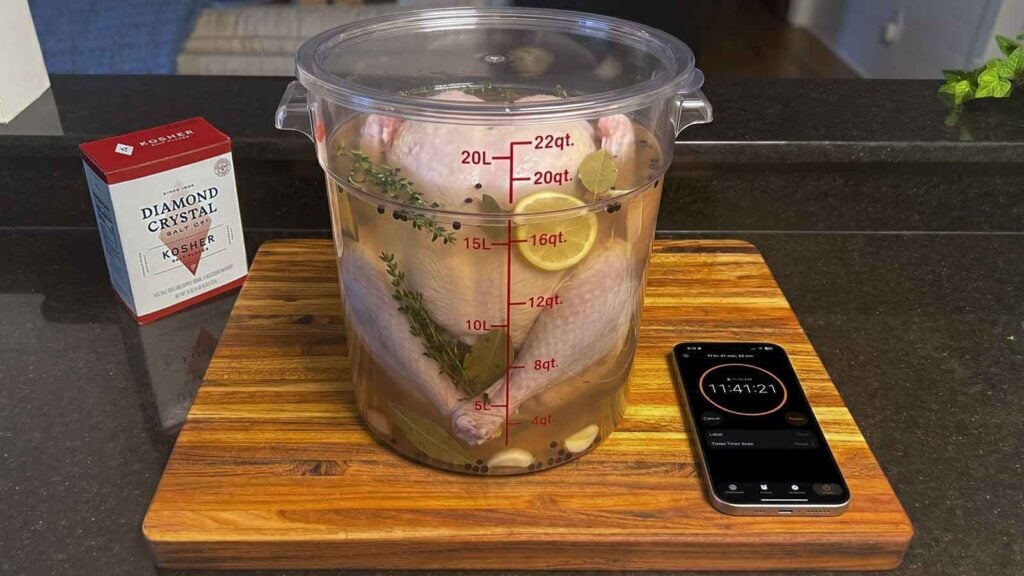
Brining time chart by meat and cut
These are starting points for basic refrigerated salt brines. The lower end of the range is usually the safer place to start for lean, thin, or delicate cuts, especially if your brine is on the strong side. Before you use the chart, check the label. If the meat is enhanced, injected, self-basting, or already contains salt or seasoning, use a lighter brine, shorten the time, or skip the brine.
| Meat or cut | Typical situation | Wet brine starting range | Dry brine starting range | Why the range moves | When this chart is not enough |
|---|---|---|---|---|---|
| Fish fillets | Thin fillets, quick cook | 15 to 45 minutes | 30 to 60 minutes, when used | Delicate flesh takes salt quickly. | The fillet is thick, the brine is strong, or the fish is headed for the smoker. |
| Salmon for smoking or thicker fish | Thicker fillet or side | 30 minutes to 2 hours | Several hours, depending on method | Thickness, salt strength, and drying time before smoking can change the clock. | The fillet is thick or you need drying time before smoking. |
| Shrimp or scallops | Small seafood | 15 to 30 minutes | Not typical | Small pieces salt quickly and can go too far fast. | The pieces are unusually large or the brine is stronger than usual. |
| Chicken breasts | Boneless, about 1 inch thick | 30 minutes to 2 hours | 1 to 8 hours | Lean white meat benefits quickly but can get spongy. | The pieces are thick, uneven, or you are not sure how salty the brine is. |
| Bone-in chicken pieces | Mixed sizes | 2 to 6 hours | 4 to 24 hours | Bone, skin, and uneven thickness make the timing less exact. | You have very different piece sizes in the same batch. |
| Whole chicken | 3 to 5 pounds | 4 to 12 hours | 12 to 24 hours | A whole bird has uneven thickness and a longer path to the center. | The bird is large or you need a tighter schedule. |
| Turkey breast | Boneless or bone-in | 6 to 18 hours | 12 to 24 hours | Size and shape vary widely from one turkey breast to the next. | The breast is thick, bone-in, rolled, or being cooked for a fixed meal time. |
| Whole turkey, 12 to 14 pounds | Holiday-size bird | Around 12 hours | 24 to 48 hours | Whole-bird shape matters, and dry brining needs more time. | You need to plan brine, drying, and cook time together. |
| Whole turkey, 16 to 20 pounds | Larger whole bird | 12 to 24 hours | 24 to 48 hours | Larger birds need more time, but USDA says not to brine turkey longer than two days. | You are near the upper end or using an enhanced, injected, or self-basting turkey. |
| Pork chops | 1 to 1.5 inches thick | 30 minutes to 4 hours | 2 to 12 hours | Thickness and salt strength matter a lot with lean pork. | The chops are thick-cut, very lean, or you want to avoid a hammy taste. |
| Pork loin | 2 to 3 inches thick | 3 to 8 hours | 12 to 24 hours | A lean roast has a longer path to the center. | The loin is especially thick, tied, or headed for a long smoke. |
| Pork shoulder | Whole butt or picnic | Not usually the best use of a wet brine | 12 to 24 hours; very large cuts need more than a broad chart | Fat, connective tissue, bark, and rub timing change the choice. | The cut is large, or the salt level needs to be more precise. |
| Beef steaks | Steak cuts | Usually skip wet brine | 1 to 24 hours | Dry brining fits browning and beef flavor better than soaking in water. | The steak is very thick or you are salting far ahead. |
| Brisket or beef roasts | BBQ roasts | Usually skip wet brine unless curing | 12 to 24 hours; very large roasts need more than a broad chart | Bark, surface dryness, thickness, and fat all matter. | The cut is thick, expensive, or you are making pastrami. |
| Ham, pastrami, corned beef, bacon | Cure #1, nitrite, or cured meats | Do not use this chart | Do not use this chart | This chart is not built for that job. | Use the proper curing guide, not this chart. |
These are starting points for refrigerated brines for chicken, pork chops, fish, and similar cuts, not promises. Your exact timing still depends on thickness, shape, salt percentage, and method.
For turkey, the wet and dry ranges are more specific because Clemson Extension gives practical turkey brining times by size and method. If you are planning the whole cook around a meal time, our turkey planner can help you work backward from serving.
Why thickness matters more than pounds
This is where the “one hour per pound” rule starts to fall apart. Pounds help you figure out how much salt you need. They do not tell you how far the salt has to travel.
Salt starts at the surface and moves inward. In Greg Blonder’s cold-brining tests, salt moved only a few millimeters in the first hour, and the rate slowed as time went on. You do not need to cook with that number in your head. The useful point is simpler: a thin pork chop and a thick roast are completely different brining problems, even if they weigh the same.
Shape changes the answer too. A flat slab, a round roast, a tenderloin, and a whole bird do not expose the same path to the center. The outside may taste right while the middle still needs more time.
If you want the math behind that idea, our guide to how brining math works goes deeper. For cooking, though, the plain version is enough: measure the thickest part and pay attention to shape. Thickness and shape are better timing clues than package weight alone.
Wet brine, dry brine, and equilibrium brine do not use the same clock
The method matters because the salt does not get into the meat the same way every time. Wet brines, dry brines, and equilibrium brines can all work, but you cannot use the same timing for all three.
Wet brines
A wet brine surrounds the meat with salty water. That can be useful for lean cuts that need help staying juicy, especially chicken breasts, pork chops, and some poultry.
The catch is that stronger wet brines work faster but give you less room for error. A short brine can help. A long soak in a strong brine can push lean meat toward salty, spongy, or hammy.
Wet brines can also leave the surface wetter than you want. That matters for poultry skin, browning, and bark. If you wet brine, build in time to pat the meat dry. For chicken or turkey skin, uncovered time in the refrigerator can help the surface dry before cooking.
Dry brines
Dry brining starts with salt on the meat surface. The salt draws moisture out, dissolves in that moisture, and then moves back into the meat.
That takes time. The upside is that you avoid a bucket of salty water, use less refrigerator space, and usually get a drier surface for browning, bark, and crisp skin. For a lot of barbecue cooks, that tradeoff is worth it.
If you are salting by weight, use our dry brine by weight guide instead of guessing by handfuls or tablespoons.
Equilibrium brines
Equilibrium brining is more controlled, but you cannot just eyeball it. It depends on meat weight, water weight, and the final salt level you want the meat and brine to settle into.
When the math is right, equilibrium brining sets a ceiling on saltiness. That gives you more protection from over-salting than a strong wet brine that keeps pushing the meat saltier over time. It does not remove the need for enough refrigerated time. Thickness and shape still matter.
Start with how equilibrium brining works if you want the method explained. For equilibrium brines, do the calculations instead of working from a rough time range.
If you are still deciding which method fits the cook, our guide to choosing a brining method is the better next stop.
When a brining chart is not enough
The chart is helpful when the meat is thin, simple, and headed for a basic salt brine before cooking. Once the cut gets thick, expensive, oddly shaped, or you are aiming for a specific salt level in the finished meat, a rough chart leaves you less room for error.
When a chart is not enough
- The cut is thick, round, rolled, bone-in, or uneven.
- The meat is expensive enough that you do not want to guess.
- Your brine is stronger or weaker than a normal recipe brine.
- You are aiming for a specific salt level in the finished meat.
- You are not sure whether the chart range fits your cut.
- You are making ham, pastrami, corned beef, bacon, or anything with Cure #1.
The chart helps you plan. The Brining Calculator is the better tool when thickness, shape, method, or salt level matters. For Cure #1, ham, pastrami, corned beef, or bacon, use the proper curing guide.
You do not need to make brining complicated. You just need to know when a rough range is enough and when the details matter.
Food safety rules for brining
This is the part that is not optional. Brining changes flavor and moisture, but it does not make raw meat safer to leave warm or handle casually.
The safest home-cook rule is simple: keep the meat and brine cold. USDA brining safety guidance says turkey and brine should be kept at 40°F or less and that turkey should not sit out while brining. The FDA recommends refrigerator thermometers because the dial in the fridge does not always tell you the actual temperature. After brining, cook the meat to the proper internal temperature using the FoodSafety.gov safe minimum temperature chart as your baseline.
Brining safety checklist
- Keep it cold: Keep meat and brine at 40°F or below, start to finish.
- Check the fridge: Use a refrigerator thermometer when you are not sure the fridge is actually holding 40°F or below.
- Cool heated brine fully: If you heat the brine to dissolve salt or sugar, cool it completely and refrigerate it until cold before adding meat.
- Do not brine on the counter: Turkey, chicken, pork, beef, and fish should not sit out at room temperature while brining.
- Do not wash raw poultry: Washing can splash raw juices around the sink and nearby surfaces.
- Use food-safe containers: Use food-safe plastic, stainless steel, glass, or a brining bag. Do not use garbage bags or reactive metal.
- Control drips: Keep wet-brined meat covered and submerged. Keep dry-brined meat on a tray or rack where raw juices cannot drip onto other foods.
- Throw used brine away: Once raw meat has been in it, do not reuse it.
- Pat wet-brined meat dry before cooking: This helps with browning, especially on poultry skin.
- Cook to a safe temperature: Poultry should reach 165°F. Beef, pork, veal, and lamb steaks, roasts, and chops should reach 145°F with a 3-minute rest. Fish should reach 145°F or cook until opaque and separating easily. Leftovers should be reheated to 165°F.
A cooler can work only if it works like a refrigerator. That means enough ice, a thermometer, and the same 40°F-or-below standard. A cooler full of warming brine is not a workaround.
Bad texture is one thing. Unsafe meat is another. Brining too long can hurt texture and flavor. Brining warm, reusing raw brine, or failing to cook the meat properly can make people sick.
What happens if you brine too long
Longer is not automatically better. That is especially true with lean, thin, or delicate meat.
Chicken breasts can turn spongy. Fish can get mushy. Pork chops can start to taste more like ham than pork chops. Poultry skin can stay too wet to brown well after a wet brine.
If the texture or flavor went wrong, this table helps you adjust next time.
| What happened | Likely cause | What to do next time |
|---|---|---|
| Too salty | The brine was too strong, the meat stayed in too long, or both. | Use a weaker brine, shorten the time, or use equilibrium brining to set a salt ceiling. |
| Spongy chicken | Lean meat sat too long in a wet brine. | Use the lower end of the range, especially for boneless breasts. |
| Mushy fish | Delicate fish brined too long or sat in a strong brine. | Keep fish brines short and stay near the low end of the chart. |
| Hammy pork chops | Salt exposure went too long for a thin lean cut. | Shorten the brine and avoid cure-like timing. |
| Soggy poultry skin | A wet brine left extra moisture in and on the skin. | Air-dry after wet brining or use a dry brine when crisp skin matters. |
| Bland center | The cut was too thick for a simple short soak. | Use thickness- and shape-based timing, or give the salt more time to reach the center. |
| Uneven seasoning | Shape, bone, skin, or fat got in the way. | Use thickness- and shape-based timing instead of package weight. |
Most of these are texture and flavor problems. They matter, but they are not the same as leaving raw meat in the danger zone or reusing raw brine.
Why ham, pastrami, corned beef, and Cure #1 are different
Ham, pastrami, corned beef, and bacon are not just longer versions of a regular chicken or pork chop brine. They use curing salt, and they need more care.
The big difference is that curing salt is not a seasoning to eyeball. Cure #1 and nitrite require accurate amounts, safe refrigeration, and the right timing for the cut. In a wet cure, that means accounting for the meat weight and the water. In a dry cure, it means accounting for the meat weight. A chicken or turkey brining chart is not the right tool for that job.
The timelines are different too. University of Minnesota Extension describes curing as a preservation method and notes that timing changes with the protein, the size or cut, and the method. That is a different job from soaking pork chops for dinner.
If that is what you are making, start with the right guide: how to use Cure #1 safely, ham brine, pastrami brine, or corned beef brine.
Do not use a basic brining chart for Cure #1 formulas, nitrite math, ppm targets, or detailed curing schedules. That is curing, not regular brining.
FAQs
Sometimes. Overnight brining can make sense for whole chicken, turkey breast, larger poultry pieces, pork loin, and many dry brines. It is usually too long for fish, shrimp, scallops, and thin wet-brined cuts. When you are not sure, use the shorter range for small or lean cuts and save overnight brining for thicker meat.
Yes. Brining too long can make meat too salty, spongy, mushy, or hammy. Fish, shrimp, chicken breasts, and pork chops are the easiest to push too far. Start near the low end of the chart, especially with a strong wet brine, and keep the meat refrigerated the whole time.
Not really. Weight helps you figure out how much salt to use, but time depends more on the thickest part of the meat and its shape. Salt moves inward from the surface, so a flat 2-pound cut and a round 2-pound roast will not brine at the same pace.
Cold. You can heat water to dissolve salt or sugar, but the brine needs to be cooled completely and chilled before raw meat goes in. Do not use warm brine to speed things up, and do not leave meat sitting out while the brine cools.
No. Regular brining is mainly about seasoning, moisture, and texture before cooking. Curing is different, especially when Cure #1, nitrite, ham, pastrami, corned beef, or bacon are involved. Those jobs need accurate amounts and specific instructions, not a general brining-time chart.
Corrections and editorial standards
- Spotted something wrong or outdated? Send a correction here: Corrections & Updates
- How we handle sources, testing, and updates: Editorial Standards
- Media or general notes: Email the publisher
Sources
The timing ranges in this guide are conservative starting points for refrigerated home brining. They are not fixed rules, and they do not replace thickness-, shape-, method-, and salt-level inputs when the cut needs more precision. Regular brining and curing are treated separately because Cure #1 and nitrite formulas require more exact handling.
- USDA: Brining Safely Will Bring Tender, Flavorful Meat to the Thanksgiving Table: supports refrigerated turkey brining, 40°F-or-below handling, cooling heated brine, not washing raw poultry, and not brining turkey longer than two days
- FDA: Refrigerator Thermometers, Cold Facts about Food Safety: supports refrigerator thermometer guidance, 40°F refrigerator handling, and the room-temperature bacterial-growth warning
- FoodSafety.gov: Cook to a Safe Minimum Internal Temperature: supports the poultry, beef, pork, fish, and leftover temperature guidance in the safety checklist
- USDA FSIS: Meat and Poultry Labeling Terms: supports the caution to check labels for self-basting, injected, or solution-added poultry before brining
- Clemson Cooperative Extension: How to Brine a Turkey: supports turkey wet-brine and dry-brine timing ranges and cold-brine handling
- The Splendid Table: Brine Time Guide: supports practical brining-time ranges for several cuts and cautions against over-brining
- Greg Blonder: Salt Diffusion: supports the explanation that salt moves inward from the surface and that thickness matters more than package weight for timing
- University of Minnesota Extension: Preserving food at home, meat, fish and poultry: supports the cured-meat boundary and the point that curing time depends on protein, size, cut, and method
For thick, oddly shaped, expensive cuts, or anything involving Cure #1, treat the chart as a guide, not the final answer.
About the author
James Roller documents South Carolina barbecue for Destination BBQ and authored the SC BBQ cookbook Going Whole Hog. His BBQ guides focus on real questions cooks run into, including how to choose the right method, when to use a calculator, and how to rely on food-safety guidance without making backyard cooking more complicated than it needs to be.