Why Orangeburg Matters to South Carolina Barbecue
Orangeburg is one of those places you can pass without thinking much about it. I-26 runs right past town, and unless barbecue is already on your mind, there’s not much to tell you how much this part of South Carolina has shaped the way the state eats barbecue.
Sit down at one of the old barbecue restaurants here, though, and you start seeing the connections.
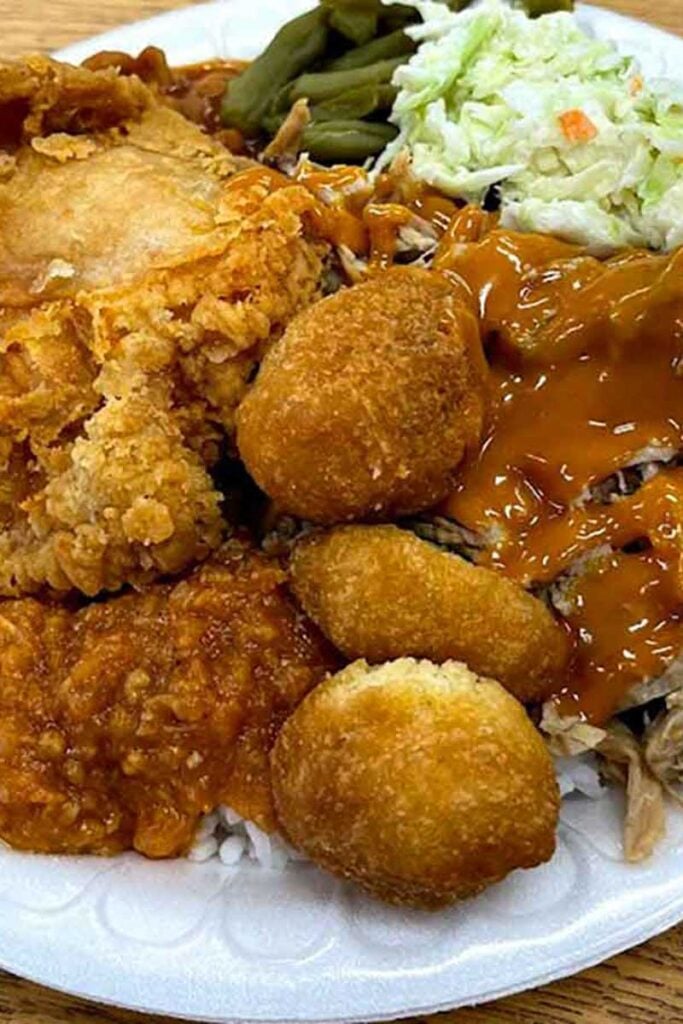
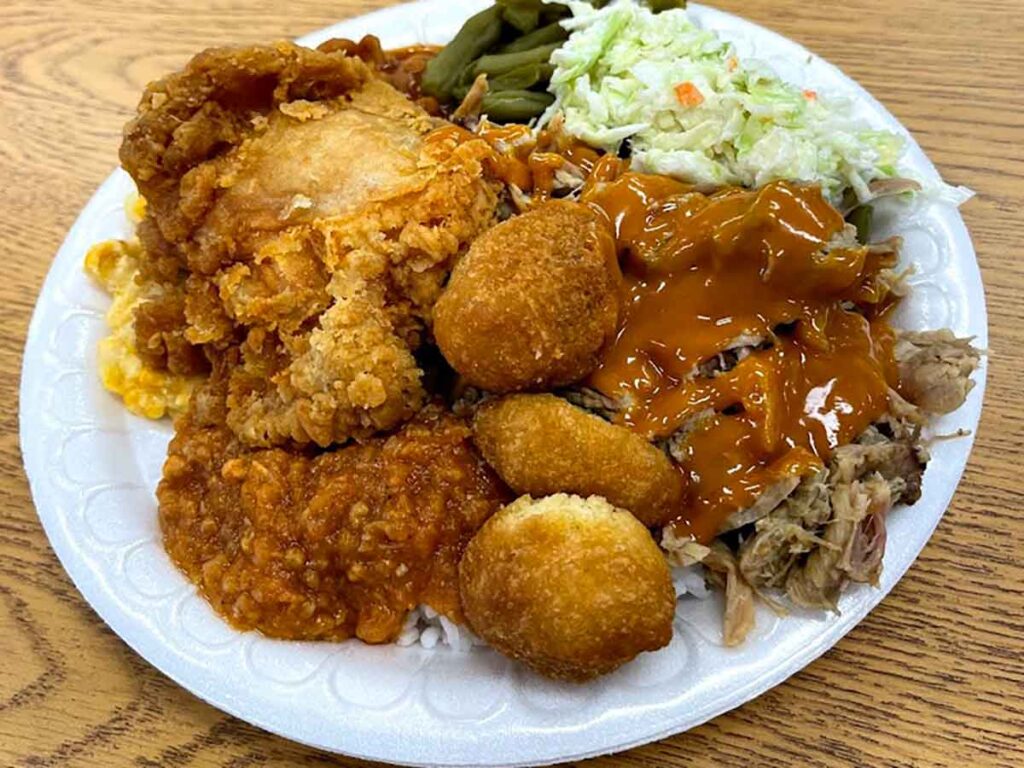
You’ll find pork with hash and rice. Mustard sauce. A sweeter, darker sauce often called Orangeburg Sweet or rust gravy. At some places, the barbecue sits on a buffet alongside fried chicken, vegetables, macaroni and cheese, and the kind of sides that have been served with it here for generations.
Then there are the family names: Dukes, Sweatman, Bessinger, Antley.
Follow those names far enough and they lead well beyond Orangeburg County, into Columbia, Charleston, Aiken, and other parts of South Carolina.
That is why Orangeburg is worth a barbecue trip.
This isn’t meant to rank every barbecue restaurant in town. It’s about a few places in Orangeburg and nearby Holly Hill where you can still eat food tied to some of the state’s most important barbecue history.
Before the Restaurants
Barbecue had been part of life around Orangeburg long before anybody opened a restaurant with Dukes on the sign.
Newspaper accounts show public barbecues being held here by at least 1868, and another barbecue and fish fry was advertised in Orangeburg in 1910. Those old notices don’t tell us what sauce was served or exactly how the meat was cooked. They do tell us that barbecue was already part of public gatherings, politics, and community life.
By the early 1900s, some of the family history gets easier to follow.
In Rowesville, a small town south of Orangeburg, Willie Baltzegar became known for cooking barbecue and hash for dances and gatherings at the local community house. Members of the Dukes family helped him and learned from him.
Baltzegar’s daughter Louise married into the Dukes family, and Danny Dukes also worked with Baltzegar before going on to open a barbecue restaurant of his own. Other members of the family followed.
Earl Dukes opened in Orangeburg in the 1950s. Brothers, sisters, children, and other relatives opened restaurants elsewhere, and over time the Dukes name spread across a good part of South Carolina.
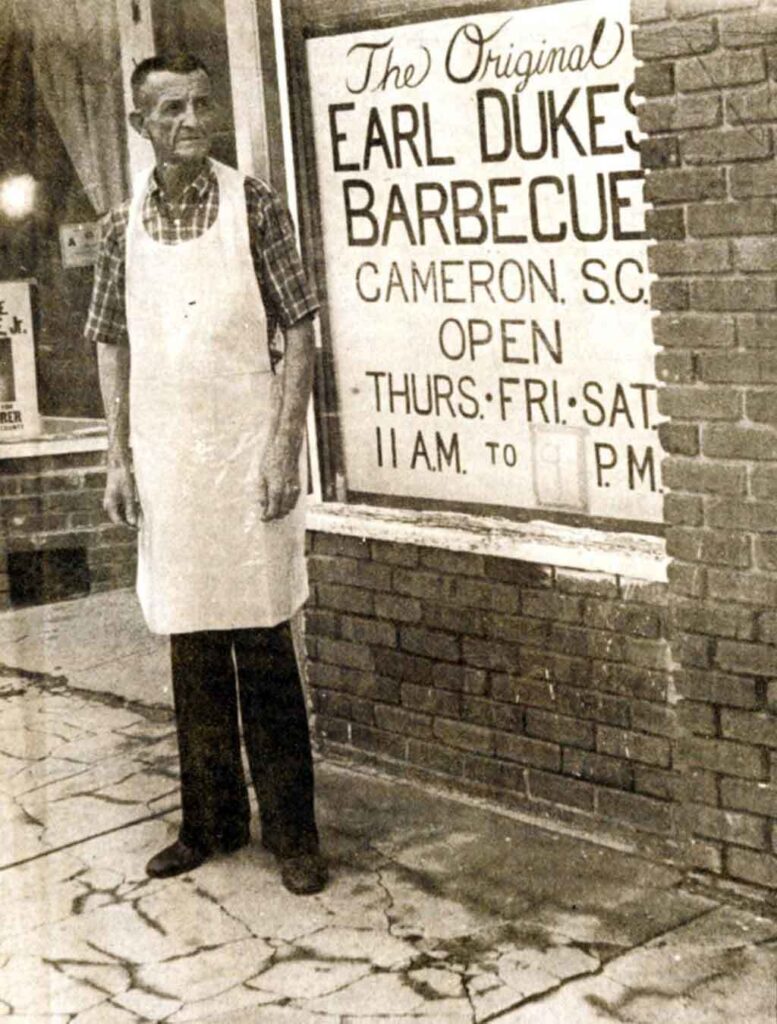
They were never one big chain. The restaurants were separate businesses, often connected by family, and many served the same basic combination of pork, hash, rice, and sauce.
Meanwhile, around Holly Hill, the Bessinger and Sweatman families were becoming closely tied to South Carolina’s mustard-based barbecue sauce.
Both histories run through Orangeburg County, and you can still eat at restaurants tied to them today.
What Makes Orangeburg Barbecue Different
There isn’t one dish that belongs only to Orangeburg.
Mustard sauce is served across much of South Carolina. Hash is found well beyond the Midlands. Buffets certainly aren’t unique to this part of the state.
What stands out here is how often all of those things show up together on the same table.
Mustard Sauce
South Carolina has a long history with several kinds of barbecue sauce, but mustard is the one most people associate with the state.
If you start digging into where mustard barbecue came from, Orangeburg County keeps coming up.
The Bessinger family traces its mustard sauce to Joseph “Big Joe” Bessinger in the early 1930s. In an oral history recorded by the Southern Foodways Alliance, David Bessinger remembered his father saying that Big Joe worked on the sauce with an older man known only as “old man Sweatman.”
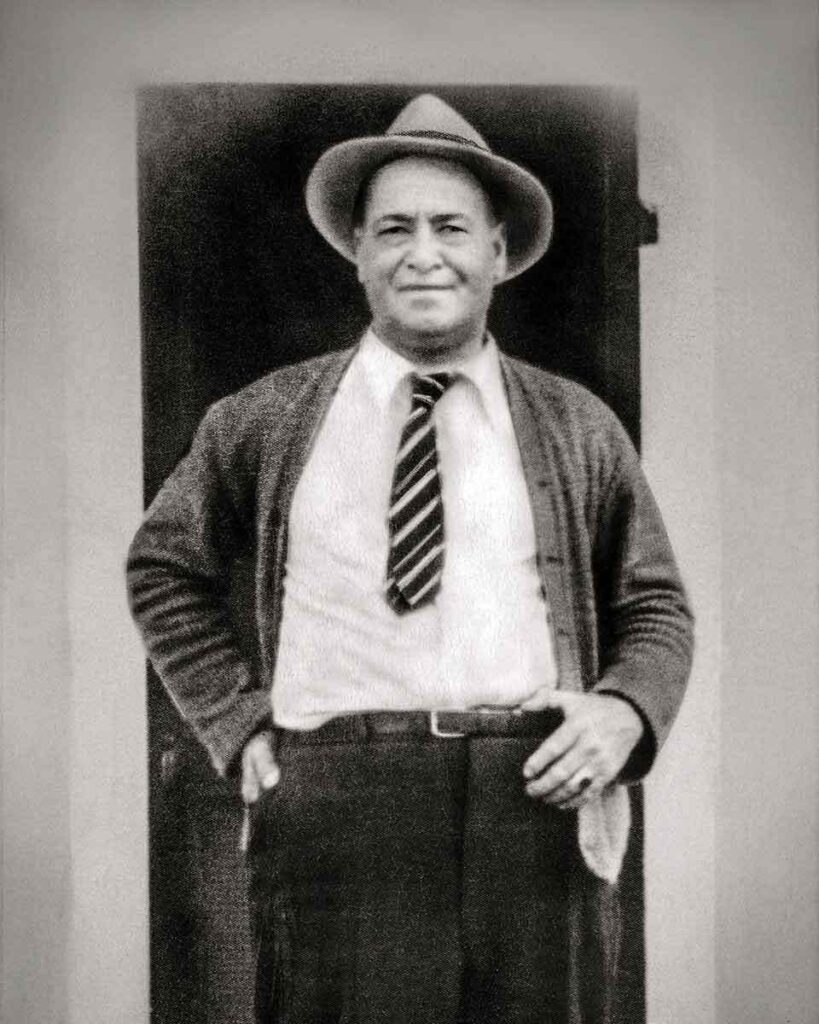
David could not say that man was H.O. “Bub” Sweatman, even though that name has sometimes been attached to the story.
The Sweatman family had its own account. Bub Sweatman told researchers in the 1970s that his family’s mustard sauce recipe was already about 75 years old. If that memory was right, it would put the recipe back around the beginning of the twentieth century.
There are mustard-sauce stories on the Baltzegar and Dukes side, too.
None of that gives us one proven inventor.
Taken together, though, those accounts make Orangeburg County one of the strongest places to look for the roots of South Carolina mustard barbecue.
Orangeburg Sweet, or Rust Gravy
The sauce associated with the Dukes side of Orangeburg barbecue is different from the bright yellow mustard sauce many visitors expect when they hear “South Carolina barbecue.”
Often called Orangeburg Sweet or rust gravy, it is darker, sweeter, and more red-orange in color.
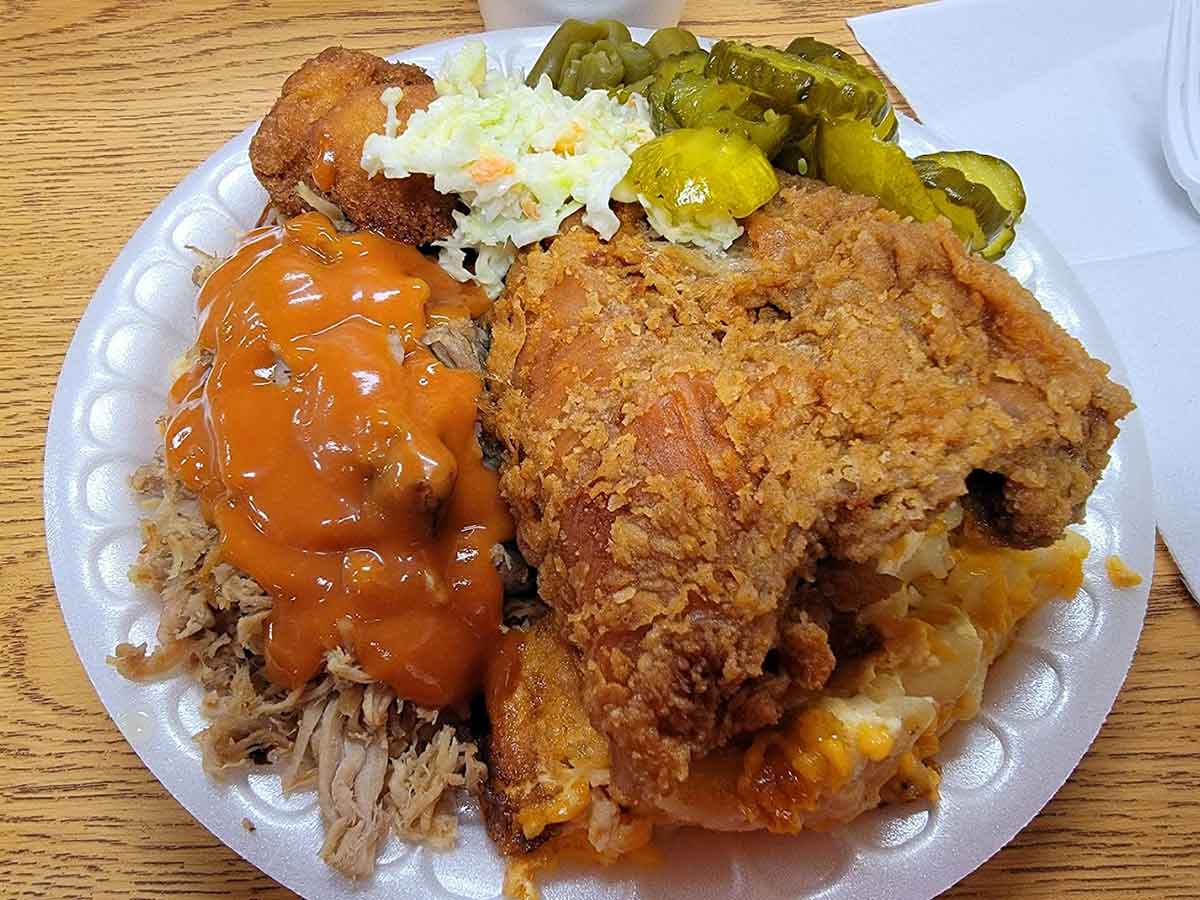
Some versions combine mustard and ketchup, with other ingredients changing from one restaurant to another. The sauces evolved as different branches of the family opened their own places.
So there isn’t one untouched recipe that every Dukes restaurant has followed for generations.
Taste the sauces at different places around Orangeburg and you’ll notice the family resemblance, even when they are not exactly the same.
Hash and Rice
If you didn’t grow up eating South Carolina barbecue hash, it may need a little explaining.
Hash is a slow-cooked meat stew or gravy served over white rice. The style changes depending on where you are. Some versions are smooth, some are chunky, and the ingredients can vary quite a bit from one part of the state to another.
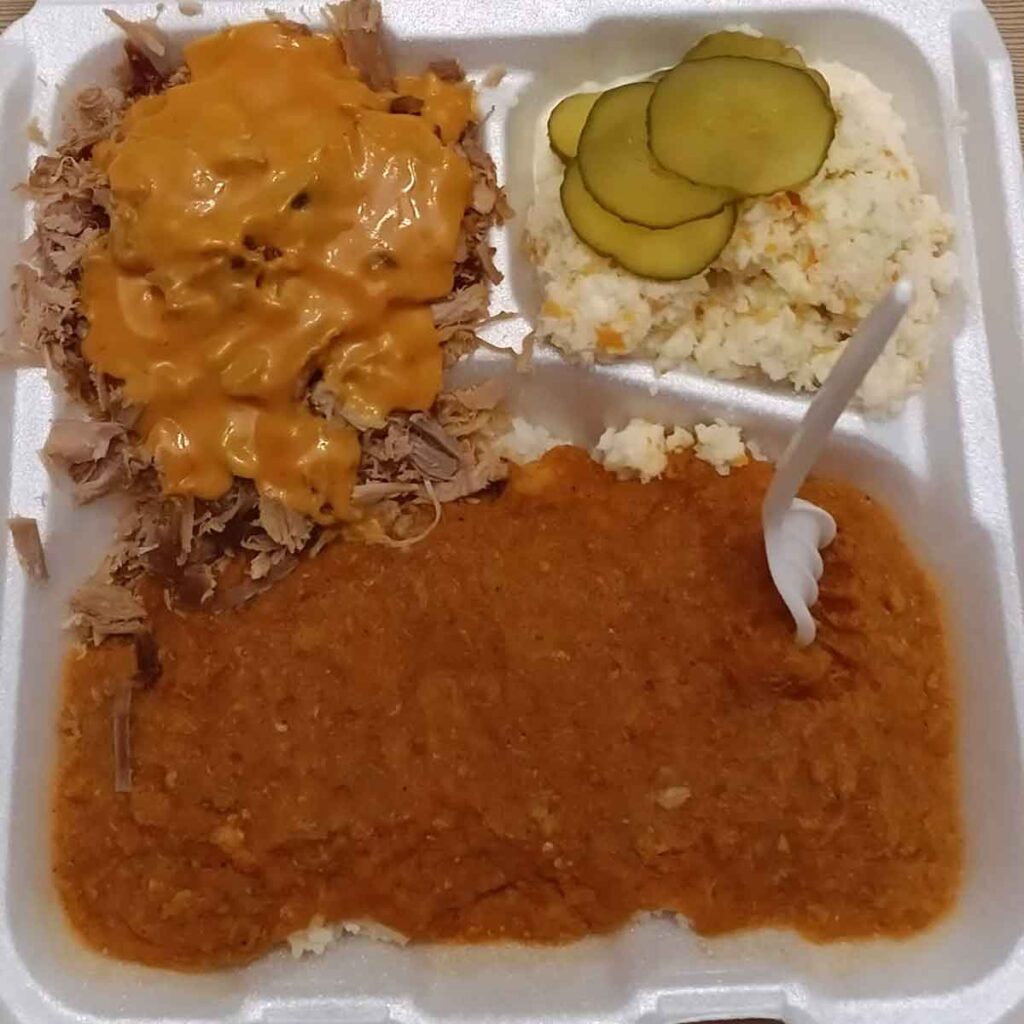
Orangeburg did not invent hash. The oldest documented South Carolina hash traditions point more strongly toward the Savannah River side of the state.
But hash and rice became a standard part of barbecue here and across much of the Midlands.
At an old-school Dukes-style restaurant, it belongs on the plate right beside the pork.
Skipping it means missing something you came here to eat.
The Buffet and the Country Table
The buffet matters, too.
At Whitman Street Dukes and Antley’s, the barbecue shares space with fried chicken, macaroni and cheese, green beans, slaw, and other sides.
Those foods are not there because somebody decided a barbecue restaurant needed more variety. They are part of the way these restaurants grew up.
In this part of South Carolina, barbecue often became a full country meal.
That helps explain why an old Orangeburg barbecue restaurant can look so different from a newer smokehouse built around brisket, ribs, and meat sold by the pound.
The pork may be why you walked in, but the hash, sides, sauce, and sweet tea are part of what you came for.
Three Stops in Orangeburg
You can get three different looks at this food without leaving town.
The restaurants share family connections and some of the same dishes, but they are not copies of one another.
Dukes Bar-B-Q — Chestnut Street
If you want to see Orangeburg barbecue with almost nothing extra around it, Dukes Bar-B-Q on Chestnut Street is a good place to start.
The choices are pretty straightforward: pork, hash and rice, sauce, and a short list of sides.
The buffet is much smaller than what you’ll find at some other old South Carolina barbecue restaurants, but that is part of what makes the place interesting.
There isn’t much between you and the pork, hash, rice, and sauce people have been eating here for generations.
Chestnut Street is one branch of the larger Dukes family tree. Elma Dukes married Harry Ott, and their family ran this restaurant for decades. Other relatives took the Dukes name in different directions around the state.
What connects those restaurants is not a corporate chain. It is family history, along with a shared way of serving pork, hash, and sauce.
Chestnut keeps it simple.
Try the pork with hash and rice, and taste the sauce before you cover everything with it. Around Orangeburg, the sauce belongs on the table just as surely as the hash.
Dukes Bar-B-Que — Whitman Street
At Dukes Bar-B-Que on Whitman Street, Dukes means a much bigger buffet.
Here, the barbecue is served alongside hash and rice, fried chicken, vegetables, macaroni and cheese, slaw, hushpuppies, and other sides.
The difference from Chestnut is obvious as soon as you see the spread. Whitman is the fuller version of the old Orangeburg barbecue buffet.
Whitman has its own place in Dukes history, too.
Earl Dukes opened his first Orangeburg restaurant in 1955 after learning the business from his brother Danny. He later moved to Whitman Street before selling the restaurant in 1969. The business continued under new ownership and kept the Dukes name.
That also explains something that can be confusing if you are new to Orangeburg.
Two restaurants can both be called Dukes, sit only a few minutes apart, share a family history, and still be separate businesses with different menus, sauces, and personalities.
There really isn’t any reason to decide which one is the “real” Dukes.
Eat at both and the family history makes more sense.
Antley’s Barbecue Restaurant
Antley’s Barbecue Restaurant makes clear that Orangeburg barbecue didn’t stop at restaurants named Dukes.
The Antley family was part of the Whitman Street Dukes operation, and Antley’s grew from that connection. Later, the family carried much of the same food to Columbia through Palmetto Pig.
The connection is easy to see when you walk through the buffet.
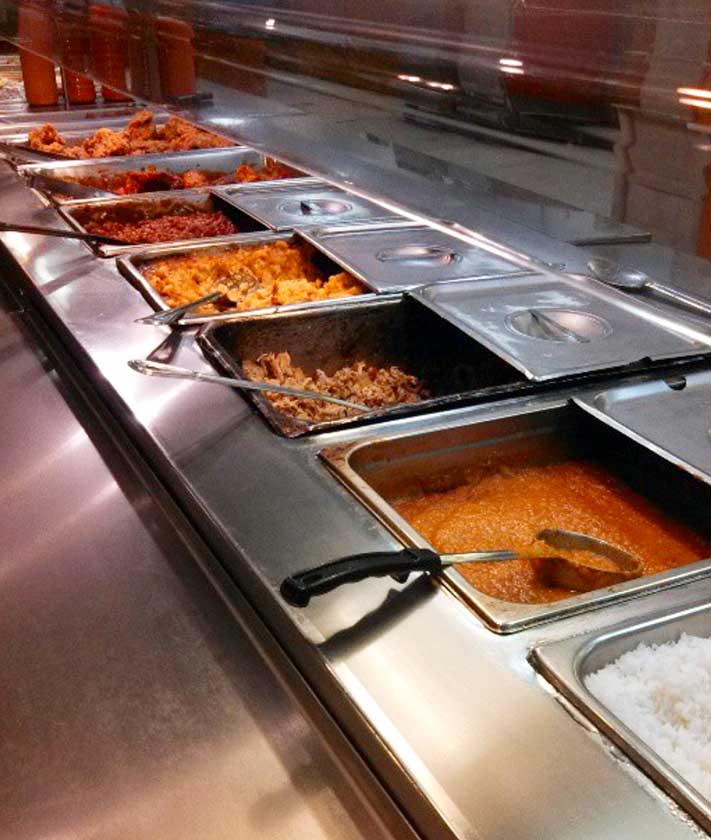
There’s pork and hash and rice, fried chicken, and a full spread of sides. Antley’s also serves its own version of Orangeburg Sweet, giving you another chance to see how the local sauce changes from one kitchen to another.
You can taste the Dukes connection without eating at a Dukes.
Eat at Chestnut, Whitman, and Antley’s and you’ll notice the similarities pretty quickly. You’ll also notice that each place has become its own thing.
The restaurants split off. Recipes changed. The family connections remained.
Holly Hill and the Mustard-Sauce Story
To understand the mustard side of Orangeburg County barbecue, you need to leave town and head toward Holly Hill.
Big Joe Bessinger opened restaurants in the Holly Hill area before his sons carried the family’s mustard-based barbecue into Columbia and Charleston. Joe’s Restaurant, which opened in the 1940s, became a well-known stop along the old road between those cities before the interstate changed the way people traveled.
The Sweatman family was part of that same local barbecue world.
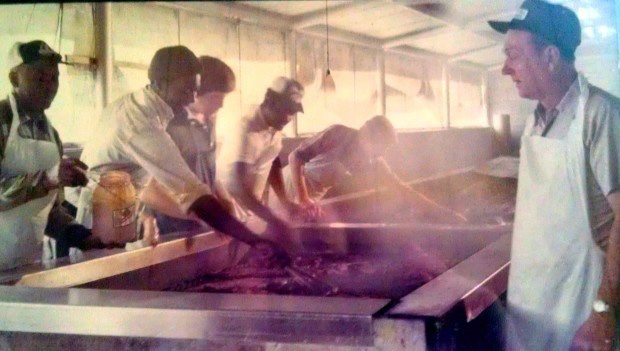
Exactly who first made mustard-based barbecue sauce is hard to pin down.
The Bessinger account points to Big Joe and an older Sweatman working together in the 1930s. The Sweatman family account reaches farther back. The Baltzegar and Dukes families have mustard stories of their own.
Orangeburg County also has deep German-Swiss roots, and that history often gets folded into explanations for why mustard became so common here. It may have played a part, but there is no solid evidence showing German settlers arriving with a mustard barbecue sauce that later turned into the one South Carolinians know today.
So there probably isn’t a neat answer.
Still, many of South Carolina’s oldest mustard-sauce stories lead back to this part of the state.
That makes Holly Hill and Orangeburg County hard to ignore when you start asking where the sauce came from.
Sweatman’s Barbeque
At Sweatman’s Barbeque, all that history is still attached to a working barbecue restaurant.
The restaurant sits in an old farmhouse outside Holly Hill, which has helped make it one of South Carolina’s best-known rural barbecue stops.
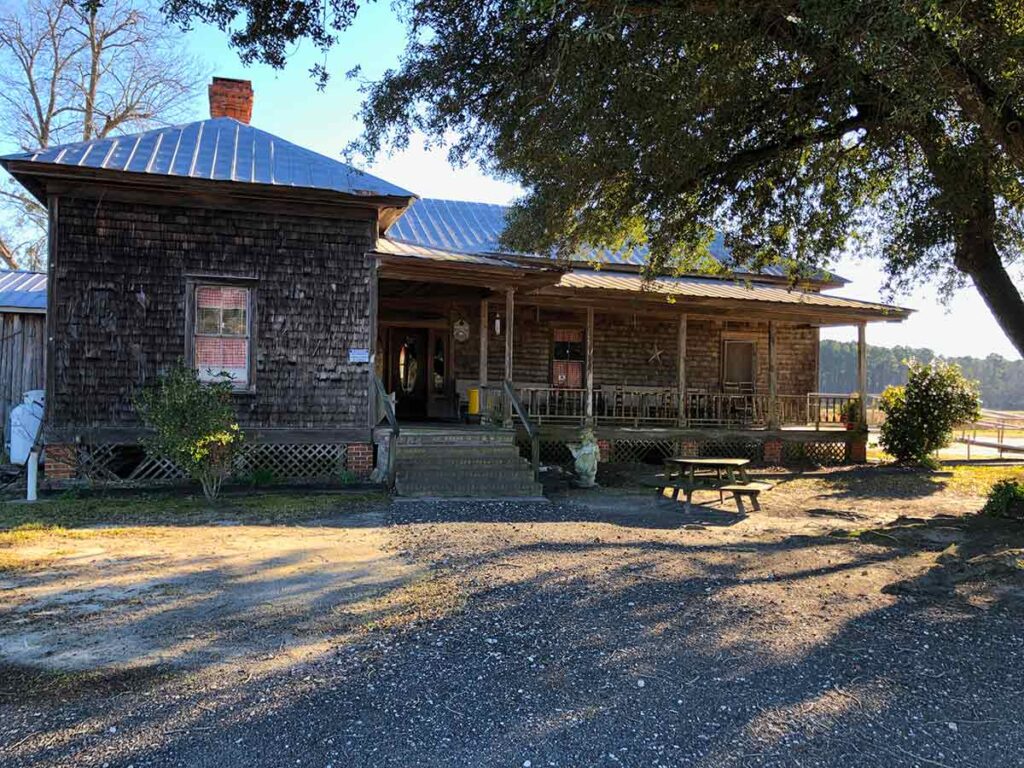
The menu still centers on pork, ribs, mustard sauce, and hash and rice.
But Sweatman’s today is not exactly the same place people remember from decades ago.
The Patel family now owns the restaurant. The old buffet is gone, and service is now built around the counter and individual plates. The old pits have also been replaced by a modern Southern Pride cooker.
If you last visited years ago, or if your picture of Sweatman’s comes from an old television show or magazine story, those changes are worth knowing before you go.
The restaurant’s history also involves more than the family whose name is on the building.
For decades, Black pit cooks did much of the cooking that made Sweatman’s what it was.
Chalmon Smalls became known for his ability to judge a hog by smell and feel. Douglas Oliver learned under Smalls and went on to spend decades cooking hogs at Sweatman’s.
Their names belong here, too.
Barbecue knowledge was often passed directly from one cook to another, not written down in a manual or recipe book. Sweatman’s is a good example of how much of that knowledge lived with the people doing the work.
How Orangeburg Barbecue Spread Across South Carolina
Once you start following these families, Orangeburg stops looking like one isolated barbecue town.
The Dukes name alone spread across a large part of the state.
Willie Baltzegar’s daughter Willie Mae opened Carolina Bar-B-Que in New Ellenton in 1968. Other Dukes restaurants appeared west toward Aiken and east toward Charleston, all sharing some of the same family history and food without ever becoming one unified chain.
The Antley family took part of that Orangeburg food north to Columbia through Palmetto Pig.
The Bessinger family spread even farther.
Big Joe’s sons and descendants took mustard-based barbecue into Columbia and Charleston, where restaurants tied to the family helped make yellow mustard sauce one of the flavors most closely associated with South Carolina barbecue.
So even if you have never eaten in Orangeburg, there is a good chance you have eaten something connected to it.
Maybe it was a plate at a Dukes elsewhere in the state. Mustard sauce in Charleston. Hash and rice in Columbia.
None of this means every South Carolina barbecue tradition started in Orangeburg. Plenty didn’t.
But several important ones took root here and then traveled with the families who carried them elsewhere.
Plan Your Trip
The first thing to know is that these are not seven-day-a-week restaurants.
The Orangeburg places line up best from Thursday through Saturday, which makes that the easiest time to plan a trip. Sweatman’s currently adds Sunday service, but operating days and hours can change, so check before you get in the car.
If you’re coming through on I-26, our I-26 barbecue road guide can help you work Orangeburg into a longer barbecue trip between Columbia and Charleston.
If you have time for one meal, choose the place that interests you most.
Chestnut Street Dukes gives you the simplest version of a traditional Dukes lunch. Whitman Street gives you the bigger buffet. Antley’s gives you another branch of the same family food, along with its own take on Orangeburg Sweet. Sweatman’s takes you down to Holly Hill for mustard sauce, pork, ribs, and hash in a restaurant with a very different history and setting.
If you have time for two meals, eat once in Orangeburg and once in Holly Hill.
That will tell you a lot more about this part of South Carolina barbecue than trying to decide which restaurant comes out on top.
And if barbecue is the reason for the trip, give yourself some time.
These are heavy meals. Trying to eat at all four places in one afternoon sounds more fun than it probably is.
Spread them out over a couple of days.
Taste the sauces. Try the hash. See how different two Dukes restaurants can be even when they come from the same family tree.
By then, the names and relationships won’t seem quite so tangled.
You’ll have eaten your way through the family tree.
Want to see all the barbecue restaurants we track around Orangeburg and Holly Hill? Browse our Orangeburg barbecue restaurant directory.
For recommendations across the rest of the state, see our guide to the best BBQ in South Carolina.