Honey-Hickory Barbecue Sauce Recipe
Tomato-based barbecue sauces are the most dominant selling sauces on the market, but historically, South Carolinians have favored a different option.
South Carolina has 4 distinct regions where particular types of BBQ sauces have long been favored: vinegar-based, mustard-based, light tomato-based, and heavy tomato-based. See the map below:
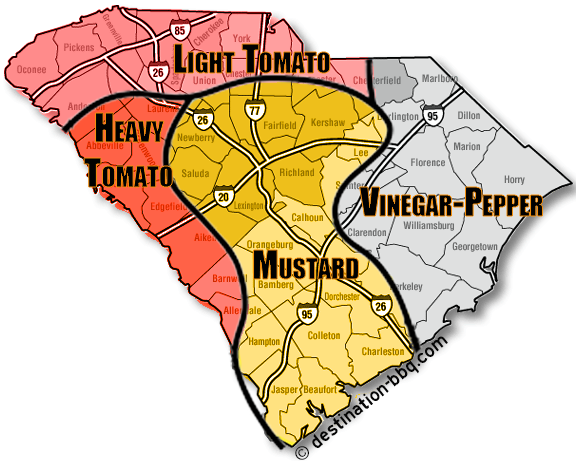
Map of SC BBQ Sauce Regions
Clearly, the smallest of these regions is the heavy tomato so much of the US seems to favor. I guess it is also true that SC has a history of standing up against the rest of the country.
Civil war allusions aside, tomato-based sauces do have their place in SC, and if you’re going to make your own at home, you might as well go to the master!
Here is a traditional tomato BBQ sauce recipe you can make at home sent in by Mike Sexton, SCBA District Chief, Marshall, and Master Judge.
Mike says it is one of the sauces he keeps in his fridge at all times. In fact, his youngest daughter, at the time a sophomore in high school, and made this sauce for her teachers as a Christmas gift, and it was quite the hit.
Mike got the recipe from champion BBQ king Myron Mixon, the “Lord of Q.”
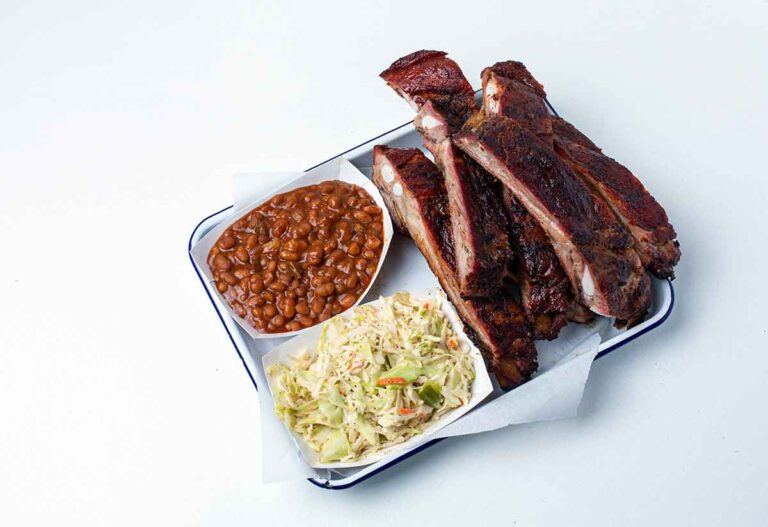
We think you’ll enjoy it, too. Perfect brushed on in the last 20–30 minutes for any type of rib: St. Louis style, spareribs, or even baby back ribs. Try this Homemade Honey Hickory BBQ Sauce recipe:

Honey-Hickory Tomato-based Barbecue Sauce
A zesty tomato-based barbecue sauce shared with Destination BBQ by SCBA judge Mike Sexton, who credits barbecue champion Myron Mixon as the source. Great on smoked meat, burgers, and hot dogs.
Ingredients
- 2 tablespoons onion powder
- 2 tablespoons garlic powder
- 2 cups ketchup
- 2 tablespoons sweet paprika, smoked
- 2/3 cup apple cider vinegar
- 2 tablespoons Worcestershire sauce
- ¼ cup dark brown sugar, packed
- 2 tablespoons honey
- 2 tablespoons maple syrup
- 2 tablespoons Kosher salt
- 2 tablespoons black pepper, freshly ground
Instructions
- Combine all ingredients in a blender and pulse until combined.
- Pour into a saucepan and warm over medium heat, stirring occasionally, without allowing it to boil.
- Use hot or refrigerate for use later.
Notes
Myron Mixon is "The winningest man in barbecue." This is his basic formula for a hickory sauce. It is supposedly close to the one he uses in competitions. It lends zest to any meat, even hot dogs and hamburgers!
Yield and serving size: Expect approximately 4 cups of sauce, or 32 servings of 2 tablespoons each. The exact finished volume depends on the thickness of your ketchup and how much moisture evaporates while warming.
Nutrition: Figures are approximate per 2 tablespoons, including the sugar and sodium from ketchup, brown sugar, honey, maple syrup, Worcestershire sauce, and the listed seasonings. Sodium is especially sensitive to your choice of kosher salt. With 2 tablespoons in the entire batch, Morton coarse kosher salt contributes about 360mg sodium per serving before the ketchup and other ingredients; a lighter salt such as Diamond Crystal contributes less by volume. Ketchup brand makes a difference, too.
Storage: This homemade sauce is not shelf-stable. Cool promptly, refrigerate in a covered container within two hours, and use within 3–4 days or freeze in smaller portions for longer storage. Heating the sauce does not make it safe for pantry storage or home canning without a tested recipe.
Nutrition Information:
Yield:
32Serving Size:
2 tablespoons sauceAmount Per Serving: Calories: 35Total Fat: 0gSaturated Fat: 0gTrans Fat: 0gUnsaturated Fat: 0gCholesterol: 0mgSodium: 545mgCarbohydrates: 9gFiber: 0gSugar: 7gProtein: 0g
Approximate values per 2 tablespoons of sauce, assuming 32 servings (about 4 cups) and all eleven ingredients as listed. Original Nutritionix estimate; based on a conventional tomato ketchup, brown sugar, honey, maple syrup, 2 tablespoons Worcestershire sauce, spices and 2 tablespoons kosher salt. Sodium is especially variable: 2 tablespoons Morton kosher salt contain about 11,520mg sodium for the entire batch (360mg per serving from salt alone), versus less for a lighter salt such as Diamond Crystal; ketchup contributes additional sodium and sugar. Actual volume and concentration depend on simmering time and product brands. Not laboratory-tested.
Like to Volunteer as One of our Recipe Testers?
We have a bookful of recipes to test and publish. Join the team and choose from our collection of unpublished recipes.
All we ask is that you photograph the process and share your thoughts on each recipe and the finished product. And we’ll feature you when we publish that recipe.
Interested? Just send me an email.
Check out these other authentic SCBBQ recipes we’ve published on destination-bbq:
Eastern SC Vinegar-Based Sauce Recipe
Home Team BBQ’s Alabama White Sauce Recipe
South Carolina’s Best Mustard-Based BBQ Sauce Recipe
And we’ve published the following sauce recipes in the SCBBQ Recipes: Going Whole Hog cookbook
You can read more about that here.
Sauces and Rubs:
Vinegar-Pepper Sauces
- Jay Phillips’ Whole Hog Sauce Recipe
- Dad’s Mop Sauce Recipe
- Eastern SC Vinegar-Pepper Sauce Recipe
- Moore Family’s Little Fisher Hog Sauce Recipe
- Lowcountry Vinegar Sauce Recipe
Mustard Sauces
- Swig & Swine’s Mustard BBQ Sauce Recipe
- Dukes BBQ-Style Sauce Recipe
- Dukes BBQ Sauce – “Actual Recipe”
- Simple South Carolina Mustard Sauce Recipe
- Bessinger’s-Style Gold Sauce Recipe
Tomato-Based Sauces
- John Padgett’s Kansas City BBQ Sauce Recipe
- Honey-Hickory Barbecue Sauce Recipe
- Bullies BBQs Thin Basting Sauce Recipe
- Cherrywood Signature BBQ Sauce Recipe
- “Carolina Red” Light Tomato Barbecue Sauce Recipe
- Basic Tomato Barbecue Sauce Recipe
Other Sauces
- Home Team BBQ Alabama White Sauce Recipe
- Moe’s Original BBQ’s Alabama White Sauce Recipe
- Brisket Mojo Sauce Recipe
- Roller Family Hot Sauce Recipe
- Salsa Verde with Avocado for Pulled Pork Recipe
Rubs
- Sticky Fingers’ Basic Dry Rub Recipe
- JB’s Smokeshack-Style Spicy Dry Rub Recipe
- Sticky Fingers’ Texas Rub Recipe
- BlackJack Barbecue Dry Rub Recipe
- Sticky Fingers’ Sweet Rib Rub Recipe
- Home Team BBQ Dry Rub Recipe for Chicken Wings Recipe
- John Lewis BBQ-Style Brisket Dry Rub Recipe
Great recipe! Do you know how long it lasts in the fridge?
Great question. I don’t actually, so the safest answer is 3-5 days, as is the case with most foods. That said — and not saying it is safe to do this — we leave our sauce in the fridge somewhat indefinitely. I mean it’s ketchup, which you don’t even have to refrigerate — spices, which you don’t refrigerate, and things we use as preservatives like salt and sugars. Again, the safe answer is 3-5 days.